Roman limestone wall unearthed at ancient site

 University of Leicester
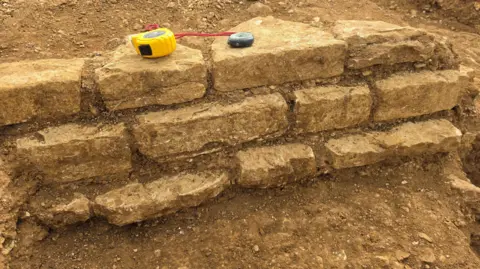
A "significantly beautiful" Roman limestone wall has been unearthed by a team of experts and volunteers.
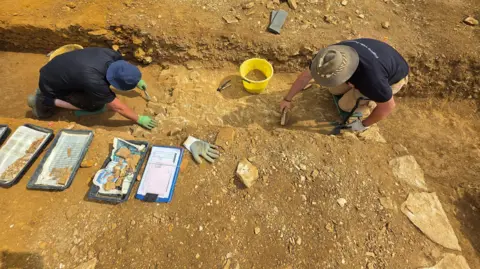
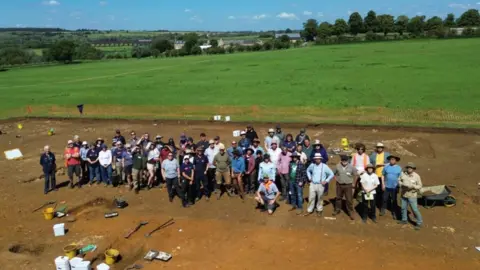
The Irchester Field School team, including staff from the University of Leicester, worked for several weeks at the site which lies within the Chester House Estate.
Sarah Scott, professor of archaeology at the university, said it was the first time the walled area had been excavated in the Roman town - a site of national significance.
"It was just so exciting to see and parts of it were still in really fantastic condition," she said.
 University of Leicester
Scott said over three weeks, 45 people were on the site and about 1,200 school children attended.
Staff from the Northamptonshire Archaeological Resource Centre and the Chester House Estate were also involved.
"We knew that Irchester had substantial walls, but very little was known about how they were constructed, what they might have looked like, the size and how the walls related to building structures within the town.
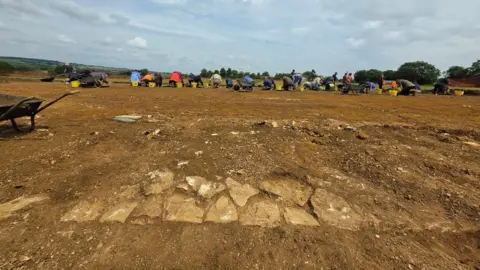
"You can see the foundations, the construction of the wall and also a huge sort of rampart.
"It was so exciting, it was so beautifully constructed and we thought it might have been constructed from ironstone, local stone, but actually it's a beautiful limestone wall and parts of it were still in really fantastic condition."
 University of Leicester
She said it gave the team a real sense of how the town might have looked, and how it would have been visible along the length of the Nene Valley.
"It would have been incredibly dramatic to see."
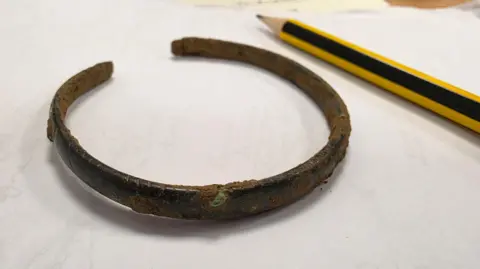
Hundreds of other items were discovered, including brooches, a bracelet, a bone comb, pottery, hairpins, a "beautiful spoon", glass beads, and coins.
"The sort of things that people today would regularly drop."
 University of Leicester
The pottery shows that people were acquiring and using quite high status pottery in the early Roman period, she added.
"It's a tangible connexion with the past.
"It's amazing to pick up a bead and imagine that was around someone's neck, almost 2000 years ago."
The professor said: "We know it was a really densely settled landscape, so the whole stretch of the Nene Valley through to Stanwick Lakes, towards Peterborough.
"It was a really busy landscape and you can imagine the sounds and the smells.
"Irchester was a really significant walled settlement so it would have been a real feature of the landscape."
 University of Leicester
Scott said everything has now been recorded, photographed, and the finds will be carefully washed and taken to Chester House to be studied.
The teams will return to the tourist attraction for Roman Fest on 25 and 26 July and a number of Young Person Archaeology Experience Days, in August.
Do you have a story suggestion for Northamptonshire? Contact us below.
Follow Northamptonshire news on BBC Sounds, Facebook, Instagram and X.