'At risk of horrific contamination': The Soviet nuclear submarine wreck that is a 'ticking time bomb'

 Alamy
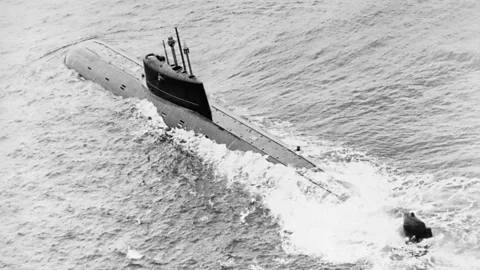
AlamyIn 1989, the Komsomolets sank off the Norwegian coast. Four years later, the BBC reported on plans to seal in its torpedoes' toxic plutonium.
"Komsomolets is a time bomb ticking away at the bottom of the Norwegian Sea.
"And unless something is done about it, and done about it quickly, we're all in danger." This is how the risk posed by a sunken Soviet nuclear submarine was described by Russian Greenpeace activist Dimitri Litvinov in a 1993 BBC news report.
Resting one mile (1.6km) deep in the sea near the coast of Norway after a fire caused it to sink four years earlier, the Komsomolets had prompted international concern. Two nuclear-tipped torpedoes inside were corroding, risking the release of 9lb (4kg) of plutonium into the Norwegian Sea.
State-of-the-art Soviet technology went into the design of the Komsomolets, which was unique for the depths it could reach. It was expected by Nato to be the first in a class of large attack submarines, but no further vessels of its kind were built. According to a 1994 BBC Horizon documentary, "The Komsomolets was to be the Soviet Union's secret invincible weapon, the only submarine in the world able to cruise and launch nuclear missiles from 1,000m [0.62 miles] deep, twice the depth at which Western submarines can operate. Today, the Komsomolets is a technical and scientific disaster."
When the fire broke out on 7 April 1989, the crew managed to bring the submarine up to the surface – but it sank after five hours afloat, killing 42 of the 69 crew members. As it went down, an escape pod shot five trapped seamen to the surface, with just one man able to climb out before it filled with water.
As the Komsomolets hit the bottom, near the Norwegian coast, an explosion ripped open the submarine's titanium pressure hull and brought seawater into contact with the nuclear torpedoes. A research mission by Russian oceanographers found that parts of the submarine's hull had "burst and crumbled from the explosion, like glass".
In History
In History is a series which uses the BBC's unique audio and video archive to explore historical events that still resonate today. Sign up to the accompanying weekly newsletter.
After the disaster, scientists were divided over what to do. Russian scientist Igor Spassky of the Rubin Institute, which designed the Komsomolets, told the BBC's Ben Brown in 1993 that it was not a catastrophic situation – although he did want the submarine to be raised out of the sea. "Within a decade, the two nuclear warheads on the ship will be fully corroded by an electrochemical reaction involving salt water… and the highly toxic plutonium will escape from the damaged torpedoes and into the environment," he told the US Naval Institute.
"According to environmentalists," said Brown in his BBC report, "if that happens, the sailors who died here would not be the only victims of the Komsomolets. The lives of many more people, they say, would be at risk, because the rich fishing grounds here would then be subject to horrific contamination." Yet a report released in 1993 by an international team of scientists concluded that the submarine was unlikely to contaminate fisheries.
Despite conflicting views on the dangers posed, efforts were made to mitigate potential contamination. Deep-sea engineering operations between 1995 and 1996 sealed hull fractures and torpedo tubes to contain radioactive material. The work finished 30 years ago, in July 1996. But investigations by the Norwegian government have since revealed that the submarine is still leaking – and the sealant was only expected to last 30 years.
An indefinite potential hazard
A report published in March 2026 found that while the torpedoes remain sealed, the reactor is degrading, periodically releasing visible plumes of radioactive material into the sea. The team from the Norwegian Radiation and Nuclear Safety Authority (DSA) said that the leak is not constant but occurs in sporadic bursts from specific locations along the hull, with a "cloud" seeping out of a ventilation duct.
They don't believe the current levels are harmful, however. "Radioactive releases from the reactor… have had little impact on the surrounding marine environment," says Ingar Amundsen, acting director of the DSA's Department for International Nuclear Safety and Security.
Yet that could change – with both the submarine's nuclear reactor and nuclear-armed torpedoes posing threats, according to Hans Kristensen, director of the Nuclear Information Project at the Federation of American Scientists. Corrosion of the submarine over time could impact current radiation levels, he tells the BBC. "That depends on other factors such as the oxygen level of the seawater around and inside the submarine wreckage, and the condition of the sealant."
More like this:
He also points to changing currents as a factor influencing how quickly radioactive materials might be released from the wreckage and potentially enter the food chain via bottom feeders and fish. "The fact that the submarine has already been sealed once is an official acknowledgement of that risk," Kristensen adds.
"Nuclear fuel is in direct contact with seawater and deteriorating," says Amundsen. "Further work should be carried out to understand the mechanisms behind the releases, the corrosion processes taking place, and their implications for further releases." But that isn't going to happen any time soon. "The depth of the submarine, close to 1,700m, makes it difficult to implement any mitigation actions, and we are not aware of any such plans for the moment."
Kristensen argues that more should be done. "At the minimum, a new expedition should be carried out to determine the current condition. With a half-life of 24,000 years, warhead plutonium will remain a potential hazard indefinitely by human standards."
--
For more stories and never-before-published radio scripts to your inbox, sign up to the In History newsletter, while The Essential List delivers a handpicked selection of features and insights twice a week.