'I phoned mum and said we've dug up a skeleton'

 Becki Bowden / BBC
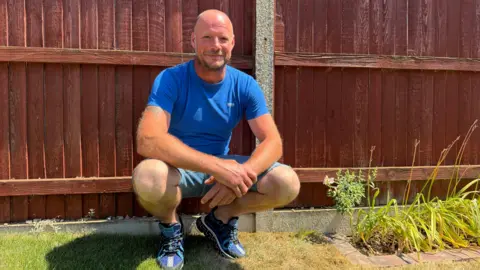
When Nick Routledge began digging in his garden, the last thing he expected to find was human bones.
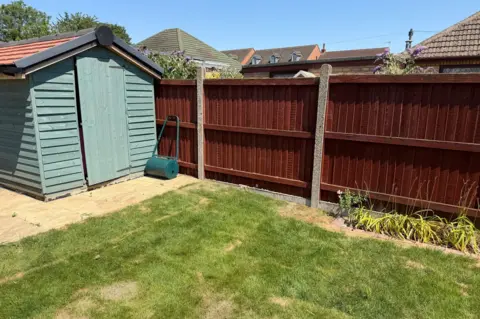
The 43-year-old was doing landscaping work at his home in Ancaster, Lincolnshire, when he uncovered the remains in March 2025.
"I panicked and I phoned my mum," he said. "I was like, mum, mum, I swear we've dug up a skeleton."
After calling the police and sending pictures of the bones, Routledge said officers arrived within 10 minutes.
"The CID turned up, they came straight in, they called it an out of place burial.
"That's when they said 'we're gonna have to treat it as a possible murder scene – you've got 10 minutes to pack a suitcase and leave the house'.
"Before you know it, the house was taped off.
"I had forensic people turn up in white suits with masks on, putting tents up.
"It all got very, very crazy."
Routledge and his wife spent three days staying in his mother's spare room, before being allowed back home. Archaeologists later confirmed the bones dated to the Roman era.
 Nick Routledge
Routledge described how his cousin Chris was operating a digger when they found the skeleton at a depth of about four-and-a-half feet (1.4m).
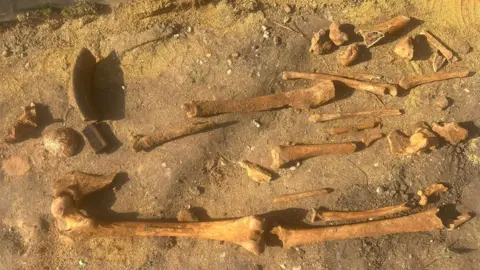
"We got so deep down, and then, whoa, bones," he recalled. "The first bone we dug up in the bucket was like the femur.
"I grabbed a shovel and we just dug around.
"We found the rest. We laid it on the floor – this is a femur and this must be like the shin bone. And then we found a bit of the hip.
"It's a pair of human legs, there's no denying it."
 Becki Bowden / BBC
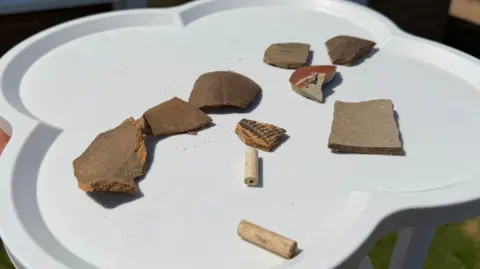
Routledge said items found in the grave helped to date the skeleton.
"With the remains, we found bits of pottery and some oyster shells," he explained. "The Romans ate a lot of oysters."
The Roman era in Britain lasted for about 400 years between the 1st and 5th centuries.
Ancaster was a town on Ermine Street, the main north-south road in the east of what is now England.
Lincolnshire Police said archaeologists carried out "a detailed assessment of both the bones and the surrounding ground" before confirming the remains were of ancient origin.
The bones were later reburied in a cemetery in nearby Wilsford.
"I was left in the dark on that, to be honest," Routledge said. "Which is a shame, because I was hoping to maybe rebury them where they were originally from."
So does he expect to come across other Roman remains?
"Who knows? Is it just a random burial, or is there more? I don't know.
"Doesn't bother me if there is – it's a good story to tell."
Listen to highlights from Lincolnshire on BBC Sounds, watch the latest episode of Look North.
Download the BBC News app from the App Store for iPhone and iPad or Google Play for Android devices