Harvest is toughest for 65 years, farmer says

 BBC
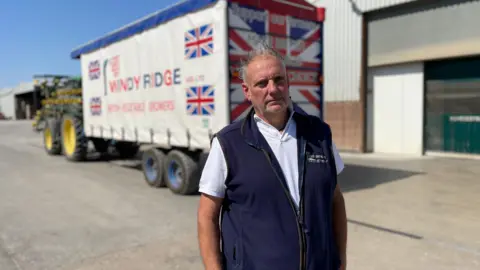
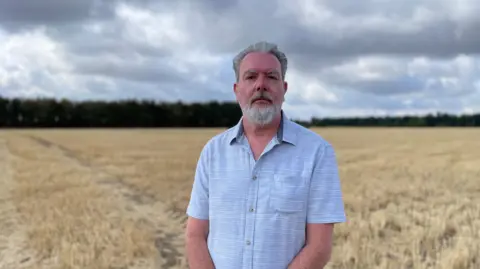
BBCA vegetable farmer says the drought has led to the toughest harvest seen in 65 years on his family farm.
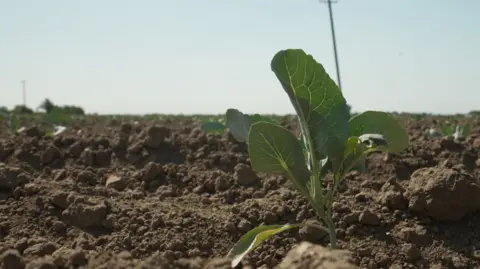
Mark Nundy, who grows cabbages, cauliflowers and broccoli near Boston, Lincolnshire, says the prolonged hot and dry weather meant many products were only half the size they should be.
"I'm in my 32nd season and my dad and myself have never seen anything like this... in terms of crop production, crop prediction, crop yield, crop quality," he said.
Grace Duncan, fresh foods editor at The Grocer magazine, said the conditions would lead to "some shortages on shelves". "That means, inevitably, if there is less availability, prices will have to go up."
Greater Lincolnshire produces one eighth of England's food and as much as 30% of its vegetables.
But the autumn harvest of water-dependent potatoes, carrots, cabbages and broccoli is going to be a lean one, according to farmers and industry experts.
Nundy said: "We're obviously planting crops in the summer for autumn-winter harvest.
"Obviously, when the crops are struggling, the pests and diseases do like to target them and there's another challenge on its own trying to keep them at bay."
This summer is on course to be the UK's hottest since records began, according to the Met Office.
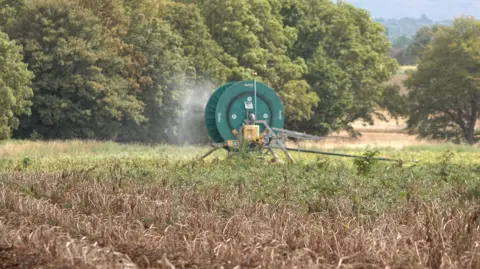
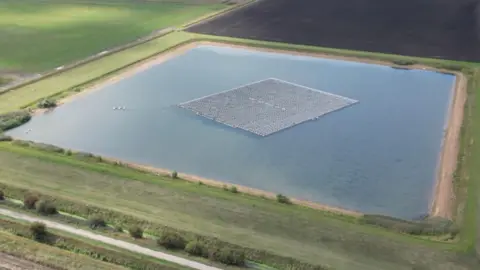
The government recently announced a package of support measures for farmers, including grant funding to construct reservoirs and irrigation infrastructure.
However, Tom Bradshaw, president of the National Farmers Union, said the package "doesn't help the crisis today".
"Many farms are on edge because of the disastrous harvest. Fields that should be green are now brown," he said.
Nundy said some of his plants were "half the size" he would have expected them to be at this time of year.
"There will be availability, but it will be reduced across the board," he said.
"We've had a full eight weeks without anything in the way of rain. I try to be optimistic every day, but you don't like to see a crop suffering and not growing."
The Grocer's Duncan said a poor harvest would "inevitably" drive prices up and the UK could not rely on continental Europe to bolster supplies.
"These farmers are also having a really hot summer," she said.
"So countries like Spain are having incredible wildfires, which we've seen on the news here, and those countries are going to have to feed their populations as well."
Matthew Goddard, professor of population and evolutionary biology at the University of Lincoln, said consumers and supermarkets would need to accept that a poor harvest will mean smaller or misshapen vegetables.
"We can't afford to be picky or choosy this autumn," he said.
"They may have a different shape, a different texture or colour. It doesn't mean they are not edible."
Goddard said the changing climate was now a "significant concern" among the farming community.
He has carried out research into how farmers can continue to grow food in soil that is becoming saltier.
"Our research is just one small example of ways that we should begin to think about being prepared for the consequences of climate change," he added.
Listen to highlights from Lincolnshire on BBC Sounds, watch the latest episode of Look North.
Download the BBC News app from the App Store for iPhone and iPad or Google Play for Android devices