Paddling pools created for ducks as pond dries up

 Nick Pike
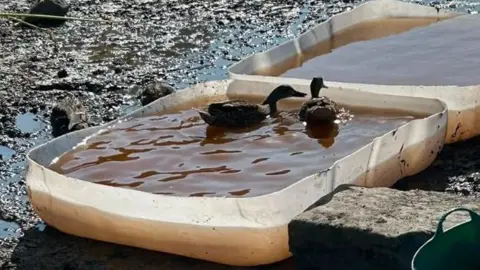
Villagers have been filling up makeshift paddling pools to help ducks stay hydrated after their historic pond completely dried up.
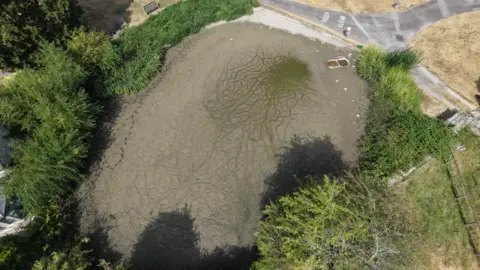
The 17th Century pond in Biddestone, Wiltshire, was originally used for cattle from nearby farms, and locals believe this is the first time it has ever lost all its water.
As well as providing the paddling pools, villagers are also attempting to preserve the ancient landmark by dredging silt from it while water levels are low.
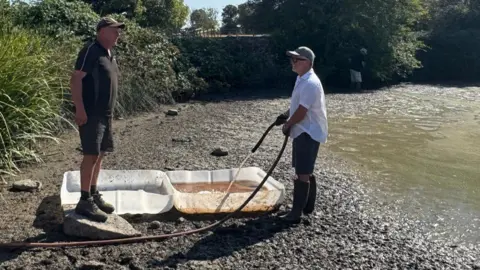
Local farmer David Taylor, who came up with the "cunning plan" to keep the ducks at the pond, said he had never seen it so dry. Parish Councillor Nick Pike said residents were missing one of the "main attractions" of the area.
 Nick Pike
Taylor said: "I found a couple of big plastic tanks and took them down to the pond and sat them in there and then I just topped them up. Within five to 10 minutes the ducks were in there.
"We need it to rain for a week - I'm telling people it'll be full by Christmas."
The Met Office has confirmed that July 2026 was the driest July since records began.
The drought conditions have been accompanied by exceptional warmth across much of the UK. It was the second warmest July for the UK as a whole and Wales' warmest ever.
 Chris Draper
The arable farmer said he and other villagers planned to use machines to dredge the silt in the coming days in a similar way to how villagers cleaned out the watering hole in 1958.
Pike explained that, although some silt is needed for the pond's ecosystem, it is getting too deep.
"It's at least 200 ml in some places...if there had been less silt and more water it wouldn't be dry now," he said.
"If we can replace some of the silt with more water volume that would be a good thing."
Pike said the ancient pond in the village, which itself dates back to Saxon Times, was believed to be "of natural origin".
"The village misses it, it's very important to the village," he said.
"It looks like the warm summers and less rain are here to stay and certainly it's going to take a lot of time for levels to be topped up," he added.
Follow BBC Wiltshire on Facebook, X and Instagram. Send your story ideas to us on email or via WhatsApp on 0800 313 4630.