'Energy invasion' fears raised by protesters

 BBC
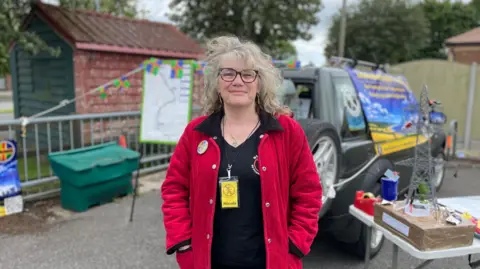
BBCCampaigners opposed to electricity infrastructure planned for Lincolnshire claim the county is facing an "energy invasion".
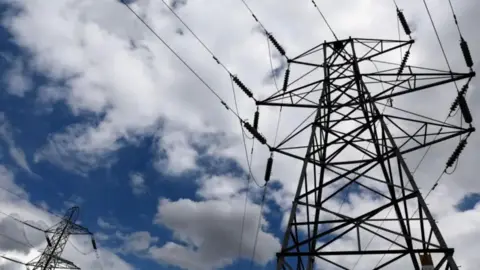
There are currently five Nationally Significant Infrastructure Projects (NSIPS) being proposed for the region including pylons, battery plants, substations, cable routes and solar farms.
Resident Nicola Hughes from Lincolnshire Against Needless Destruction (LAND) said: "Lincolnshire is facing a large scale energy invasion. It is not a physical invasion yet but it will be."
A government spokesperson said: "Every wind turbine, solar panel and pylon we build helps protect families from future energy shocks."
 Reuters
They added: "All projects are subject to a rigorous planning process and the views of the local community must be taken into account."
The energy infrastructure proposed for Lincolnshire includes National Grid's 'Great Grid Upgrade'.
This would see an 87 mile (140 km) pylon route between Grimsby and North Norfolk and a second 37 mile (60 km) pylon route between Weston Marsh and Leicestershire.
Jenny Pennington farms land near in Weston Marsh where pylons and two of six new electricity substations planned for the region could be built.
"These are huge structures, taking 25 acres of land each. My concern is that there are so many projects coming in now that we are going to totally destroy the area and destroy good farmland too" she said.
A spokesperson for National Grid said: "The grid we have today was not built for the level of electricity demand we expect in the region in the future, so upgrading it is essential. Our projects go through a planning process that considers cumulative impacts, and we have engaged with thousands of people at face-to face events to listen to local views to help shape our plans."

The county is also seeing significant interest from solar farm developers and these projects will need new infrastructure to connect to the electricity grid.
At least 12 large solar farms, with battery storage, have already been approved for Lincolnshire by the government with more being planned.
The Springwell Solar Farm between Lincoln and Sleaford is the largest to be approved in the UK but is now the subject of a legal challenge from two local authorities.
A spokesperson for Springwell Solar Farm said: "We are disappointed that parties are legally challenging the Secretary of State for Energy Security and Net Zero's decision to grant development consent for Springwell Solar Farm.
"This is a legal process reviewing how the decision was made, rather than weighing up the merits of the project itself. We remain confident in the robustness of the planning process that led to consent being granted.
"Springwell Solar Farm would make an important contribution to the UK's domestic supply of clean, secure energy and we will continue to engage constructively in the legal process where required."
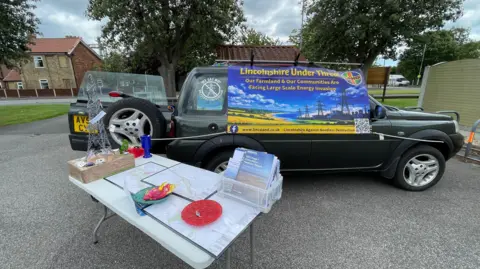
Nicola Hughes said she has attended about 30 public consultation events for planned electricity infrastructure.
The latest is for a National Grid project called Eastern Greenlink 5' which plans to bring power via an underground cable from North Sea wind farms to substations in Lincolnshire.
"They want it [the cable] to come here so they can connect other things to it and so the industrialisation of this landscape continues." she said.
There are ongoing legal fights and even attempts to change the law on building some infrastructure.
The Conservative MP for Louth and Horncastle Victoria Atkins has announced she wants to stop the county being "plastered in pylons" and solar panels: "The government wants to put huge numbers of solar panels across our fields and devastate our landscape, so I am bringing forward a piece of legislation to protect prime agricultural land from Ed Miliband's net zero plans."
The government has already announced plans to compensate residents who live near to energy infrastructure and has commissioned a Strategic Spatial Energy Plan to look at the concerns about the cumulative impact of energy plans.
Ms Hughes said the compensation schemes "fell short" of recognising the issue: "Unfortunately £250 off your energy bill each year is very little when your home is going to be devalued by tens of thousands of pounds" she said.
A spokesperson for National Grid said: "We recognise that a number of energy infrastructure projects are being proposed across Lincolnshire by different developers. We are also working hard to reduce local effects while supporting jobs and economic growth in the county."
Listen to highlights from Lincolnshire on BBC Sounds, watch the latest episode of Look North.
Download the BBC News app from the App Store for iPhone and iPad or Google Play for Android devices