Battery plans to take advantage of Scottish wind

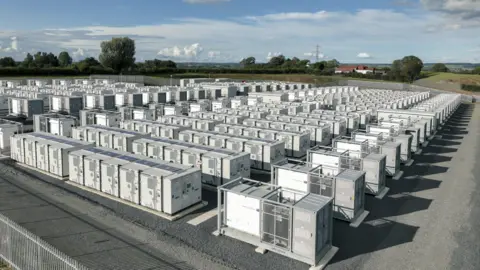 Zenobe
Plans for a major new battery energy storage system (BESS) to take advantage of offshore Scottish wind have been submitted.
Developers Zenobe are seeking to build the project on 25 acres (10 hectares) of agricultural land near Easington in County Durham.
If built, it would be one of the largest such schemes in the UK. BESSs are designed to stockpile energy from renewable sources and release it when needed.
But parish councillor Claire Dale objected to the plans and said it would fundamentally alter the "rural identity of Easington".
According to the application, Hawthorn Pitt BESS will be made up of about 288 metal containers that store large numbers of lithium-ion batteries.
Zenobe has agreed to connect the scheme to a nearby substation that is currently being built.
The substation will be connected via a 122 mile-long (196km) subsea and underground cable to Torness in East Lothian, Scotland, and will increase the amount of renewable energy shared between the nations.
'Sprawling industrial zone'
Zenobe said the project would take about 18 months to build and create between 150 to 400 construction jobs.
But during its decades-long operation, the scheme would only create between two and four jobs each year as the site is not expected to be manned.
In her objection to Durham County Council, Dale said the scheme would contribute to turning the area's agricultural land into a "sprawling industrial zone".
National Grid has said BESSs are "essential" to speeding up the replacement of fossil fuels with renewable energy.
Plans for a BESS near South Hetton were turned down last month after hundreds of objections.
Fires at the storage sites are a common concern but "safety incidents" are rare, according to a House of Commons briefing paper.
An investigation was launched into a BESS fire in Exeter in June.