Why is cracking clay causing train troubles?

 Danny Lawson/PA
A summer of record-breaking temperatures is drawing to a close - with the prolonged heat and lack of rainfall having taken its toll on the land beneath us.
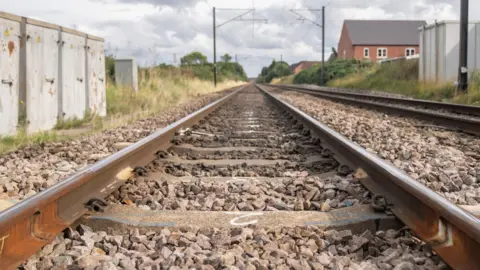
Rail bosses say the clay that sits under the railway in Essex has dried out and shrunk because of the weather, leading to issues with the quality of the track.
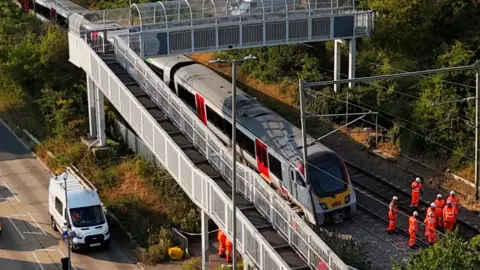
Earlier this month, a train derailed in Lewes, Sussex, injuring 30 people, followed by another derailment in Wickford just over 24 hours later.
What are rail companies doing to make sure trains and tracks are safe? And how are they trying to protect train travel against climate change?
Why is cracking clay a problem?
 Getty Images
Described by the British Geological Survey (BGS) as "one of the most damaging geohazards in the UK today", changes to clay can affect buildings and infrastructure such as railways.
Soil in some areas contains clay minerals which absorb water and swell when wet, then lose water and shrink as it dries out.
This can lead to problems with whatever's been built on top, for example train tracks becoming uneven.
Last year, Network Rail said it wouldn't be safe to run trains at full speed if the track moved - and that areas between Salisbury and Exeter were particularly vulnerable to clay changes, along with Essex.
It also said peat soil north of Ely in Cambridgeshire behaved in a similar way to clay after prolonged periods of hot and dry weather.
"The Victorians didn't know much about the makeup of the soil when they built much of our railway in the 1800s," Network Rail said.
"Engineers then didn't know how the railway would react in the dry summers we're experiencing, which they couldn't have predicted back then."
Slower speeds and timetable changes
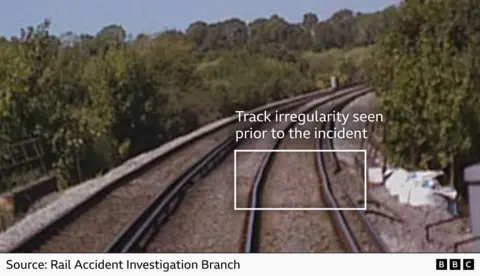
GBR Anglia - which involves train operators Greater Anglia and c2c, as well as track operator Network Rail Anglia - says safety is its top priority, and it's having to make some changes as a result of what's happened to the ground this summer.
Passengers will notice timetable changes on the c2c route from 25 August and on the Greater Anglia line between Southend Victoria and London on Tuesday 1 September.
You might notice slower speeds once you're on board, too - some journeys will take between two and eight minutes longer than usual, and will have slightly amended departure and arrival times.
On Monday, c2c said it "strongly recommends" customers travelled earlier in the day or after peak times where possible, and told passengers to expect short notice delays and cancellations until further notice.
If you regularly catch a certain service, it's worth checking for the latest before you travel on c2c or Greater Anglia's websites.
How long will this go on?
 Jonathan Brady/PA
At the moment, it's not clear how long the ground will take to recover.
GBR Anglia says until it's done so, the speed restrictions will need to be kept in place.
It also says its engineers are "closely monitoring track conditions across the region" and there's a chance they'll have to bring further speed restrictions in over the next few weeks to keep services running smoothly.
Network Rail previously said once moisture returned to the ground, processes to repair and smooth out the tracks - more on that below - would be much longer lasting and trains could return to normal speeds.
Will this keep happening every year?
 Submitted
Scientists have found that summers are getting hotter and are likely to become drier because of climate change in the future.
Network Rail says it's spending £2.6 billion on track maintenance and renewals, and has started a programme to protect the railway from extreme weather and climate change.
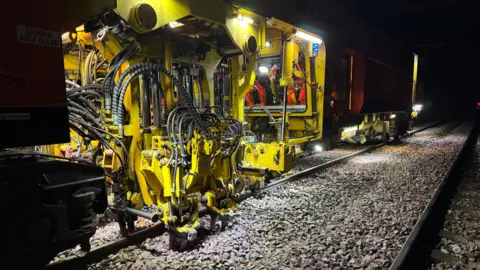
It's laying on extra engineering work, using machines called tampers to help create a solid foundation underneath tracks.
It's also putting in new ballast, the stones underneath the rails and sleepers, to help raise the level of track.
In 2025, engineers used tampers to treat 100km (62 miles) of track affected by dried-out soil in the Essex area.
They also dropped thousands of tonnes of ballast to smooth out the tracks this summer, and said 49,000 tonnes were expected to be dropped across 2026.
Dickon Ross, editor of Rail Magazine, says tampers and ballast are a "temporary fix", and that he expects to "see some recurrence of these issues".
"The measures they're taking aren't long term, but they've got to be done," he told the BBC.
"In the longer run, I think technology can be used for predictive maintenance - as well as helping to avoid failures, it'll pinpoint what needs fixing and help with efficiency and safety."
Do you have a story suggestion for Essex? Contact us below.
Follow Essex news on BBC Sounds, Facebook, Instagram and X.