'With London in drought we need to change how we think about water'

 EPA
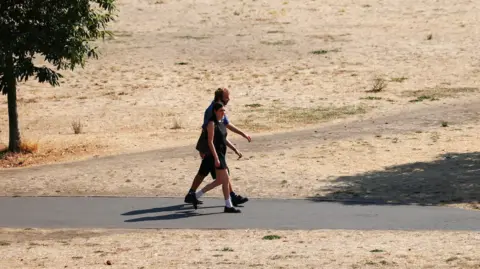
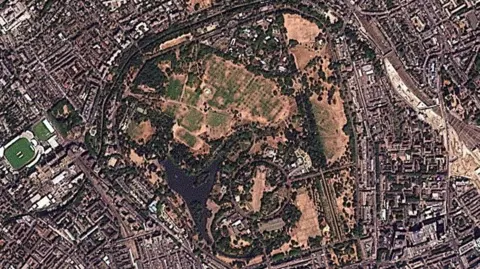
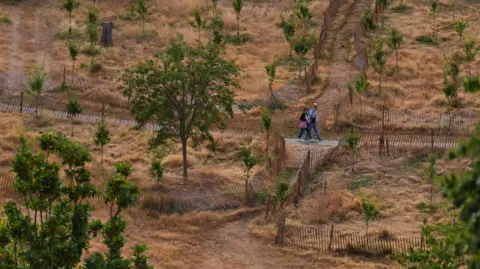
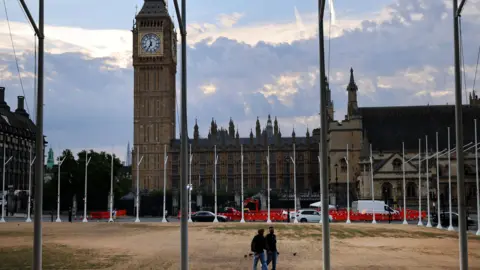
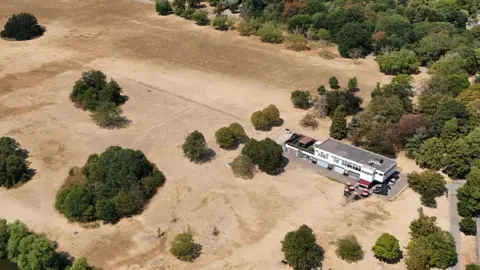
EPAHyde Park looks more like the Serengeti and the green belt has turned yellow. But with London now seeing the occasional shower, does that mean we are no longer in drought? And if not, the big question is how long will the drought last?
The capital is particularly susceptible to drought as there is a very large population, in an area that is actually very dry. Experts call it "water stressed."
The myth is London is a rainy city, yet the capital gets less rain than many other cities in Europe.
According to the Met Office the Thames Valley, London and the north Kent coast normally receive less than 650mm (26in) of rain every year. By comparison, Rome gets up to 900mm (35in).
 PA Media
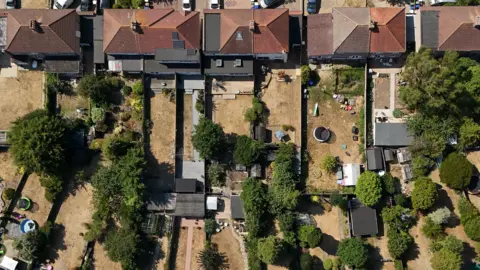
SES Water covers parts of Surrey, Kent and south London and at the moment it is one of the few water companies that doesn't have a hosepipe ban.
Daniel Kennedy, the firm's water services director, says it is impossible to predict when the drought will end.
"We do model our position with where we think things might go, but a lot of it is determined by the hot weather and the prolonged dry period that we've had."
He says water companies "are looking forward to when the rain does come because it does ease the position somewhat. But until it happens, it's really difficult to say how long it'll go on for.
"We would want a sustained period of rain... so we can replenish our groundwater stocks and our reservoirs, to enable us to have water in supply in our reserves for next year."
 PA Media
Liz Stephens is a professor in climate risks and resilience at the University of Reading.
She thinks it could take months to get back to normal, noting that previous hosepipe bans in parts of the South East were only lifted "towards the end of January, early February", while "the Thames Water hosepipe ban lifted towards the end of November".
"It really does depend on the amount of rainfall that we get. If we see a dry autumn and winter, and we don't see that recharge of groundwater, the rise in reservoir levels, potentially we could be looking at similar restrictions next summer as well," she says.
There is even a possibility this drought might not come to an end this year, according to Stephens.
"If we don't get the amount of rain that's needed, then there will be a lot of concern about the water supply going into next spring and summer as well. We probably would then expect further restrictions.
"The 1976 drought came after a period of low winter rainfall as well. And in that situation that summer there were the standpipes on the streets for water supply," she says.
Most of the capital's water comes from chalk aquifers under the ground. These take much longer to recharge than reservoirs.
Stephens also points out that while water companies may have been preparing for a prolonged drought, they are now facing other issues as well.
"They might not have been able to anticipate the type of demands that we're now seeing in the South East, not just from the increase in population, but also the very recent increase in data centres and the demand that they're putting on water as well."
 Planet Labs PBC / Reuters
Reservoir levels are currently at about 70%, which is lower than usual at this time of year.
Martin Padley, water director at Thames Water, which does have a hosepipe ban, says the company is grateful to everyone for reducing their water use, but given the current situation "we're asking customers to keep going and continue using only what they need.
"Small changes, such as taking shorter showers, turning off taps and avoiding non-essential water use outdoors, all help reduce pressure on our network while our teams continue working around the clock to find and fix leaks."
Long-term water scarcity is becoming more of an issue in London and the South East.
No major reservoirs have been completed in England since 1992. But a growing population and developments like new data centres are putting intense pressure on our water supplies.
Also, climate change is bringing hotter, drier summers that increase the risk of drought.
The government's solution is to build nine new reservoirs by 2050, potentially providing 670 million litres of extra water daily.
But some experts say we're thinking about water all wrong.
Hannah Cloke, professor of hydrology at the School of Archaeology, Geography and Environmental Science at the University of Reading, believes "we need a complete overhaul of the way we use water".
"We need to plug leaks, cut down on waste and use water more than once in our homes and buildings before sloshing it down the drain. We need to catch more water wherever it falls – not just in the river basins that are linked to big reservoirs," she says.
"An unprecedented climate calls for unprecedented solutions," adds Cloke.
"These could include the widespread roll out of sustainable drainage solutions that mimic nature and capture rainwater where it falls, on roofs or ditches filled with plants, rather than letting it rush straight down the drains into the rivers."
 PA Media
And one of the big unknowns long term is data centres.
Stephens says they're making an enormous difference.
"Thames Water had been trying to predict demand over the next 10 years... They've estimated that about 30% of that increased demand is coming from the growth of data centres.
"And I think they've already admitted that they're underestimating the demand that's happened so far from those data centres. It's an incredible amount of water that these centres use."
A huge new reservoir is planned to be built in Oxfordshire, called the White Horse Reservoir, to improve water supply.
However, Stephens says that while it will cover "a very large area of land, actually, by the time it's built, it might already be out of date.
"The extra volume that it's going to supply is roughly equivalent to that sort of upper estimate of the demand from data centres. So these really are crazy amounts of water that these data centres can use."
 EPA
EPAKennedy, from SES Water, says we will have to use water wisely throughout the year, especially with a changing climate.
This includes the likes of having shorter showers, turning the tap off when cleaning your teeth and making sure washing machines and dishwashers are only run when they are fully loaded, he says.
"If we can use water wisely all year round, it will obviously help us with our stocks in the times of the year when we really need it.
"The world is changing and we've had five heatwaves already this summer. So people are starting to understand that water is a precious commodity," he says.
 PA Media
At the moment, about 20% of water is lost through leaks. Thames Water says it is investing a record amount £21bn in fixing them. Critics say that is too little, too late.
Thames Water has also estimated that it could face a daily shortfall of over one billion litres of water by 2050. The funding needed for improvements and new water systems will be significant.
Its proposals include the new reservoir in Oxfordshire and a water recycling project in west London at Teddington. Both have faced opposition.
To match the demand, Thames Water is also striving to reduce daily water use to 110 litres per person by 2050, with current water use in the area at about 140 litres per person.
In other words, all of us will have to use less water.
In the face of a hotter climate, the mayor of London has created a heat plan, called Heat Ready London, which also highlights behaviour change as crucial.
It says: "Alongside infrastructure upgrades, changes in behaviours and system operation are essential to reduce pressure on water supplies.
"To enhance long-term water security, investment should be scaled up through a portfolio-based and integrated water management approach, recognising that no single intervention can address future challenges in isolation.
"A balanced portfolio of measures – including smart meters, active leakage reduction, water-efficiency initiatives, water recycling and reuse, rainwater harvesting, and targeted new supply schemes – should be implemented in a co-ordinated manner to deliver greater resilience and adaptability across the entire water system."
Experts say the whole water system needs a rethink to make it fit for the future.
Certainly, with a warming climate this won't be the last hosepipe ban in London and the South East.
Listen to the best of BBC Radio London on Sounds and follow BBC London on Facebook, X and Instagram. Send your story ideas to hello.bbclondon@bbc.co.uk