Drought leaves woman without running water for first time in 30 years

 BBC
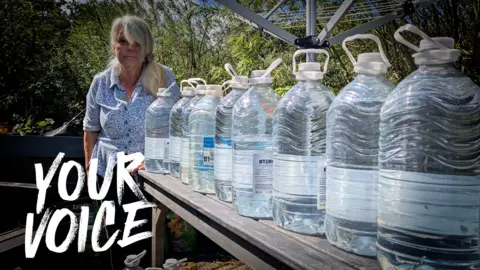
BBCGenista Tanner never imagined she would be left without running water in the home she has lived in for three decades.
The 72-year-old, who lives in rural Ceredigion, relies on a well for her water supply. But for the first time in 30 years, the well has run dry.
Researchers have warned that many of them are vulnerable during droughts, and the problem could get worse in future.
Wales had the driest July on record and remains in drought conditions.
"I have not had any fresh water coming from the well into the house for at least a month," said Tanner.
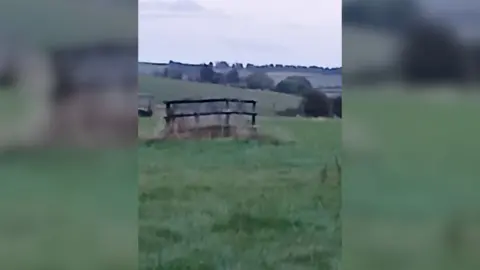
Tanner's home is not connected to the mains water network, instead drawing water from a well in a field across the road.
For most of the year, gravity carries enough water to the property for bathing, washing and household use. In drier periods, a pump helps move water from the well into storage tanks.
This summer, however, there was nothing left to pump.
"I've never had that happen before. Never. In all the 30 years we've lived here," she said.
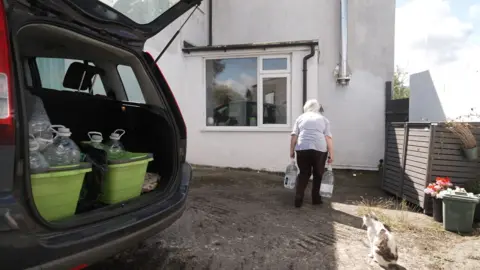
Tanner now relies on bottled water from supermarkets, water borrowed from friends and family, and has travelled for more than 40 minutes to have a shower at her daughter's home in Aberystwyth.
"I never realised the value of water until I didn't have it," she said.
"I've discovered that 1.7 litres of water will wash my hair. I've also discovered that four cups of water will give me a good wash."
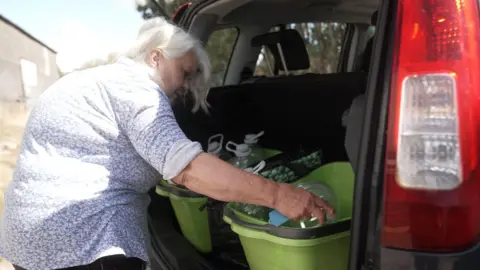
As a pensioner, Tanner said the cost of bottled water had added to the pressure.
"It means that you have to say to yourself 'what do I eat?' Because I will need to set aside a certain amount for water."
Tanner's concerns extends beyond the immediate inconvenience.
Her connection to the property is deeply personal. She moved there with her husband, mother-in-law and five children more than 30 years ago. Since then, her mother-in-law, husband and one of her sons have died while living there.
"I love this home," she said.
"Because these things happened in the home, then it makes me feel more bonded to it."
But she worries increasingly dry summers could ultimately leave her with little choice but to move.
"I would feel pretty cheated," she said.
"I don't want to be pushed into having to do something I don't want to do."
 Genista Tanner
Tanner's experience comes as Wales remains in drought status and concerns grow about the resilience of private water supplies.
A spokesperson for Natural Resources Wales said: "Climate change is expected to bring wetter winters and drier summers. This has been clearly illustrated in the last couple of years, with extended periods of prolonged dry weather and drought in the summer, and significant flooding in the winter months."
They added: "Groundwaters, from which most private water supplies are dependant, are as vulnerable to climate change as our rivers, streams, lakes and reservoirs", adding that "water may not be so reliably available all year round in the future".
Dr Emmanuel Zarate, Principal Hydrogeologist at the British Geological Survey Wales, said private water supplies were "more important in Wales than many people realise".
He said recent figures suggested around 104,000 people across Wales relied on private water supplies, with dependence particularly concentrated in rural communities.
Zarate said Tanner's experience was "not an isolated case" and reflected problems being seen elsewhere during the current drought.
"We know that private water supplies in Wales have been vulnerable to prolonged dry weather in previous droughts," he said.
He said wells and boreholes drying up was "widespread across Wales, particularly this summer".
He said many groundwater sources in Wales were supplied by so-called secondary aquifers with lower storage capacity than those used elsewhere in Britain.
"That low storage means that they're particularly more vulnerable to prolonged dry spells and may have less of a buffer," he said.
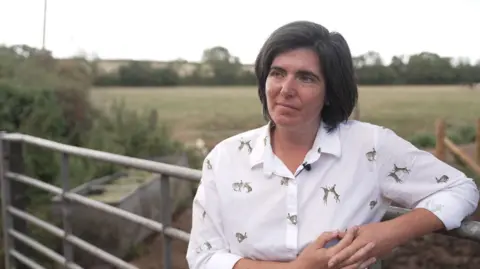
The National Farmers' Union (NFU) Cymru president Abi Reader echoed these concerns.
"There's a huge rural landscape out there that is wholly reliant on private water sources," she said.
Reader said farmers were increasingly having to transport water to livestock as streams, springs and ponds dried up during the hot weather.
She added that some groundwater sources may take months to recover even after rain returns.
"It's going to be months before some of these springs start running again," she said.
Ceredigion County Council said prolonged dry weather could place pressure on private water supplies, particularly those reliant on wells and springs.
A spokesperson said that while private water supplies were the responsibility of owners and users, the council provided advice and guidance to residents experiencing problems.
The authority said it discussed individual circumstances with affected residents, offered advice on alternative arrangements and longer-term solutions. It also encouraged private water supply users to consider contingency plans during extended periods of dry weather.
For Tanner, her experience has left her considering a future where turning on the tap is no longer guaranteed.
"All I know is that people, whether they have a well or not, really need to think what they would do if they didn't have water," she said.