Water company issues first hosepipe ban in decades

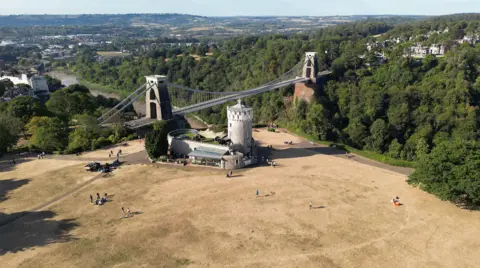 Reuters
A water company has announced its first hosepipe ban caused by drought in more than 50 years.
Bristol Water said the restriction - which bans people from using hosepipes for watering gardens, washing cars or filling paddling pools - would come into force from 00:01 BST on Thursday to protect the River Severn's resources.
Half of the UK's water companies - including Wessex Water, Thames Water and South West Water - have now announced hosepipe bans, as most of England is in drought.
"Introducing a hosepipe ban is never a decision we take lightly, and we fully appreciate the inconvenience it will cause," said Richard Stanbrook, director for drinking water services at Bristol Water.
This marks the first hosepipe ban in the Bristol Water area caused by drought since 1975, when a dry summer was then followed by 16 months of low rainfall.
The supplier then introduced a short ban in 1990 because of a hole in the bottom of the Gloucester and Sharpness Canal, which then collapsed.
Announcing its latest action, Bristol Water said that although the ban would not be in force until Thursday, it was asking people to follow restrictions immediately.
Why is water ban needed?
When the weather is as dry as it has been this summer, Bristol Water takes more than half of its supply from river sources, including the Severn via the Gloucester and Sharpness Canal.
However, the Environment Agency and Natural Resources Wales have applied a drought order to protect the river.
Bristol Water also pointed to warnings around El Niño, a powerful natural climate phenomenon which pushes up global temperatures and could increase the risk of extreme weather.
Stanbrook added: "The water resources we depend on, particularly the River Severn, support the wildlife, habitats and species that rely on water directly or indirectly, and it's critical we all carefully balance public water use with water needed for our natural environment to thrive.
"We take our responsibility for preserving the water environment very seriously and we know our customers do too."
Will rain affect the ban?
The region - alongside most of the country - has gone months without substantial rain, but that is looking likely to change in the coming days.
BBC weather forecaster Ian Fergusson said Thursday would bring "a much wider potential for widespread rain as a front moves north during the morning", amid a Met Office yellow weather warning for thunderstorms covering Bristol, parts of North Somerset and Gloucestershire.
"Some of this is likely to turn heavy and, in places, thundery. However, the distribution of areas of heaviest rain and thunderstorm activity is still fairly uncertain," he said.
"However, in broad terms, the rainfall amounts are likely to prove greatest for areas from about the M4 northwards."
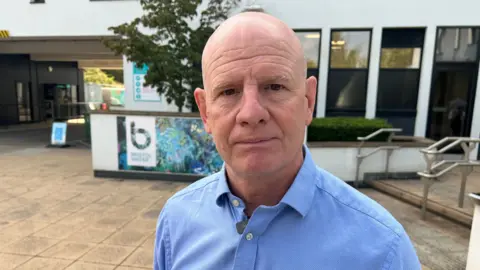
But how will this affect the hosepipe ban?
Stanbrook said that while it was looking likely to rain, "we need sustained rainfall and we need our reservoirs to recover" - as well as reservoirs in Wales which help supply the area.
"We need to bear in mind that there's already a forecast for next year of being a dry, hot summer. We need to prepare for that as well so we need to make sure there's a substantial recovery," he added.
An earlier version of this article used an image of Chew Valley Lake taken in August 2025 which has since been replaced.
Follow BBC Bristol on Facebook, X and Instagram. Send your story ideas to us on email or via WhatsApp on 0800 313 4630.