Light Brigade medals sold for three times estimate

 Noonans
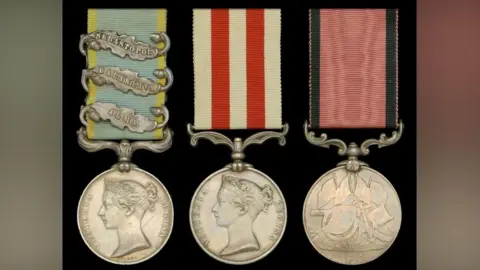
A trio of medals awarded to a cavalryman involved in the infamous Charge of the Light Brigade have sold at auction for nearly three times their estimate.
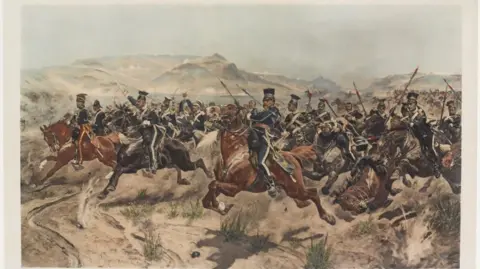
The collection belonged to York-born Sgt James William Wightman, of the 17th Lancers, who was later immortalised in Richard Caton Woodville's painting of the ill-fated military engagement.
The medals, which had been expected to fetch between £6,000 and £8,000 at auction in London, sold for £22,000.
"I am delighted to see how well the medals did and that the military romance attached to The Charge of The Light Brigade continues to echo clearly in our history 175 years on," said Christopher Mellor-Hill, from Noonans auctioneers.
Mellor-Hill, said the charge was "one of the most famous and tragic actions in British military history".
The charge took place in 1854 during the Crimean War, fought between the Russian empire and European powers, including France, the UK and Ottoman Empire.
During the Battle of Balaclava, an order given to the British Army's cavalry division - known as the Light Brigade - was misunderstood and more than 600 cavalrymen charged down a narrow valley straight into the fire of Russian cannons.
About 110 British soldiers were killed and 160 wounded.
 National Army Museum
The set of medals, which had remained in the same collection for 40 years, also included Wightman's Indian Mutiny medal.
The sale also included a copy of Wightman's 1892 memoir of the charge and his Russian captivity, which recounts the moment the brigade advanced into battle.
"He gave the word of command, and then turning his head toward his trumpeter, Britten of the Lancers, he quietly said, 'Sound the Advance!' and wheeled his horse, facing the dark mass at the farther end of the valley which we knew to be the enemy," it reads.
Wightman later lived in London until his death in 1907 and is buried at Brompton Cemetery.
Listen to highlights from North Yorkshire on BBC Sounds, catch up with the latest episode of Look North.