Gold ring 'once in a lifetime find' for detectorist

 Stuart Jones
A metal detectorist's "once in a lifetime find" - a 16th Century gold ring - is expected to fetch thousands of pounds at auction.
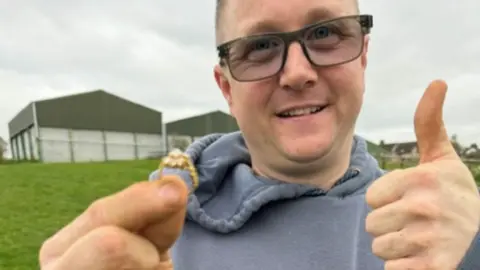
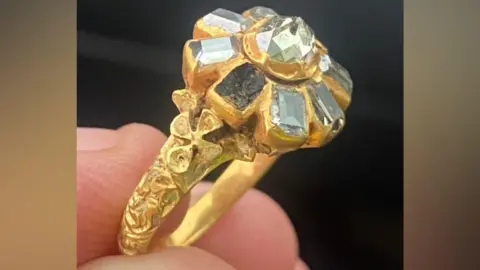
The diamond cluster gold ring was uncovered in the village of Wormington, Gloucestershire, by Stuart Jones in November 2024.
Jones, 42, from Solihull, said he was "absolutely overwhelmed with joy" after finding the ring bearing eight diamonds and will split the proceeds of the sale with the landowner.
The ring is expected to attract bids of between £15,000 and £20,000 when it goes under the hammer at Noonans of Mayfair on 23 June.
Jones has been metal detecting for several years but said he had never previously explored in Wormington, four miles from Broadway, and the find came towards the end of a seven-hour day of searching.
"I was over the moon," Jones said.
"Everyone around me was congratulating me and taking photographs while I held the ring."
 Stuart Hall
As he pulled the ring from the soil, one diamond came loose and fell into Jones' hand, and a second jewel was also missing.
Having previously tried gold panning, Jones gathered the soil around the spot where he uncovered the ring and took it home to wash and sieve, which led to him finding the missing diamond.
"I describe it as my 'once in a lifetime find'," he said of the ring.
"Like many detectorists, I have always dreamed of finding something truly special, but I never imagined I would discover an item of this significance."
'Very rare'
The ring was examined by the British Museum and Laura Smith, a jewellery specialist at Noonans, who said the piece was in keeping with the style of the time which required "grand rings to make an impression from a distance".
"This ring has a flowerhead bezel composed of a cluster of eight hogback diamonds - which is very rare - although two are loose," she said.
The gold was found to be 19.2 carat, the exact gold standard set by Edward I in 1300, Smith added.
Follow BBC Gloucestershire on Facebook, X and Instagram. Send your story ideas to us on email or via WhatsApp on 0800 313 4630.