Wedding experts welcome plans for more flexible vows

 Rachel Wood Weddings
Wedding planners and celebrants say proposed marriage law reforms will allow couples to create more personalised and affordable ceremonies.
Couples in England and Wales could be allowed to legally marry in their garden, favourite pub or on a cruise ship under the government's biggest overhaul of wedding law in almost 200 years.
"To be able to have it where they had their first date or a favourite spot by the river means the celebration can be truly unique," said Wiltshire wedding planner Francesca Notman.
Sam White, an independent celebrant from Bristol, said the reforms would "modernise things" and particularly benefit interfaith couples wanting to reflect different traditions and beliefs.
Currently, most celebrant-led ceremonies in England and Wales are not legally binding, meaning couples must complete a separate legal marriage beforehand.
"Every single one of my couples has had to do the two-step process," said White, who officiates weddings in Bristol, Somerset, Gloucestershire and Wiltshire.
"Most have done it the week before, it's a bit annoying for couples."
Under the proposals, couples could legally marry almost anywhere - from a castle, to a hot-air balloon or a beach - as long as the ceremony location is approved by a registered officiant.
The government has stressed ceremonies would still need to be "serious" and "dignified", with safeguards in place over where weddings could take place.
"You couldn't just get married on a rollercoaster," White added.
"There has to be an assessment of whether there will be distractions or interruptions."
'We re-enacted it'
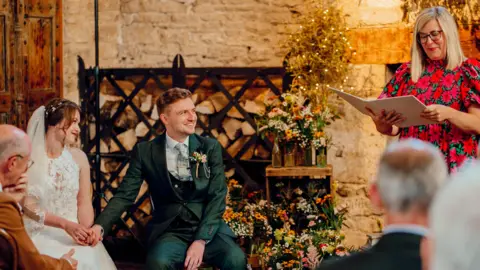
Dairy farmers Nick and Morgan Cavill married at a farm in Godney, Somerset earlier this year.
Because the venue they chose was not licensed for marriage, they - like many - had to legally marry at a registry office.
"We had a very, very small ceremony on the Friday before [the wedding] which was just my wife and I and our two witnesses, where we signed the paperwork, and then we had the actual party," Nick said.
"As far as we're concerned, we just re-enacted it."
Had they had the option, he said they would have chosen to marry in front of all of their friends and family on one day.
While it did not make much differences to their wedding budget - with the registry office ceremony costing around £80 - Nick said: "It was more the planning of doing one day and then having [the reception] another day, [rather than] making it real on one day."
 Stu Tucker
Somerset wedding planner Georgi Fisher, who previously worked in Australia where celebrant-led weddings are commonplace, said her first reaction to the announcement was "about time."
"When I moved here I assumed it was the same sort of thing," she said.
"In Australia, most ceremonies were celebrant-led and you could marry in so many different places.
"It gives people more flexibility and more opportunity to create something that reflects who they are."
 Hamish Irvine
Wiltshire wedding planner Notman specialises in marquee weddings "which makes this very exciting," she added.
"[The changes] mean you can get married in your garden," she said.
"People who are wanting to spend less will like it because of that."
 Prue Nilsson
Jo Cranston, co-founder of Queen and Whippet Catering, who are based in Bristol and work across the south west, said while the reforms are "a natural revolution", she does not necessarily think it will make weddings cheaper.
"It's wonderful if you want a simple elopement but for a bigger wedding, you need to think of the logistics of bringing everything in.
Cranston said while she was "excited" there could be more woodland and remote weddings, they also come with a "very different set of requirements" including vehicle access, waste removal and weather contingency.
"It's not necessarily cheaper than going to a venue where everything is already set up."
What happens next?
The Law Commission has estimated the reforms could increase the number of marriages by around 3 percent.
The exact details of the government's reforms will be announced after the consultation ends on 24 September.
Cranston said she also does not think the reforms will have an impact on wedding venues but feels those who are more forward facing and more flexible will stand out.
"There's still definitely going to be a place for wedding venues. They have experienced teams and a trusted supplier network. The market is not going anywhere," she said.
"It's going to really help people who have a special place," she added.
 Elizabeth Watts Photography
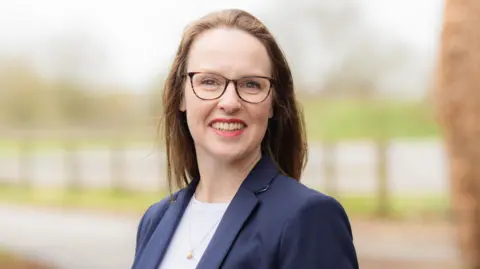
Amy Nelson, from Wedding Day Dance UK who are based in Marlborough but provide services across the country, said the reforms would mean couples do not need to have weddings "in two parts".
Nelson said often couples who want a certain unlicensed venue have to have the legal ceremony on a different day.
"Some people can't have the celebration they want because it doesn't fit into what's legal."
Nelson said the reforms would particularly benefit people like her clients, who are very intentional with their decisions for the wedding.
"I think it will allow people to do what's special to them," she said.
"It will be so nice for the people who really do value the personal touches of their wedding day," she added.
When it comes to current licensed venues, Nelson said some may struggle, especially those who "don't provide a great service".
Nelson said she hoped the potential changes could allow couples "to have a wedding they want for the price they can afford".
"These changes that's achievable for them," she added.
Follow BBC Bristol on Facebook, X and Instagram. Send your story ideas to us on email or via WhatsApp on 0800 313 4630.