The crops being grown indoors without sun or soil

 BBC
BBCCrop fields have been taken indoors in part of rural Berkshire - into highly controlled environments - in the search for efficiency and innovation in arable farming.
A group of farming scientists have shut their crops away from the elements, choosing instead to grow them on vertical aeroponic beds with the help of artificial intelligence (AI).
They will grow without sunlight or soil and, the scientists say, will use 98% less water than traditional farming. Innovation Agritech Group (IAG) has designed and built the grow panels using full-spectrum LED lighting and automated closed-loop irrigation.
It comes as a drought has been declared in Berkshire with difficult conditions for farmers.
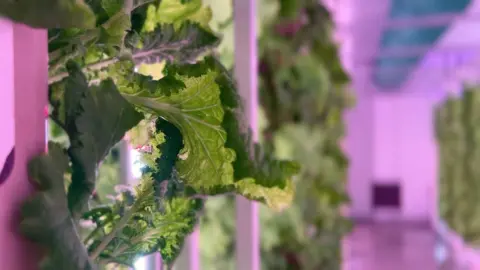
Under an eerie pink light in humid, sealed rooms with complex water pipework, plants grow in vertically suspended grow panels, which are about the size of a double mattress.
Aeroponic beds do not use soil, instead the plants' roots hang in the air, getting nutrients from a fine water mist.
Laura Nelson, research manager at IAG, said: "It's incredibly exciting. It's very high tech, very different, but it's an example of how we are adapting to climate change.
"We control the humidity, the temperature, the CO2 [carbon dioxide], the irrigation timing, the nutrient levels, lighting, all of this stuff."
She added: "If there is an issue with the environment and it's not right for growing crops we can still grow them in here no problem. Our yields are unaffected."
The company uses AI to help predict what impact changes to the plants' care will have on their yield.
However, this style of farming has been criticised with a report commissioned by Defra in March 2023 saying it has a limited range of produce, mostly non-flowering, non-fruiting crops.
In a statement IAG said: "Historically, this has been a fair observation, with vertical farming primarily focused on herbs and leafy greens.
"However, the technology within the industry has advanced significantly. Today, soft fruits are being grown successfully in controlled environment systems, and protein crops are also becoming viable."
The same report also found a large amount of electricity was required to run these systems.
IAG said: "...significant advances in LED grow lighting and environmental control systems have dramatically improved the efficiency of controlled environment agriculture in recent years, reducing the amount of electricity required per unit of crop produced."
Phd student and plant scientist, Felix Trimmer, says AI will play an increasingly large role in farming.
"What we can do is model how the plants grow, adjust variables, and then we can train some machine-learning algorithms to basically tell us if we change one variable how will that affect the outcome and the yield," he explained.
"We can use that to detect, almost in real-time, perhaps a disease maybe spreading and catch it very early, or catch where something may have gone wrong in the system to simplify our maintenance.
"Really the possibilities are endless in how we can use it."