Bluetongue virus 'big issue' for South West farmers

 PA Media
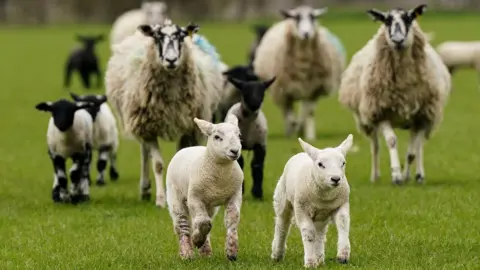
The spread of bluetongue disease over the past two weeks is causing a "big issue for beef and sheep farmers" in the South West, a farmer has said.
More than 40 animals in Devon and Cornwall have been confirmed to have the Bluetongue virus (BTV) in recent weeks, with the UK put into a BTV restricted zone.
BTV affects cattle, goats, sheep, deer and camelids and can cause ulcers or sores around the animal's mouth and face, difficulties swallowing and breathing, fever and lameness, foetal deformities and stillbirths.
Spread by midges, Defra said bluetongue poses no threat to the public or food safety but can affect cloven-hoofed animals like sheep and cattle.
'Contact your vet'
Latest figures show there have been 50 cases of the virus in England since 1 July.
Ian May, the South West regional manager for the National Sheep Association, said it was causing issues for farmers across the UK.
He said: "There are a significant number of deaths that will occur through it, but it is vaccinatable and it is, when you see signs, there is a significant number of the sheep that we've been working with and cattle have been responding to treatment as well.
"If you do suspect it on your farm then you should really contact your vet and they will help identify it and send away a blood test so that you can confirm that it is blue tongue."
The Department for Environment Food and Rural Affairs (Defra) said farmers should look out for signs of fever, facial swelling, drooling, nasal discharge, lameness and mouth ulcers - and to report any suspected cases.
Penbode Farm Vets in Cornwall said it attended about 20 cases of suspected BTV in unvaccinated sheep last weekend and recommended vaccinating flocks.
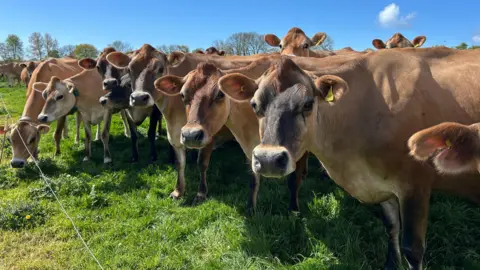
Under new restrictions, the government said livestock could move within England without specific bluetongue licences or pre-movement testing and freezing germinal products anywhere in England would require a specific licence and testing.
Due to the outbreak, Launceston Agricultural Show in Cornwall said cattle and sheep would not be attending its show on Thursday "to ensure the welfare of all animals and reduce the risk of spreading beyond the showground".
Show Secretary Sharon Horsington said it had put contingency planning in place which had "created a bit of a challenge for us".
She said: "It's upsetting, it's disappointing, great sympathy to the farmers and no doubt the other farmers around us now.
"But now the show must go on and we have a duty to put on an agricultural show and that's exactly what we'll do."
'Transmission risk increased'
Restrictions for moving livestock from Northern Ireland across the boarder were lifted at the beginning of March after BTV was discovered at a farm in November.
A case of BTV was confirmed among cattle in Shropshire in February.
Defra said the midges that spread bluetongue "became active again" in the UK on 31 March.
It said: "Following the recent warm weather, experts advise that cumulative temperatures are now high enough for the virus to develop inside the midges, and onward transmission is now possible.
"Temperatures are also now high enough in many areas of nearby continental Europe for the virus to have developed inside midges."
Defra said it expected any midges which had been "newly infected" in the last few months would "have the potential to have completed their extrinsic incubation period and become infectious".
"The risk of transmission from midges blown across the channel has increased," it said.