'Full of magic and humanity': Five things you need to know about The Odyssey

 Universal Pictures
As Christopher Nolan's epic blockbuster starring Matt Damon, Anne Hathaway and Tom Holland arrives in cinemas – here are the key takeaways from the film.
One thing I'd never considered before seeing The Odyssey: it was quite foul-smelling inside that Trojan horse. No detail is too small and no action too big for Christopher Nolan's film, epic in its scope and ambition.
You may think of Homer's centuries-old poem as the cornerstone of Western literature or as a dreaded school assignment. Possibly both. But Nolan's extravagant adaptation is decidedly more an action-adventure blockbuster than a classics lesson.
It is also the purest Christopher Nolan. Odysseus fits in his line of morally complex heroes, from the justice-seeking vigilante Batman to Oppenheimer, the conscience-stricken father of the atomic bomb.
And Homer's digressions suit Nolan's taste for lucid, non-linear narratives. The Odyssey gracefully loops back and forth in time as it tells of Odysseus's nearly decade-long journey back to his kingdom of Ithaca after winning the Trojan War.
The build-up to the film has felt as long as Odysseus's journey itself – remember when tickets went on sale a year ago? – but we can now finally see what Nolan has done. Here are the notable takeaways from his spectacular, thoughtful drama.
1. A 'mesmerising' hero
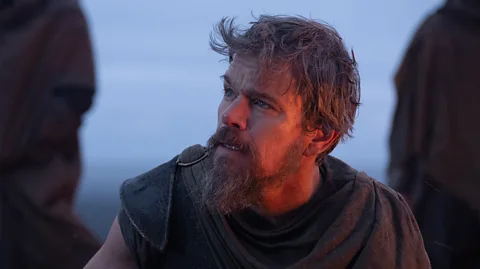
Whoever Damon plays, you can always see that his characters are thinking, and he is at his action-fuelled, reflective, Jason-Bourne-best here as Odysseus, a mortal who interacts with gods and monsters and sometimes acts like a god himself.
A warrior who doesn't hesitate to plunge a sword into an enemy, he eventually grapples with the consequences of the godlike choices that determine the fate of the men he commands. He isn't above lying. And on a journey that literally takes him to hell and back, in the underworld of Hades the prophet Tiresias tells him to choose between sailing toward the whirlpool Charybdis, where all his men will die, or the monster Scylla, who will only kill six. He secretly chooses for them. Damon carries the action and the moral weight of the film and is mesmerising through all its turns.
 Universal Pictures
2. 'Massive' action scenes
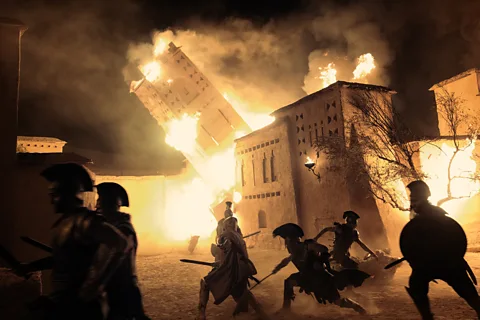
In one explosive set piece after another, Nolan uses his IMAX cameras to reflect the scale of Odysseus's journey and also how powerless mortals are next to the gods. Much of the film takes place on a sapphire-blue sea, with a wide horizon and enormous cliffs that dwarf the boat carrying Odysseus and his men. The film is so immersive that we feel like we are in the boat with them.
The massive action scenes are just as immersive – each sword, spear and arrow perfectly choreographed. Those sequences are even more impressive because Nolan relied on practical effects, with a minimum of CGI. The battle of Troy is shown in two episodes, firstly when Odysseus and his men drop out of the horse. In an especially stunning scene near the end, he recalls the battle in all its fury as we see buildings collapse and violence that he calls "fires, anarchy and pain".
Filmed in a real cave, the sequence where the giant Cyclops bites off soldiers' heads, is harrowing. And like all the action scenes, it has a point, demonstrating Odysseus's cleverness in plotting their escape.
3. A star-packed cast
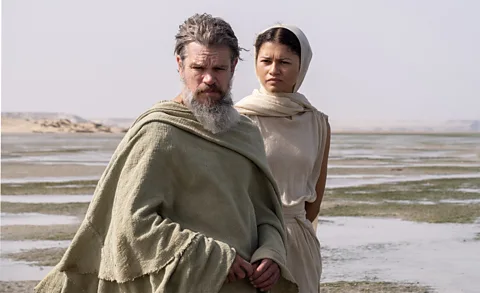
Nolan has stocked the cast with leading actors willing to take smaller parts for him. Next to Odysseus they are all relatively small roles, but delivered with passion. Anne Hathaway is a standout as his wife, Penelope, no patient shrinking violet here. A savvy queen surrounded by suitors vying for the throne, she has irate outbursts about her perilous situation. Her intimate conversation with her husband before he leaves her and their infant son for war is the kind of stirring emotional scene the film could have used more of.
Tom Holland's role as their coming-of-age son, Telemachus, is underwritten. But John Leguizamo is touching as a blind swineherd loyal to Odysseus. Robert Pattinson makes Penelope's main suitor, Antinous, arrogant and wily, and Samantha Morton is chilling as the witch Circe. Zendaya serenely flits in and out as the empathetic goddess Athena. Even the stars who appear for a blip of time get some meaty scenes, like Lupita Nyong'o, beautiful and angry as the devastated Helen of Troy and her murderous sister, Clytemnestra.
 Universal Pictures
4. 'Resonant' storytelling
In Nolan's swirling narrative, flashbacks are spun out of memories and second-hand stories until the nature of history and reality themselves seem uncertain. And after a slightly slow start with some clunky exposition in the dialogue, the pacing never flags and the rest of the three-hour run-time flies by.
And there is, in the end, a resonant moral to the story. Zeus's law, adapted to the modern age as the golden rule to treat others as you'd wish to be treated, is a major theme. Violating the rule comes back to haunt Odysseus, which Nolan uses to make the film relatable. The film pointedly echoes anxieties about the world today as Odysseus looks around him and talks about a civilisation in ruins that must repair itself and remember that heroes should be honest as well as brave.
5. Does it live up to the hype?
Almost. It would be easy to get caught up in the sheer astounding immensity of the spectacle. But it's also true that the action often mutes the emotional impact, which is a bit too little and becomes powerful too late. Oppenheimer, with its singular focus, is still Nolan's most perfectly wrought film. But even with its flaws, The Odyssey is so rich, so full of magic and humanity, that I'm eager to see this epic again.
The Odyssey is released in cinemas worldwide on 17 July.
--
If you liked this story, sign up for The Essential List newsletter – a handpicked selection of features, videos and can't-miss news, delivered to your inbox twice a week.