Good at maths and into jazz: Nine extraordinary things you probably didn't know about sharks

 Hannes Klostermann/ Ocean Image Bank
Humans have more in common with these elite ocean predators than often thought. A little Miles Davis anyone?
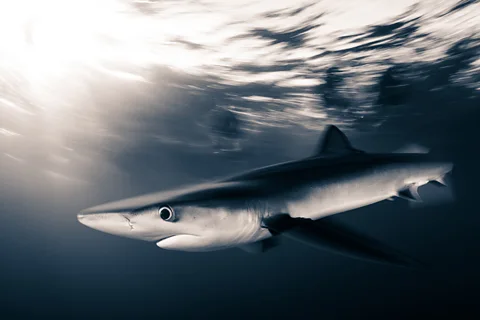
Sharks are among the Earth's original vertebrate predators.
They (or their close ancestors) survived all five of Earth's major mass extinctions – including the largest and most devastating, the Permian-Triassic extinction, or the "Great Dying". This cataclysmic climate event killed the majority of life on Earth, including around 90% of marine life.
But sharks lived on. Today they are found in just about every bit of the ocean – and after hundreds of millions of years of evolution, they have developed some surprising traits along the way.
Here are nine extraordinary facts about sharks.
1. Sharks can do maths
While sharks are often thought to be mindless predators driven solely by their instinct and voracious hunger, science suggests they're actually pretty clever and good learners. They can distinguish between subtly different sounds, as well as different abstract patterns and colourful geometric shapes.
In one famous experiment, young grey bamboo sharks were shown to remember information about shapes and optical illusions for almost a year. They can also do basic mathematics, telling the difference between quantities such as three and five, and four and seven (but not quantities as close as four and five).
2. Sharks have a taste for jazz
As far as Port Jackson sharks are concerned, it don't mean a thing if it ain't got that swing.
Examples of the Australia-favouring, bottom-dwelling species were set a challenge: swim over to a certain spot of their tank when music played, and they'd be fed a reward.
The study, carried out by researchers at Sydney's Macquarie University, showed the sharks favoured the feeding spot when jazz was being played but were not able to make the same association for classical music.
"It was obvious that the sharks knew that they had to do something when the classical music was played, but they couldn't figure out that they had to go to a different location," said researcher Culum Brown in a press release.
 Jayne Jenkins/ Ocean Image Bank
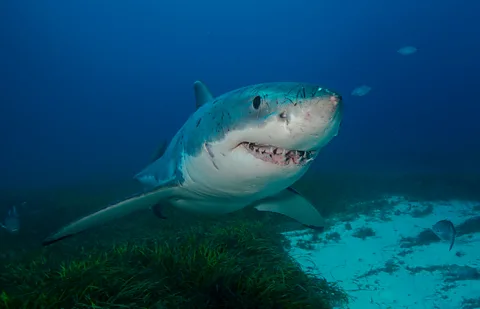
While some sharks lay eggs, many – including bull sharks and hammerheads – carry their young in their uterus and feed them through an umbilical cord, just like humans. This is why, for a few weeks or months after birth, these pups have belly buttons until the scar from the umbilical cord heals.
Other sharks neither lay eggs nor raise their babies in their wombs like mammals: the embryos grow in eggs which hatch while still inside the mother. These pups are then also born live. Spiny dogfish sharks give birth like this, for instance, after a pregnancy that can last up to two years.
4. Baby sharks eat each other in the womb
Sand tiger shark babies are thrown into a fight for survival right from the beginning – while still inside their mother.
Female sand tiger sharks have two uteruses, and as many as five young grow in each. The embryos feed on their siblings, however, until there is only one left. This is known as intrauterine cannibalism or adelphophagy, which means "eating one's brother".
After having their fill of their brothers and sisters, the sand tiger shark babies enjoy exclusive access to a steady supply of unfertilised eggs that their mothers continue to release – making them fit and strong by the time they are born.
5. Sharks have besties
Sharks aren't the lone hunters they're often depicted to be. Grey reef sharks like to hang out with the same clique of friends for as long as four years, splitting up into smaller groups, going their own ways, and then regrouping throughout the seasons.
Young lemon sharks also like to live in groups and, importantly, learn new skills from each other during these social interactions – like how to find food or avoid predators. They prefer to hang out with other lemon sharks their size and ones they've met before.
Great whites may even have best friends. Usually thought of as solitary, two great white sharks, named Simon and Jekyll, were seen to travel together for 6,000km (3,730 miles) without ever separating.
 Hannes Klostermann/ Ocean Image Bank
7. Sharks' bodies are covered in tiny teeth
Shark skin is a wonder material. In 18th-Century Italy, craftsmen used it to smooth the delicate edges of priceless Stradivarius violins. And in Victorian Britain, it became a favoured accessory for cabinet makers (who called it "shagreen").
Instead of scales, shark skin is studded with numerous tiny "teeth" – called denticles – which are flattened by the creature's forward movement of water, reducing aerodynamic drag. Run your hand against the grain and it would feel like rubbing particularly coarse sandpaper.
Sharks sometimes bump into unfamiliar objects, feeling their texture and consistency with the rough edge of their skin – a lazier kind of "taste test" for objects that might not be a meal.
8. Sharks can sense your beating heart
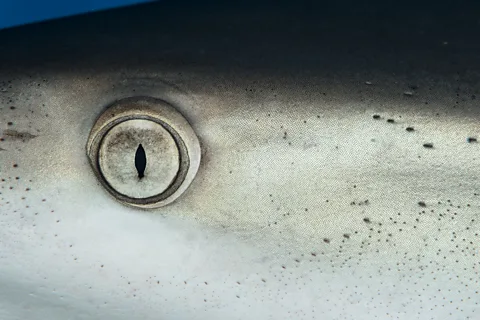
Sharks have eight senses. In addition to our five basic senses of vision, hearing, smell and touch they also have super-senses that allow them to detect changes in pressure or voltage in the water, and even the Earth's magnetic field.
Rows of pores known as lateral lines run down each side of the shark's body, filled with fluid and sensory cells. Movement in the water around the shark causes these hair-like cells to sway in the fluid, allowing the sharks to detect vibrations.
More like this:
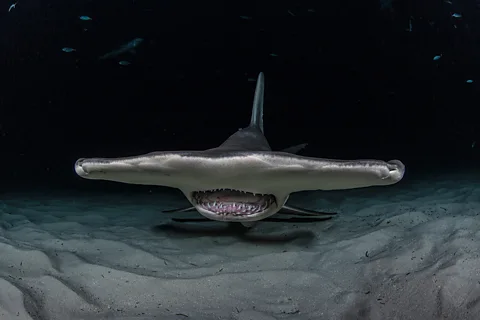
Pit organs are sensory hair-like cells scattered all over the body. These allow sharks to detect low-frequency electrical fields given off by other animals, allowing them to hunt in total darkness or find prey hiding in the sand.
Meanwhile another series of sensors, ampullae of Lorenzini, may be both electroreceptive and magnetoreceptive. Hundreds or thousands of these pores dot the shark's head, each filled with sensitive nerve cells. These allow sharks to sense electrical impulses generated by the muscle contractions of nearby animals – for example, a beating heart. They may also help sharks cross thousands of miles of ocean, using the Earth's magnetic field to navigate.
 Larsvon Ritter Zahony/ Ocean Image Bank
9. Sharks are older than trees, Saturn's rings and the North Star
Sharks are incredibly ancient. The earliest fossil evidence for the ancestors of today's sharks is a collection of scales dating back 450 million years. That's about 60 million years before the first trees, 220 million before dinosaurs, 350 million years before Saturn's rings and 380 million years before the birth of the North Star.
The first shark-like teeth came 410 million years ago, and the first group that really looked like sharks evolved around 380 million years ago. Many of these ancient fish may not have technically been sharks, but they were related to them. Then, 195 million years ago, the oldest-known group of modern sharks arrived, with their flexible, protruding jaws and speedier swimming prowess.
Today, there are around 500 species of shark. That number is far below their peak around 50 million years ago, though more are being discovered all the time.
As for our association with these elite ocean predators, human's closest common ancestor with sharks lived around 440 million years ago, although it looked a lot more like a shark than it did a human. Our lines may have split all those millennia ago – but our existence on this Earth is intrinsically linked.
--
For essential climate news and hopeful developments to your inbox, sign up to the Future Earth newsletter, while The Essential List delivers a handpicked selection of features and insights twice a week.