Dead fish found at lake linked to heatwave

 LDRS
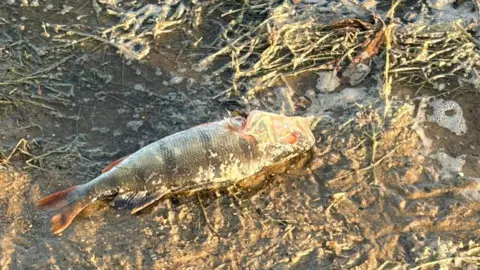
LDRSDozens of dead fish that have washed up on the shores of a west London lake are believed to have died due to a mass algal bloom caused by recent heatwaves.
Residents spotted the fish carcasses when walking through the Ruislip Lido area on Monday.
The Environment Agency (EA) said officers tested the water and believe a recent algal bloom, likely to have been triggered by the prolonged heat this summer, has caused a drop in oxygen in the water.
Hillingdon Council Conservative councillor Philip Corthorne said the lake was now closed to fishing to preserve stocks while work is undertaken to aerate it. He said it may take three to four days to "stabilise the lake" and the EA will reassess.
Swimming is banned in Ruislip Lido, a 60-acre reservoir, because it contains several hazards including blooms of blue-green algae which can be toxic to people, and large submerged objects and vegetation. It is managed and owned by Hillingdon Council.
The EA told the Local Democracy Reporting Service it had provided the council with three aerators to re-oxygenate the lake, focusing on the area where most fish tend to congregate.
The aeration process generates ripples, which will prevent the water becoming stagnant, helping fish to breathe and encouraging good bacteria to survive by controlling algae growth.
"The fishing lake is privately owned and therefore the responsibility of the owner to manage," an EA spokesperson said.
"We have agreed to provide them with aeration equipment to help restore oxygen levels in the lido and will continue to provide advice and guidance."
It has been an exceptionally warm summer so far with the Met Office saying it is likely to be the hottest on record.
A late-spring heatwave that set a new May temperature record was followed by another heatwave in June, and a third in July which lasted for two weeks in places.
Further heat spikes have followed, with many places reaching their heatwave thresholds multiple times throughout the summer.
As the temperature of the water increases, the amount of oxygen that water can hold decreases, resulting in less oxygen for aquatic life and subsequent fish kills.
A similar incident occurred at Wimbledon Park lake, where fish were seen floating on the surface of the lake. Initial findings suggested the deaths were caused by "a prolonged period of exceptionally hot weather".
Listen to the best of BBC Radio London on Sounds and follow BBC London on Facebook, X and Instagram. Send your story ideas to hello.bbclondon@bbc.co.uk