Climate change leads to blackcurrant struggles for Ribena

 BBC
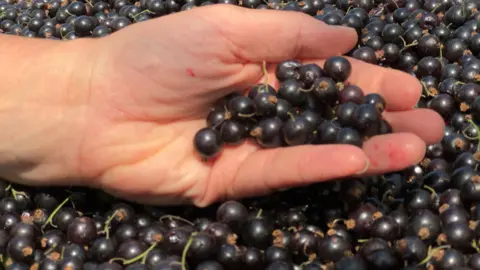
BBCOn the outskirts of Ledbury in Herefordshire, I have come to see a brand new, multimillion-pound factory. Its job is to turn the nation's blackcurrants into concentrate for a well-known brand of squash.
About 90% of the entire harvest in the country goes into making Ribena.
But it has been a tough year for growers sending blackcurrants here, both locally in Herefordshire and from further afield in East Anglia and Scotland.
The difficulties the growers have faced include "heavy rain and hail, and then we've have three major heatwaves," according to Harriet Prosser, the agronomist for Ribena.
"For a little black berry on a bush that can cook in the sun, get up to 40 or 50 degrees, we've had some real challenges."
As an agronomist, Prosser's job is to help develop new varieties that can cope better with climate change extremes.
But it is a juggling act, you also need blackcurrants that ripen at different times so this big new factory has a consistent supply and is not overwhelmed.
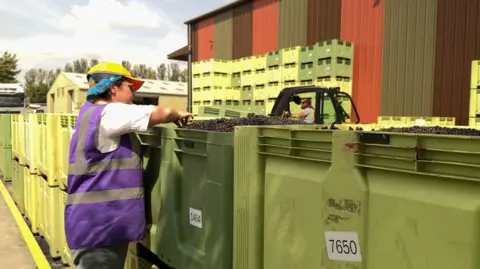
Donning hairnets and steel-capped boots, Prosser invites me to check out the latest delivery of boxes filled with currants.
"Each one contains about 500kg of berries," she tells me.
The plant will process 400 tonnes each day, or 10,000 tonnes over a harvest.
But there is good and bad news.
The bad news is the harvest will be down this year because of the challenges of a changing climate.
The good news is that some of the newer varieties - all traditionally named after Scottish mountains - have performed very well this year.
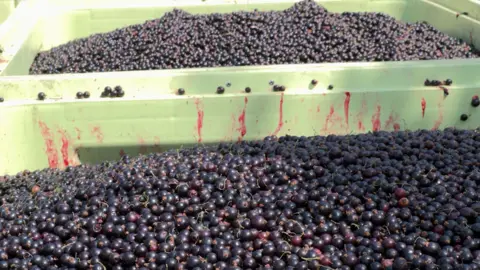
Those new varieties take time, so Prosser is also looking at ways to improve things now by tweaking farming methods.
"We are trying different ways to increase organic content in the soil so it acts like a sponge, holding more water and making those bushes more resilient to drought," she said.
At this time of year Prosser is usually focused on farming, but her role means she must also keep an eye towards the harvest - making sure the currants are the right quality, at the right time, and that they make good juice.
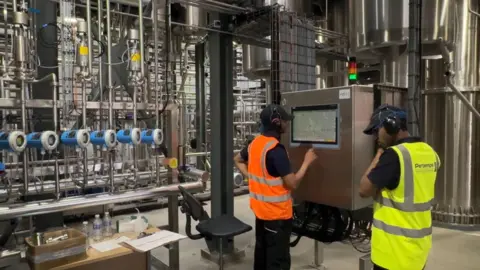
She takes me on a tour of the new juice plant, working flat out dealing with its first harvest.
The first thing you notice is the noise from the machinery and the second the amazing smell of crushed fruit.
That fruit is turned into a concentrate that forms the basis for Ribena, which is mixed and bottled at its factory in the Forest of Dean in Gloucestershire.
The concentrate also stores very well, so while this year there will be less thanks to climate change and the weather, supplies can be topped up with juice from the bumper harvests of 2024 and 2025.
"But the challenges of climate change are increasing" Prosser told me, "and we need to think long term about how we deal with that."
The hope is new varieties, along with adapting how the blackcurrants are grown - which means often working with farmers who have grown them for generations - will keep this new factory busy every harvest.
Follow BBC Hereford & Worcester on BBC Sounds, Facebook, X and Instagram.