Village's secret role in D-Day planning

 Burton upon Stather Heritage Group
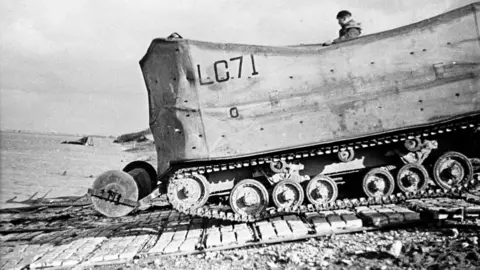
D-Day marked the start of the campaign to liberate Nazi-occupied north-west Europe during World War Two. It was the largest military seaborne operation and took more than a year to plan, with a tiny village in North Lincolnshire playing a crucial and secret role.
When I arrive in Burton upon Stather, there is little more than the sound of birdsong, the occasional car and the ripple of the river.
But, during World War Two, the silence of the village on the banks of the River Trent, just a few miles from Scunthorpe, was interrupted by squadrons of British and Canadian soldiers.
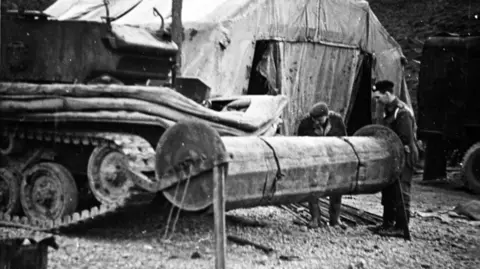
Their mission was to test amphibious Duplex Drive tanks that would be used in the D-Day landings, as the Secret Lincolnshire podcast has been hearing.
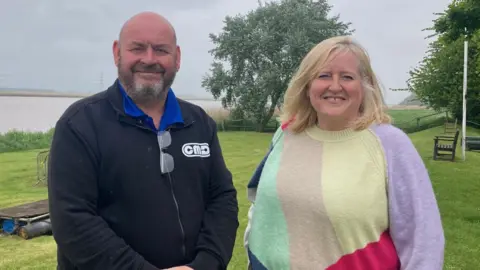
"They used this stretch of the Trent because the current was similar to the rivers that they thought would be crossed in the operation," says Craig Allison, from the Burton upon Stather Heritage group.
During that time, the village was transformed.
 Sally Fairfax / BBC
"There was camouflage on the roads and people were told to close their curtains when anything went up and down the hill," Karen Day, from the group tells me.
"It was as secret as it could be," adds Craig. "But everyone in the village knew."
Karen adds: "The soldiers were put up under canvas on the banks of the river.
"Sometimes officers and any special visitors stayed at Normanby Hall and there was a room apparently at the pub, which was useful as they had a phone there for communication."
The tank ramp is now on private land, about a third of a mile (500m) from the pub, where I meet them both.
The banks of the river, now green with grass and trees, were lined for a year with mess tents, as well as sites for ammunition and fuel.
"It makes me proud to know what a big part the village played," says Karen. "I suppose the residents took quite a big risk being in on the secret."
"I think it's important," says Craig. "It puts us on the map."
 Burton upon Stather Heritage Group
The presence of the troops made life a bit more exciting for children and young people growing up in the village, and it changed lives for some, who met and married soldiers who were stationed there.
Sally Robinson was interviewed by the heritage group in 2010. At the time of the ramp testing operation, she was 16.
"The streets were full of soldiers every night," she says. "My sister and I used to be in bed with the window open and soldiers would shout up: 'Anyone up there with you, sister?' Then my dad would shout: 'Get back in bloody bed!'"
 Burton on Stather Heritage Group
"There were dances at the village hall," Karen says.
"They nicknamed it the stage door canteen and there was always a cup of tea, a biscuit and a chat there."
Karen tells me the general had to call his soldiers in each night using a loudhailer, as they all got regular invites out for tea.
"I think they had a good war - a good 1944 anyway," she says.
Listen to highlights from Lincolnshire on BBC Sounds, watch the latest episode of Look North.
Download the BBC News app from the App Store for iPhone and iPad or Google Play for Android devices