Long Wave radio era set to end with switch-off

 BBC
BBCA campaign has begun to get two large transmitter masts listed, after the BBC's Long Wave (LW) service is turned off.
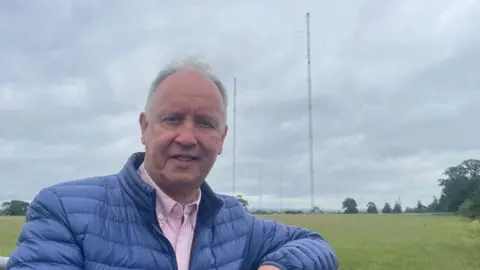
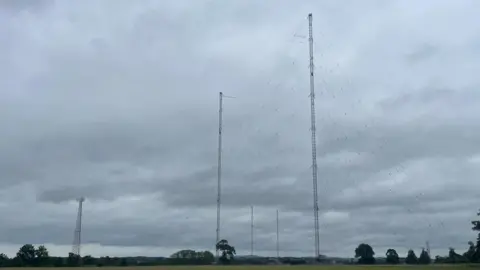
The 700ft (213m) high Wychbold Masts in the Worcestershire countryside can be seen for miles and are often used as a landmark for drivers on the M5 near Droitwich.
They have been in use since 1934 for sending the signal across the country, as well as for transmitting important messages during the World War Two.
Local history experts and the Twentieth Century Society have called for them to become listed, due to their "historical importance".
Droitwich was picked as a central location for the station and masts so Long Wave could reach everywhere in the UK.
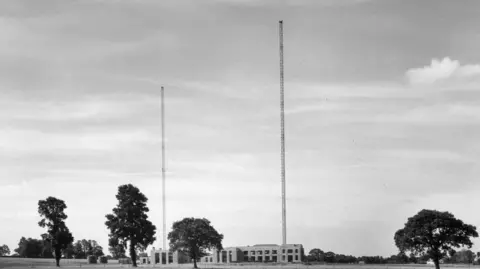
The construction was a big operation for the time and local expert Alastair Moseley, from the Bromsgrove Society, said a huge team of workers had to come and put them up
"It cost £200,000 to build then, that's about £20m now, which actually is quite a good value I think," he said.
"But the towers themselves were built by just 10 riggers and there was one particular guy, Derek Pigeon, who actually had just come over from building Sydney's Harbour Bridge."
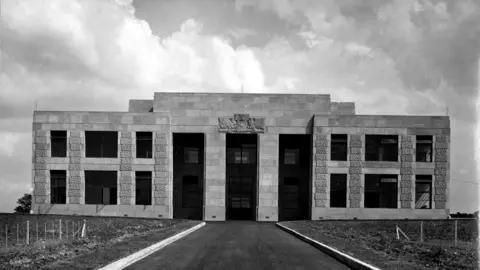
On the 6 September 1934 everything was ready to go, and the first thing the country heard on LW was a musical piece by composer Eric Coates, famed for the Dam Busters theme, called The Merry Makers.
A few years later, when World War Two started, the masts had a new job to do as Moseley explained.
"They were used to block transmissions and radar facilities from the Luftwaffe, so that they were almost blind when they were coming in to fly," he said.
"They also transmitted messages to the French Resistance, they had a part in that so it was very covert.
"And D-Day, they were part of the co-ordination of communications that were needed to make that such a successful landmark event in history".
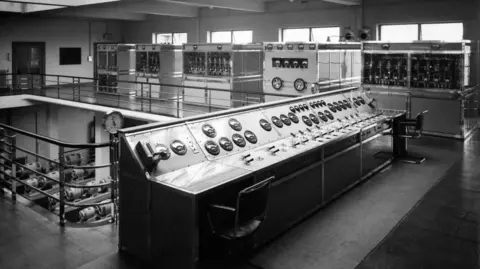
After the war, the transmitting station returned to its usual broadcasts.
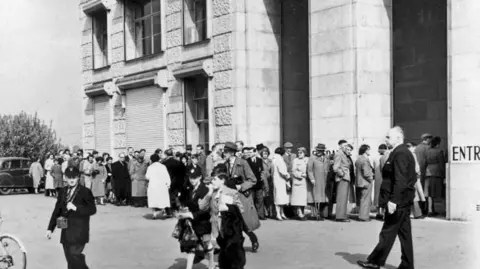
In 1957 officials held an open day but public interest was so high that 13,000 people turned up to take a look.
That led to other transmitting stations across the country having their own open days, particularly those with new TV masts.
 Droitwich Spa Heritage Centre
Over the years, the equipment was changed from analogue to digital and several other smaller masts were built for the Medium Wave signal.
The Wychbold Masts will no longer transmit LW with the switch-off expected at 00:01 BST on Saturday.
A spokesperson for the BBC said the move came as the equipment was reaching the end of its life.
"As Long Wave is an older broadcasting technology, recent years have seen a decline in listener numbers, with the majority now opting for FM and DAB digital platforms," they said.
"Given these factors, investing in upgrading the LW equipment is not considered a cost-effective solution for licence fee-funded services".
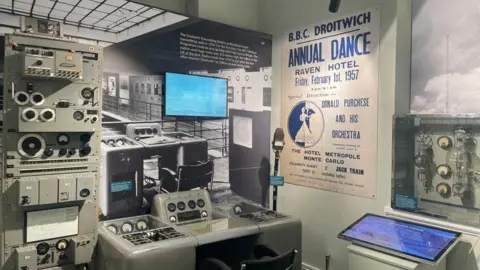
The transmitting station's history is captured in a special exhibition in the town's heritage centre, called Droitwich Calling.
Old equipment and photos were donated by former BBC engineer John Phillips, who worked there his entire career.
He wanted to make sure the masts' legacy continued and worked with the centre until he passed away.
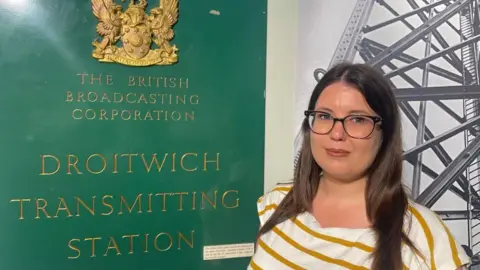
Manager Rebecca Butler said the exhibition was important to keep awareness of the masts' legacy alive.
"We're telling the stories of Droitwich Transmitting Station for future prosperity, we're holding onto these artefacts for the future," she said.
"There may be a time where those masts are no longer here, but for 92 years they have stood strong and I feel like it's something that we need to be proud of".
An event to remember and celebrate the history of the transmitting station is being held at the centre on Saturday from 12:00-16:00.
Historic England did consult on potentially listing the site in 2025 - but ultimately decided they did not meet the criteria, mainly because so much of the original buildings were demolished.
Granting a building listed status gives it special protection.
The Twentieth Century Society, who campaign to save "outstanding buildings" from the century, want the masts themselves to be specifically considered.
A spokesperson said they have broadcast such "national staples" as the World Service, the Shipping Forecast and Test Match Special, as well as their role in the war.
They should be listed "on account of their historic importance and architectural, engineering and technological interest"," they added.
But for Moseley, there is another idea for the site - a museum.
"If there was just some way of having a museum of some description on the site and maybe keeping parts of the towers, I'd love to see this as a national centre for broadcasting history," he said.
"That would be marvellous for the whole region"
The current site's owners, Arqiva, were approached for a response about the future of the Droitwich Transmitting Station.
Follow BBC Hereford & Worcester on BBC Sounds, Facebook, X and Instagram.