What is the water parasite cryptosporidium?

 Getty Images
There are thousands of cases of cryptosporidium across England every year but the health authorities say infections from the drinking water supply are "very rare".
In May 2024 an outbreak in and around Brixham, Devon, led to more than 140 confirmed cases, with four people needing hospital treatment.
What is cryptosporidium parasite and how dangerous is it?
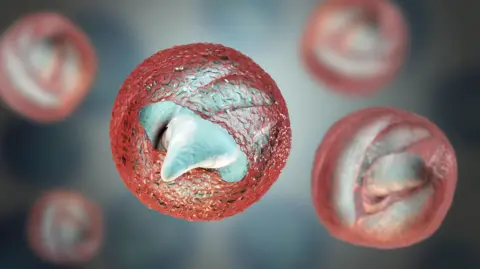
Cryptosporidium is a tiny organism that causes an illness in people and some animals, health officials say.
It is found in human and animal poo and can contaminate waterways, swimming pools, raw milk and fresh produce, the UK Health Security Agency (UKHSA) says.
Anyone can get infected and there is no effective drug treatment for cryptosporidiosis, with the main symptom being prolonged diarrhoea.
Prof Paul Hunter, a specialist in microbiology and infectious disease from the University of East Anglia, said most people recovered after a couple of weeks but it could be deadly for a small number of people with severely weakened immune systems.
He said most people would not need to see a doctor unless they were seriously unwell or a child.
 Alamy Live News
Where was it found in Devon?
"Small traces" of the parasite were confirmed in the water supply in and around Brixham, south Devon, during an outbreak in May 2024.
South West Water issued an urgent boil water notice to about 40,000 residents following positive samples.
Advice not to drink tap water without boiling it first remained in place for 54 days for some properties, before it was finally lifted on 8 July 2024.
South West Water pleaded guilty to supplying water unfit for human consumption in March 2026, offering a "full and unreserved apology".
On Tuesday, the firm was fined £1.853m when Judge Stuart Smith told the court it had been "a major public health incident" in which "disruption to daily life was extensive". He said the harm had been "wide-ranging and profound".
How significant was the outbreak?
There were 143 confirmed cases of cryptosporidium associated with the Devon outbreak but the true number of cases is likely to be "substantially higher", said Dr Beth Smout, Interim Regional Deputy Director of Health Protection at UKHSA.
"We know there were more people who reported symptoms, not everyone got tested, so the true scale is likely to be larger," she said.
"This was a very significant outbreak, both in terms of its scale but also in terms of the impact on local residents, businesses and the community."
Is drinking water the only source of outbreaks?
Cryptosporidiosis affected about 4,000 people in England in 2025, according to the latest available data.
"Outbreaks of cryptosporidium linked to drinking water are very rare," said Smout.
"It's a parasite that tends to be carried by animals, so infections are largely caused by interactions with farm animals, people visiting petting farms for example," she added.
Hunter, who sits on a World Health Organization committee on drinking water quality, said outbreaks were less common these days after new laws were brought in forcing UK water companies to do more testing for cryptosporidium.
However, he said data on outbreaks was no longer regularly published.
"It is often difficult to know how many outbreaks we are seeing," he said.
"Drinking water isn't the only cause of outbreaks, we see outbreaks in swimming pools quite often, there have been outbreaks associated with drinking unpasteurised milk, and we see outbreaks in nurseries."

What should you do if cryptosporidium is found in your area?
During the outbreak in Devon in 2024, thousands of residents were advised to boil their water before using it for drinking, cooking, preparing food or brushing teeth.
People are also advised to thoroughly wash their hands with soap and warm water before handling food and after going to the toilet or touching animals, the UKHSA said.
Cryptosporidiosis is "highly infectious" and those who have symptoms should wash their clothes on the hottest possible setting and not share towels with anyone, according to the guidance.
People with the illness should not go swimming for at least two weeks after the diarrhoea has stopped.
What are the symptoms of cryptosporidium?
According to government advice, the main symptoms of cryptosporidium include:
- profuse watery diarrhoea
- stomach pains
- nausea or vomiting
- low-grade fever
- loss of appetite which can lead to dehydration and weight loss
Symptoms are similar to other stomach bugs and the only way to confirm the illness for sure is by a doctor sending a sample of your faeces to be tested in a laboratory, according to health officials.
How do you treat cryptosporidium?
There is no specific treatment for cryptosporidiosis, according to the UKHSA.
It advises that most people with a healthy immune system will recover within one month, adding that it is important to drink plenty of fluids as diarrhoea or vomiting can lead to dehydration and you can lose important sugars and minerals from your body.
Follow BBC Devon on X (formerly Twitter), Facebook and Instagram. Send your story ideas to spotlight@bbc.co.uk.