WW2 Dad's Army 'protecting the nation' on the water

 Royal Berkshire Archives
On 3 September 1939, Britain and France declared war on Germany after it invaded Poland, officially marking the start of World War II in Europe.
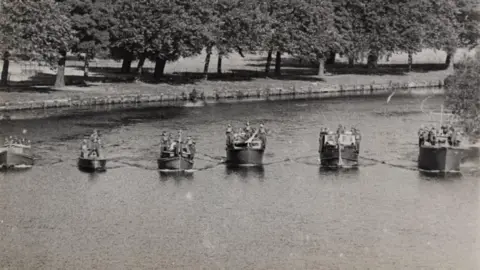
Back on home soil, a unique waterborne division of the Home Guard was formed to protect the River Thames from enemy invasion and sabotage - the Upper Thames Patrol (UTP).
Affectionately known as the Home Guard Navy, its members actively patrolled and guarded locks, reaches and towpaths along the river, from Teddington in Greater London to Lechlade in Gloucestershire.
Formed by Sir Ralph Glyn, UTP's headquarters were based at Yeomanry House in Reading, making the Berkshire stretch a central hub for their river monitoring.
Radio Berkshire's Sophie Drew met Ellie Thorne, from the Royal Berkshire Archives, at Sonning Lock to find out more about this crucial group of volunteers.
When WW2 broke out more than 85 years ago, the river became a vital line of defence, stretching for more than 100 miles through towns and villages across six English counties.
"It's a natural barrier between the South East and the rest of the country," said Thorne.
"One of the Germans' key plans was to try and capture the bridges over the Thames and therefore have control of the river before it gets into London."
Britain was worried about invasion after thousands of Allied soldiers, trapped in northern France by advancing German forces, had to be evacuated from the beaches and harbour of Dunkirk in May 1940, said Thorne.
Around Britain, local defence volunteer groups were set up, including the UTP.
 Royal Berkshire Archives
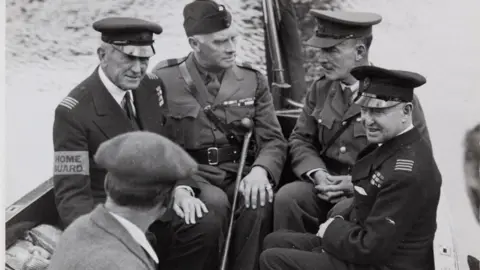
Many lock keepers and others who worked for the Thames Conservancy, the body responsible for the management of the Thames, were reservists, so were among the first to be called up to serve in the Armed Forces in 1939.
So Sir Ralph, a Thames conservator, called for local watermen, civilians and sea cadets to form the waterborne defence unit.
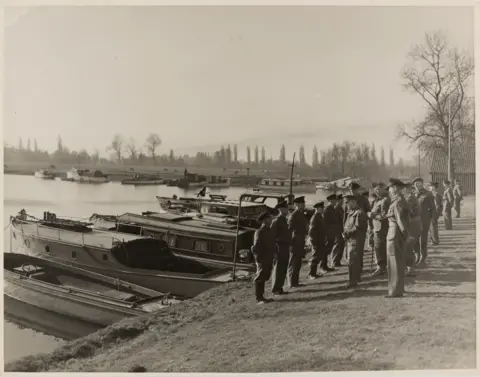
The UTP patrolled the river mostly in boats, privately-owned by people who lived along its banks and "had a lot of knowledge of the Thames already", said Thorne, as well as foot patrols along the towpath.
At least two members of a boat's crew "were likely to have been armed" but women and teenagers would also have been on board and were not allowed to carry weapons, she said.
"They were having to make sure there weren't any boats with enemy spies on them or anybody sending out radio messages but they were also there to look after the locks and to patrol the river generally. They were very, very busy.
"Most people would have gone and done a full day's work and then come and done several hours on the river in the evening.
"They were expected to do seven-and-a-half hours work a week but many people did much more than that."
 Royal Berkshire Archives
Most of the women in the UTP joined in 1939, before it was formally absorbed as a branch of the Home Guard, said the archivist.
"Once the Home Guard was formed in 1940, they actually tried to get rid of these women, they told them they were no longer welcome to work on the UTP, but they refused to go so that's why we still have women involved right until 1944.
"Unfortunately, they weren't allowed to wear a uniform, they tended to make their own uniform and they would embroider their own UTP badge on to it as well.
"They played an important role but weren't maybe recognised in quite the same way the men were."
Why did some of these women fight to stay on with the unit?
"I think some would have been boat owners, they already felt very much a connection with the river and a connection with the job they were doing," Thorne said.
"They didn't want to give that up and they thought they were doing something important."
 Royal Berkshire Archives
The UTP was disbanded in November 1944, when the threat of invasion had reduced, with some of the unit's members continuing to help out on the river.
"It's interesting to think if people would actually know about the Home Guard if we didn't have [BBC television show] Dad's Army," said Thorne.
"It would be lovely if more people knew about the UTP because it's important to remember these people who played their part in the war.
"Most of them would have loved the river, they would have loved being on it. That's possibly what they did it in their spare time but there was added incentive, obviously.
"They wanted to protect the country and this is their way of doing it. These were people who were going about their ordinary lives but they also felt they had a task to do and they needed to protect the nation."