Britain's oldest avocet spotted at nature reserve

 Justin Coleman
An avocet spotted at an RSPB nature reserve in the West Midlands has been confirmed as the oldest of its kind ever recorded in Britain.
The distinctive black and white wading bird, identified at RSPB Middleton Lakes in Staffordshire, is now 36 years old - more than five times the species' average lifespan of about seven years.
The birds were once rare to the point of extinction in the UK, being lost as a breeding bird during the 1840s, with the RSPB being integral to its recovery.
The sighting was a "fantastic moment," said James Robinson, the organisation's chief operating officer, adding the bird "symbolises hope and the incredible recovery that is possible when people come together to help wildlife".
The RSPB said the bird had been ringed as a nestling at its Titchwell Marsh reserve in Norfolk on 2 July 1990.
The slender wading bird, with distinctive upturned beak, features as the RSPB's logo and "represents what nature conservation can to for threatened species," said the organisation.
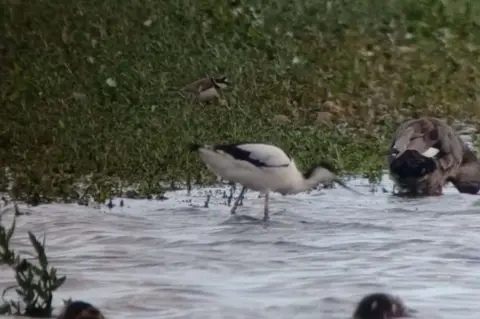 Steve Pick RSPB Middleton Lakes
It had been spotted at the reserve, a former gravel extraction site, close to the border with Warwickshire.
The bird was identified using its unique combination of different coloured rings.
The British Trust for Ornithology (BTO), which coordinates bird ringing across Britain, confirmed the age of the bird using historical records.
Jon Carter, of the BTO, said: "Ringing data makes a major contribution to the study of population changes and to our overall understanding of species declines.
"Thanks to the dedicated efforts of volunteer ringers we can learn so much, and this information helps us steer conservation and policy decisions."
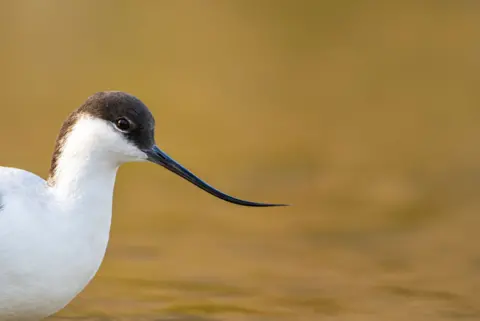 RSPB/Ben Andrew
"It seems an extraordinarily long time for a relatively small bird to live," said Josh Jones, editor of Birdguides.com and Birdwatch magazine.
The bird had broken the British record for the oldest avocet, "set by exactly the same bird when it was last seen a few years ago," he said.
It was previously identified at Titchwell Marsh in 2022, when it was 31 years old and was already the oldest known avocet recorded in Britain.
Before then, the record for the species stood at 27 years.
Now, after another four years, the bird has extended that record again.
"So it's a remarkable, remarkable bird," Jones added.
"And it just goes to show that with the right conditions and if these birds can can become wily and streetwise and learn to survive and know the sites, they can really live for a long time."
Symbol of resilience
By the 1840s, the species had disappeared as a breeding bird in Britain after widespread drainage of wetlands for agriculture and development.
Its return began more than a century later, when four breeding pairs settled on the Suffolk coast in 1947 at what would later become RSPB Minsmere.
The RSPB has detailed how, after World War Two, soldiers slept "top-to-toe in a tent" guarding the precious breeding birds in a secret mission codenamed Operation Zebra.
Avocets have bred there every year since 1963, and here are now an estimated 1,950 breeding pairs and 8,700 wintering birds in the UK, compared with just four breeding pairs in the late 1940s.
The record-breaking avocet is evidence of both the resilience of wildlife and the success of long-term conservation efforts, added Jones.
"It is wonderful to think that despite all the adversity birds face, and the pressures wildlife faces from humans, they can be extraordinarily resilient," he said.
"You wonder how many chicks this bird might have parented over the years. It's remarkable, really."
Follow BBC Stoke & Staffordshire on BBC Sounds, Facebook, X and Instagram.