Burnham faces criticism over plans for mayors to get share of income tax

 Reuters
The government is facing criticism over its plan to allow regional mayors to keep a share of income tax and business rates in England.
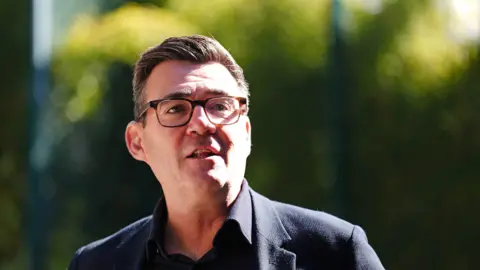
Andy Burnham says that the proposals, expected to be phased in from next April, will give metro mayors powers to invest the money in their communities for public services.
The prime minister said on Friday that this amounted to "the biggest shift of power out of Whitehall and Westminster" to regions across the UK.
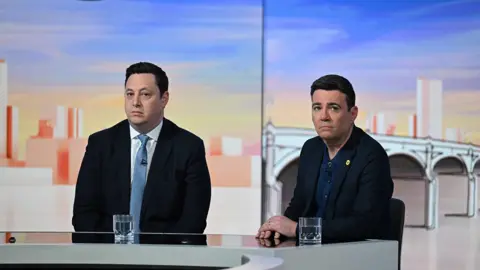
But Lord Houchen, the Conservative mayor of Tees Valley, argues he should be able to offer taxpayers a rebate instead, while opposition parties say the plans could lead to areas with weaker economies losing out.
"The prime minister has said he wants to alleviate the cost of living [crisis] and give people room to breathe - what better way to do that than allow them to keep more of their own money?" the Tory mayor told BBC Radio 4's World at One.
First Secretary of State Louise Haigh told the BBC that there was not currently a mechanism in place for mayors to offer a rebate.
But Lord Houchen said it was "not beyond the wit of man" to create a system, adding it would not be "overly complicated" and would not be particularly controversial.
"I think the prime minister and what this government is doing on fiscal devolution is a move in the right direction, but for it to be real devolution we've got to have local decision-making and choose what's best for the people we represent."
Burnham later directly rejected the idea of mayors giving their taxpayers rebates, telling reporters the plans were not about making local leaders into "mini-chancellors of the exchequer, undermining or rewriting policy on tax and personal finance".
As it stands, mayors of English strategic authorities receive most of their funding by central government grants.
Mayors are expected to start retaining some revenue from business rates from April 2027 and receive a portion of income tax from April 2028.
The rates of income tax will not change as a result of the reform.
Burnham, the former mayor of Greater Manchester, has made devolution a centrepiece of his agenda in the early weeks of his premiership.
He said this policy would "make good" on his pledge to "bring power home" to "every postcode in the country".
Chancellor John Healey will set out more of the detail when he delivers his first Budget on 28 October.
'Two-tier system'
Tracy Brabin, the Labour mayor of West Yorkshire, said that giving regions like hers a proportion of income tax would mean "people will be able to see and feel the real benefit of their hard work and where that money is going".
Richard Parker, the Labour mayor for the West Midlands, described the plans as "phenomenal", adding: "It really is a sea change, it's monumental."
But some within the Labour Party have voiced concerns.
Labour backbencher Sean Woodcock, MP for Banbury in Oxfordshire, said he supported the plans but said there was still the need for redistribution from central government in order to help poorer areas.
"If you want to close the gap between the areas that are affluent with the ones that are less so, the ones that are less so need more support, more help, and that means redistribution, frankly, from the centre," he told BBC Radio Oxford.
"That's not part of the package that's been announced. In fact, some grants have been talked about being got rid of.
"While this does have the potential to benefit a number of areas, frankly a lot of areas will see minimal benefit."
Perran Moon, MP for Camborne and Redruth in Cornwall, told the BBC the government's plans were "discriminatory" and could create a "two-tier system".
He said his area would never have a mayor or become a combined authority and so risked not having access to devolved powers that other areas would have.
"What we're asking government to do is to provide us with the same powers, the same funding that mayoral combined authorities have without the requirement of becoming a combined authority or having a mayor."
Conservative shadow chancellor Sir Mel Stride said Burnham's announcement was "very short on the detail" with "no new money being announced", which could mean areas with weaker local economies could end up losing out.
The Liberal Democrats warned the plans risked "creating a postcode lottery" that would leave millions of people living in rural areas "short-changed and underfunded".
Reform UK home affairs spokesman Zia Yusuf said the prime minister should "fully devolve the power to stop the housing of illegal migrants in local communities by the Home Office".