Dog owner wants change after plant poisoning

 BBC
BBCA dog owner says she had to pay thousands of pounds for treatment when her pet chihuahua nearly died after eating a common garden plant.
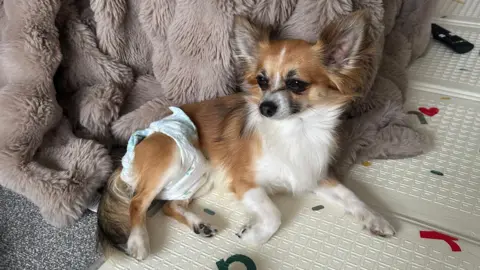
Caitlin Roberts has launched a petition calling on the government to make toxicity labelling mandatory on plant sales, after her dog Cooper became seriously ill and needed surgery in May.
The 18-month-old canine was thought to have eaten a hosta, a plant available from many high street shops and garden centres but which is toxic to dogs.
Roberts claimed she spent £9,000 after toxins in the plant did not show up on blood tests. An X-ray eventually revealed a blockage and Cooper had emergency surgery on his gut and intestines.
The blockage was down to undigested food building up, due to the dog's intestines being temporarily paralysed from the plant's toxins, Roberts said she was told by her vet.
The 25-year-old, from Tamworth, Staffordshire, currently on maternity leave, said she was unable to claim the costs back through her insurance.
Roberts added she had just switched providers and was not eligible and her family had to use their savings to help her.
 Caitlin Roberts
"[Cooper] spent days in pain because we couldn't find an answer," she said. "How do you forgive yourself for that?
"They're not just dogs, are they? They're like your babies.
"I love him the same way I love my daughter, exactly equally. This one just has fur."
 Getty Images
Cooper will now have lifelong complications and have to eat specially adapted food following his operation, she said.
Her Change.org petition, signed by more than 500 people, is calling for all plant suppliers in the UK to signpost whether a plant is toxic to cats and dogs and to include the Animal PoisonLine number on the label.
"It's such an easy fix," she said. "I'm not asking for a million pounds to change the world.
"I'm just asking for a little bit of writing on a label upon purchase to save our little fur babies."
Hostas are described by the Royal Horticultural Society as "one of the best foliage plants" and easy to grow but animal experts say they are toxic to dogs and cats.
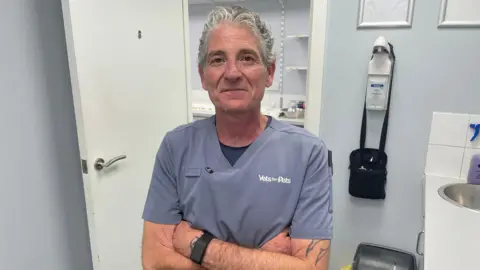
Cooper was treated at Vets4Pets in Sutton Coldfield where practice owner and vet Gabriel Wax said many owners did not realise common household plants could harm dogs.
"Lilies, daffodils, tulips, there's a variety of them," he said.
"It's very difficult to have a complete list of all of them because there is far too many.
"I think we should be a bit more aware of what we have in the garden and what we have in the kitchen for our pets."

The Dogs Trust said plant-poisoning cases were relatively rare and have not risen recently.
But the charity regularly gives advice to pet owners through its website on how to keep their furry friends safe and well, including on common plants such as mistletoe, lavender and geraniums.
Tristan Smith, a vet nurse manager for the charity, who often works in Kenilworth, Warwickshire, said people should try to teach their dogs what was acceptable to play with.
"Do your research [and] keep an eye on your dog in the garden," he said.
"If there are any concerns and you think your dog's eaten anything, call the vet and they will be able to advise you further."

Birmingham-based labelling software company Kallik works with some of the biggest companies in the world, including Kenvue, which makes Listerine.
"A lot of people probably don't realise the label is what really keeps you safe," said their chief executive, Gurdip Singh.
"It tells you how to use a product, what it should be used for [and] the health hazards around it as well."
Singh said he thought mandatory labels for plants were a "fabulous" idea to keep pets safe, pointing to recent changes in human allergen labelling as a precedent.
"In terms of feasibility [it's] very doable," he added. "Companies around the world work to strict regulations [and] have systems in place.
"This is just about putting further information onto the label to enable the consumer to be better informed."
The government declined to comment specifically on the issue of plant labels and the petition, after being approached by the BBC.
A spokesperson instead said they published codes of practice for the welfare of dogs and cats for owners.
Follow BBC Stoke & Staffordshire on BBC Sounds, Facebook, X and Instagram.