'We suncream apples' - how heatwaves are affecting farming

 Leanne Rinne/BBC
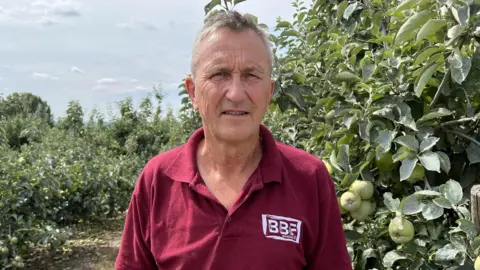
Clive Baxter is in charge of farming about 200 acres (81 hectares) of fruit trees but he says "everything is suffering now in the heatwaves".
"Bramley apples are very susceptible to sunburn so we are spraying them with a clay substance that acts like suncream."
Baxter, from Amsbury Farm, near Maidstone, says traditional English fruit, like Bramley apples and Coxes, do not do well in hot weather.
"Once the temperature gets to 30 degrees and above, if there is no wind, the juice starts to boil in the apples and cooks the fruit.
"When this happens it means the fruit is of no value at all."
He says the heat has forced them to start "thinning" apple trees because the trees are "so stressed", which means lower yields and smaller apples.
 Leanne Rinne/BBC
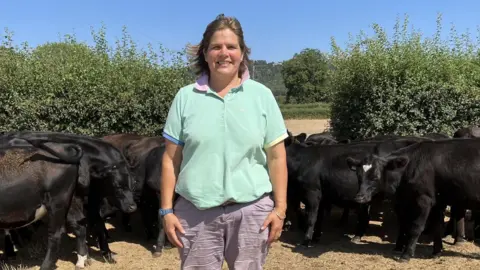
Cattle farmer Nellie Budd has 247 cows on her farm in Brockham, Surrey. She says her "biggest worry" during the heatwaves is trying to find food for the cows to eat.
"We have had 47 days now with no rain. Grass normally is so resilient, once we cut it for hay or cut it for silage it will come back and we can continue grazing, but, this year, with the heat, there has been no let up."
Budd says she is now feeding the cows hay, which is their winter food supply.
"With limited food to eat, the carcasses are just not getting big enough which means they are not going to be the size for what we want because they are beef cattle."
She says reducing their cattle numbers is not an option because then her family "could not afford to live".
"We have been putting an overlay in our grasslands to try and help but, this year, with no moisture in the ground, we couldn't do anything.
"Everything is a gamble for farmers and we just hope weather patterns cause a wetter year next year," she said.
 Leanne Rinne/BBC
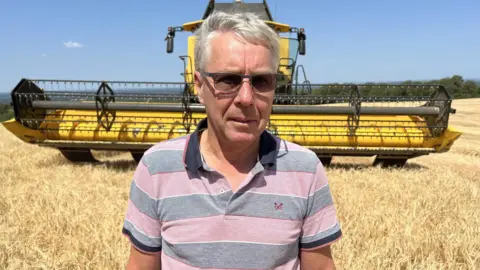
Peter Knight is an arable farmer and contractor and is currently harvesting about 2,000 acres (809 hectares) at Woolgars Farm in West Horsley.
He said the problems for arable farmers started during the first heatwave in May.
"Spring barley, which is used for making beer, is planted in March and it has had very little rain on it since then," he said.
"The crops flower in early June but, at that time the heat puts it under stress, which means we immediately know the yield is going to be impacted."
Knight said throughout the whole of the grain-filling period there had been no rain at all.
"We are very worried because three out of the last five years we have had very similar weather patterns in terms of drought-like conditions and trying to manage our way through that is very difficult."
He said irrigation for arable farmers is not a feasible option because of the scale involved.
"We are doing our best by trying to sow earlier in the spring and we are doing less cultivations which helps preserve moisture but this year the yield here is reduced by around 30-40% on what we would normally expect."
He said if the heatwave conditions continue to impact arable farming in this way the country "will end up importing more".
Follow BBC Surrey on Facebook, on X, and on Instagram. Send your story ideas to southeasttoday@bbc.co.uk or WhatsApp us on 08081 002250.