Cat spent decade living in tunnels under castle

 Historic England
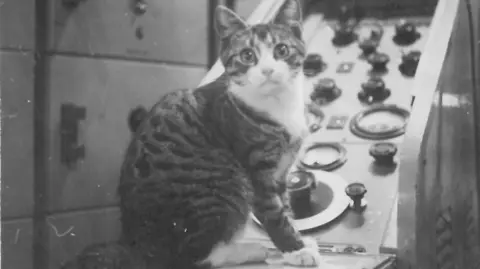
A cat that spent 10 years living in the tunnels beneath Dover Castle arrived there in 1948 to catch mice but ended up having a pampered life.
Curators said Tosca, whose full name was Toscanini, remained underground until 1958 and was known for stealing food, causing mischief and avoiding the seagulls that terrified him.
Tosca lived in a vast network of tunnels beneath the castle, some of which played a key role during World War Two, Secret Kent has heard.
Hattie Hartly, visitor assistant for English Heritage at Dover Castle, said he was spoiled with treats and "well-loved".
"There were no other animals on site. I think it was very nice for everyone to have him down there," she said.
"He also was a little bit of a trickster, so he was well known on site for things he liked to play.
"He never went outside, because whenever he did, he would be attacked by seagulls, so he spent all of his time inside causing mischief."
One of the lasting anecdotes passed down about Tosca is an account of him stealing a joint of beef intended for Christmas dinner.
Hattie said: "He was seen marching off through the tunnels with that, and he was quite ready to steal sausages from people's plates."
During Tosca's time underground, the tunnels were operated around the clock by the General Post Office (GPO) as a communications centre.
Military and civilian staff working there were thought to have supplemented Tosca's diet, despite his official role as a mouser.
Gavin Wright, visitor assistant for English Heritage at Dover Castle, said some tunnels dated back to the 18th Century and were repurposed in the 1930s, before being used extensively in the war.
He said: "The whole of the Dover district has got a honeycomb of tunnels and caves and passages from all sorts of different periods, so it wouldn't surprise me if there are places that are not fully explored."
Grace Parsonage, assistant curator at Dover Castle, said Tosca had a happy ending when a worker adopted him after the site switched from 24-hour operation to day shifts.
"It took him a little while to get used to being outside because obviously he was not overly keen on seagulls, but he lived a really happy life," she said.
She said Tosca was 17 when he died, adding: "We've got some beautiful photos in our archive of him being cuddled by family members, and there's a brilliant story of him being pushed around in a pram."
Follow BBC Kent on Facebook, X, and on Instagram and listen to BBC Radio Kent on Sounds. Send your story ideas to southeasttoday@bbc.co.uk or WhatsApp us on 08081 002250.