Forgotten battle saw Blackshirts driven out of Hull

 Sally Fairfax/BBC
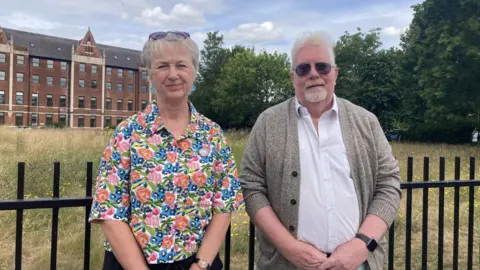
Behind a modern shopping centre stands a patch of ground where wild flowers and tall grasses grow. But on this peaceful spot 90 years ago, thousands of people gathered to drive the leader of Britain's fascist Blackshirts out of town.
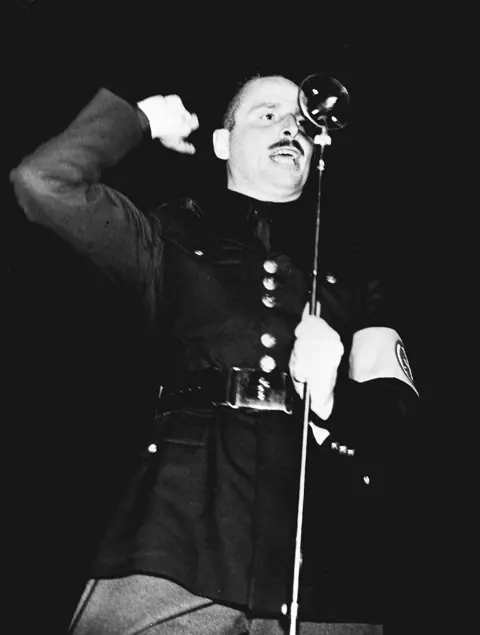
Sir Oswald Mosley was head of the British Union of Fascists (BUF), a militaristic movement that drew inspiration from Italian dictator Benito Mussolini and Nazi Germany.
On 12 July 1936, he came to Hull to rally support at a site called Corporation Field, off Park Street, which was often used for public events and fairs.
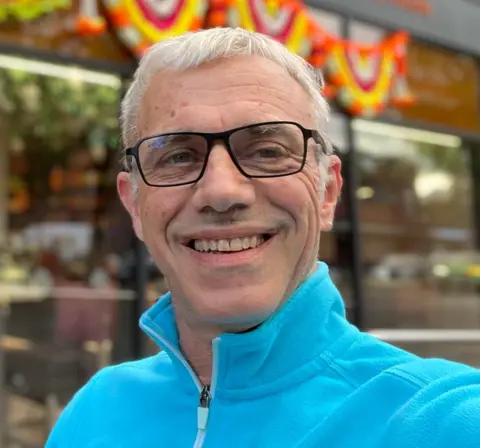
Mark Krantz, who has written a book about the BUF and its opponents, says Mosley blamed Jewish people "for everything".
"Mosley wanted a dictatorship in Britain and he was very open about that," he tells the Hidden East Yorkshire podcast.
Today, the event, known as the Battle of Corporation Field, is largely forgotten, but it happened just months before the famous Battle of Cable Street, when protesters clashed with members of the BUF in the East End of London.
Hull's corporation (now the council) blocked Mosley from using public buildings, so his supporters headed to Corporation Field.
Mosley and his men were dressed in the black uniforms inspired by Mussolini's Italian militia, also known as Blackshirts.
"They marched down Park Street to the sound of drums," says Paul Power, of the Hull and East Yorkshire Stand Up To Racism group.
According to Power, Mosley was jeered by the crowds, but when the noise died down he approached the microphone, only to find it was broken.
"It transpired, in a letter to the Hull Daily Mail later that year, that two boys had been paid in ice-cream to cut the wires."
According to a report in the newspaper on 13 July, when Mosley eventually spoke, he said he was "going to put the case for fascism" and said his socialist opponents, whom he described as "Red hooligans", were "frightened" to hear his case.
Power says: "There was fighting in the crowd, missiles were thrown and, after 30 minutes, Mosley began his retreat.
"The drums continued and Mosley's men marched towards Anlaby Road, with Mosley in his car.
"The crowd followed, filling the road, filling the pavement, and as Mosley's car reached the bridge near the junction with Anlaby Road, the side window was broken."
 PA News
The Hull Daily Mail report described "violent scenes", "stone throwing" and "free fights".
"Many people were injured, including several Blackshirts, who were afterwards treated for their hurts at an Anlaby Road garage where their cars had been parked," the reporter wrote.
Tony Collins, a professor of history at De Montfort University, says there was a heavy police presence at the event.
"At least one person was arrested for accidentally attacking a plain-clothed policeman," he says.
"The chief constable at the time said it was the duty of his men to allow Mosley and his men to meet."
The political picture in 1936 was feverish. In March, Adolf Hitler ordered German forces to reoccupy the Rhineland, which had been demilitarised after World War One, while in May, Italian forces completed the conquest of Ethiopia.
"Days after Corporation Field," Collins says, "the Spanish Civil War broke out."
 Mark Krantz
Krantz argues that the Battle of Corporation Field, and other events like it, held Mosley back.
In October 1936, a series of clashes, known as the Battle of Cable Street, took place between the BUF and opponents in the East End, which was home to a substantial Jewish population.
Three years later, on the outbreak of World War Two, Mosley was interned and his movement died out.
Wendy Dobbs, from Hull, says those who protested at Corporation Field remembered the event with pride. Her grandfather was among them, along with his brother and his wife.
"I remember him telling me is that he was so proud of what they'd done."
Power says the Battle of Corporation Field is "hidden from history".
"It's amazing that 10,000 people turned out and stopped Mosley from speaking in Hull," he says.
"Everyone's heard of Cable Street, but before Cable Street there was Hull, when we showed that fascism isn't welcome here."
Listen to highlights from Hull and East Yorkshire on BBC Sounds, watch the latest episode of Look North.
Download the BBC News app from the App Store for iPhone and iPad or Google Play for Android devices