Railway told to replace 'flagmen' at road crossings

 Mark Lewis
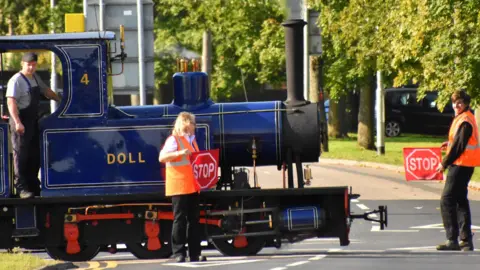
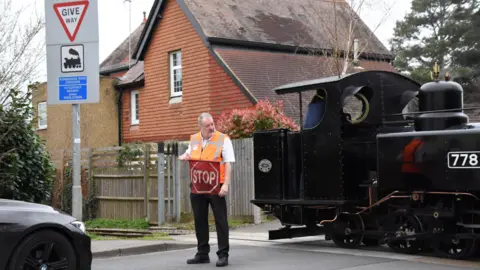
A heritage railway is getting rid of its volunteers who hold "stop" flags where trains cross public roads and replacing them with flashing lights.
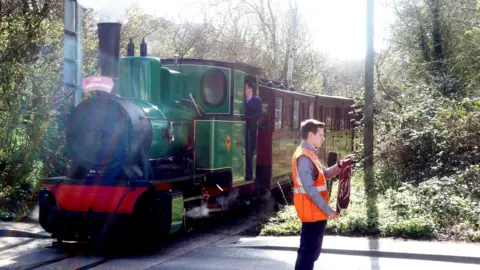
The Leighton Buzzard Railway, in Bedfordshire, opened in 1919 to serve quarries, and has used "flagmen" along its three-mile route.
It said it was served with improvement notices from the Office of Rail and Road (ORR) meaning it must now install "Wig-Wag" colour light signals at three road junctions.
Ian Hale, the railway's operations manager, said although some volunteers see it as a "loss of tradition, health and safety has to be the prime mover".
 Leighton Buzzard Railway
The railway, managed and operated by volunteer members of the Leighton Buzzard Narrow Gauge Railway Society, is a non-profit organisation with charitable status.
Originally built to primarily transport sand, and it gradually become a passenger and heritage line service. It is based at Page's Park and the line runs to the Stonehenge Works and Munday's Hill.
Hale told Andy Collins on BBC Three Counties Radio that when the line opened after World War One it was "considerably more rural than it is today".
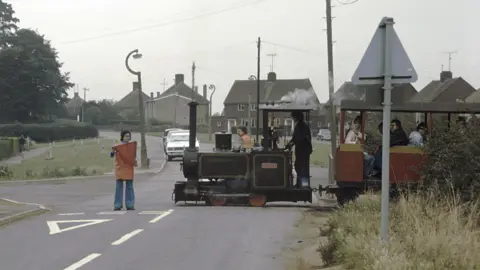
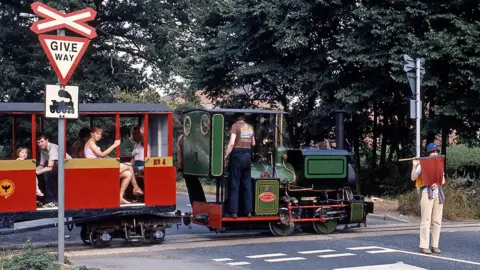
"There were only three roads the line had to cross - from Heath and Reach down to Page's Park - and they were given permission for the guys on the train to hop out, stop the cars, or carts, with flags and let the train go through," he said.
He said that right had continued and, although the train now had to cross six roads, it only needed flag wavers at three locations.
He said no-one had ever been hit, but some motorists did get "disgruntled" and try to slip past.
 Chris Grimes
The ORR said: "Given the increase in road vehicle use over recent years following various local developments, our inspector was of the opinion that additional measures were required to ensure the railway meets its obligations under health and safety legislation to minimise the risk of harm so far as is reasonably practicable."
 Chris Grimes
The trains have three locomotive crew members and two guards.
"One of the loco crew and the assistant guard, they hop out and hold the flags," Hale said.
"The biggest reaction from a lot of the volunteers is 'it's a loss of tradition; we're a heritage railway; we've been modernised'.
"But health and safety has to be the prime mover, so we haven't any choice."
He said the improvements were due to cost up to £130,000 and would be paid for from its reserves.
The charity said it was full steam ahead to install the new lights in a few months' time, but it "could take some time to complete".
 David Barrow
Do you have a story suggestion for Beds, Herts or Bucks? Contact us below.
Follow Beds, Herts and Bucks news on BBC Sounds, Facebook, Instagram and X.