Shark species changing due to warmer waters

 Andrew Alsop/Whitewater Charters
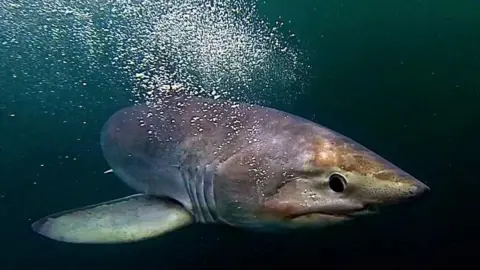
Scientists say different species of shark are becoming more common in southern waters because of the rise in water temperature.
Bryce Stewart of the Plymouth-based marine research charity Marine Biological Association said some species were moving north into warmer waters around the Channel Islands and the South West because their prey was doing the same.
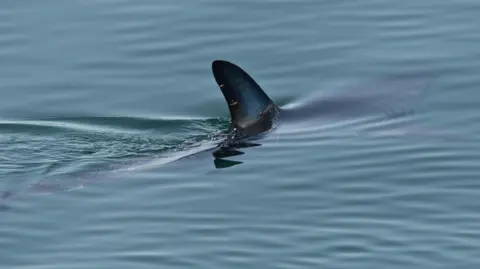
Lifeguards asked people to leave the sea after a 10 to 12ft (3 to 3.36m) long, dark grey shark was seen off a beach in Jersey on Saturday.
Alex Plaster, from Jersey's marine resources team, said there had been "rare sightings of the larger sharks like shortfin mako, porbeagle and blue sharks" in the waters off the Channel Islands but the chance of anyone being bitten or attacked by a shark "was effectively zero".
 PA Media
Plaster said there had never been a reporting of anyone being bitten by a shark "in the whole English Channel area, let alone in Jersey itself".
"The species that you read about online like bull sharks and great white sharks that have, these have been incidents around the world and we've never had a confirmed sighting of one of those in our area."
But Stewart said one-off sightings of other sharks were relatively common.
He said: "I think we always get these one off sightings, occurrences like with the smalltooth sand tiger shark that got washed up in the Channel Islands, and a sighting of a large shark, which could be many things.
"It could have been a basking shark, but it could have been another smalltooth sand tiger shark or it could have been a blue shark or a porbeagle.
"These kind of sightings will always happen, especially with large animals that can swim a long way, as they get in a certain current system or weather system than where they normally are."
Plaster said there had been 14 different shark species recorded in Jersey during the last 100 years, most of them measuring between 1 to 2ft (0.3 to 0.6m) long and larger ones between 5 to 6ft (1.5 to 1.8m) long.
"It really is quite a diverse bunch that we have in Jersey's area and the surrounding Channel Island waters," he added.
 Andrew Alsop/Whitewater Charters
He said the warmer sea temperatures in winter were having a "huge effect" on marine life.
"More recently, we've been seeing new species in greater abundances, it might be things like gill-head breams, stingrays and some have put bluefin tuna down as a species that's reacting to warming waters around the world and changing predator-prey relations," he added.
Stewart said warmer waters and changes to the availability of prey had lead to both the increase in bluefin tuna in the region and shark species.
"Here off the south west coast we've seen this increase and that really is only explained by shift in their migration patterns," he added.
He said a three-year project with the University of Exeter was studying sharks to learn more about them.
He said: "One of the things we think is happening, and we have quite good evidence for this, is the blue sharks are actually pregnant when they're here and they give birth somewhere off the south west coast of the UK.
"So almost all of the sharks that are seen off the south coast are female.
"So the theory is they are moving to these marginal waters, while they're pregnant, so they can avoid the males.
"During the matings the males are quite violent to the females and the males eat the pups when they hatch.
So, this is just a theory at the moment, but this could be a safe zone for them, it's like a maternity ward, basically."