Controversial farm subsidy scheme gets billion pound budget

 Chris Jackson/Getty Images
Funding for Wales' controversial new farm subsidy scheme will exceed a billion pounds during this Senedd term, the Welsh government has announced.
Setting a budget spanning several years to help farmers plan ahead was one of Plaid Cymru's promises for its first 100 days in power.
But the offer of £340m a year is roughly the same as farms have received since 2012. Farming and environment groups had been calling for closer to £500m a year.
Farming minister Llyr Gruffydd said the money was a "baseline" that would be ring-fenced for farming, delivering "certainty and stability" for the sector.
The protest-hit Sustainable Farming Scheme (SFS) was introduced earlier this year, after almost a decade in development.
Payments with a greener focus replace the subsidies farms had received before Brexit based on how much land they had.
Those who sign up have to agree to a checklist of requirements - including managing at least 10% of their land as habitat.
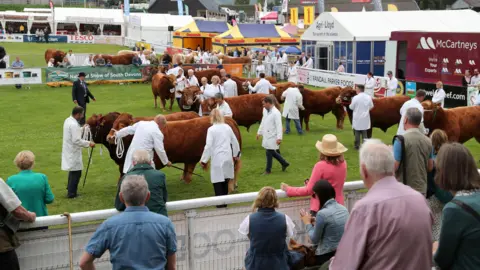
The budget announcement is being made on the opening day of the Royal Welsh Agricultural Show in Llanelwedd.
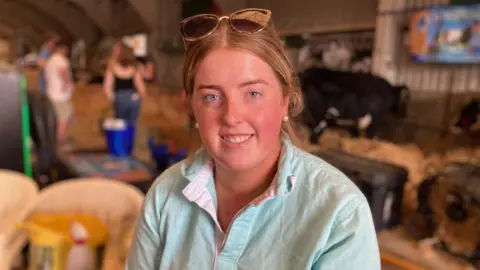
Caryl Davies, a beef and sheep farmer from Eglwyswrw, Pembrokeshire, said her family had decided to join the new scheme.
"There are ways that farming and nature can work together, it'll improve the soil and the crops we're growing," she said.
The fact that the budget was being ring-fenced over several years would "give people a bit more confidence they've made the right decision," she said.
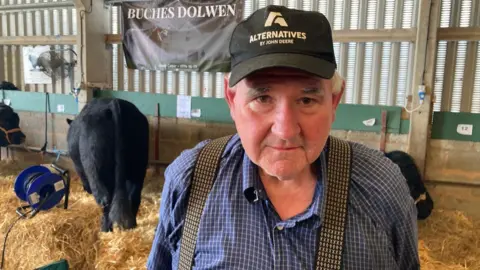
"A three-year plan gives you some certainty about what you're going to get," agreed retired livestock auctioneer Alwyn Jones, showing his pedigree Welsh Black cattle.
But the money would not go far, he said, as costs have gone up and "everything has gone dearer".
While a three-year budget is welcome, "five years would be better and a bit more money obviously," added Stephen Roberts from Denbigh.
Figures show that about half of farmers applying for subsidies this year decided to opt into the new SFS.
The other half decided to stick with the old regime for now, meaning they will see a 40% cut in funding this year as those subsides are phased out.
However far more land is covered by the new arrangements - with 905,545 hectares being farmed by those in the SFS, and 384,399 hectares by those who remain in the legacy scheme.
The Welsh government said it would commit £340m per year to the SFS up to March 2030 and the next Senedd election.
It means £238m a year will be reserved for the entry-level payment - known as the scheme's universal layer.
A further £102m will go towards optional and collaborative layers - where farms can choose additional, more ambitious environmental work for extra cash.
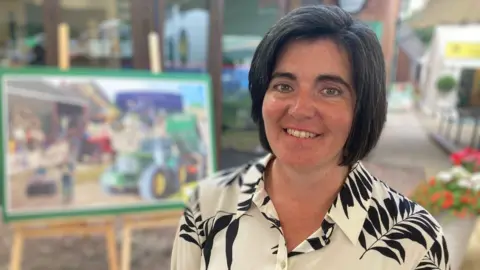
NFU Cymru president Abi Reader said the industry would "really welcome the multi-annual funding".
"If we were still in the EU we would have a seven-year cycle so we're not quite there but at least we know for the next three years it's certain," she said.
"It would be really good to see a budgetary uplift," she added, but acknowledged that "in this economic climate that is going to be a real challenge".
Farmers' Union of Wales president Ian Rickman said recent years had brought significant financial uncertainty for the farming sector in Wales, making it "increasingly difficult for businesses to plan with confidence and make informed long-term financial decisions".
"The FUW has consistently called for a five-year funding framework, so today's commitment to provide certainty until March 2030 is a welcomed relief for the family farms of Wales," he said.
Environment groups said more funding would be needed to help farmers - who manage 90% of the Welsh landscape - restore nature and tackle climate change.
"For many people, the future of farming can feel like a distant policy debate. But the choices made through the SFS will shape the rivers we swim in, the wildlife we see, the food we eat and the way Welsh communities cope with floods, drought and a changing climate," explained Rachel Sharp of Wildlife Trusts Wales.
The charity, alongside the RSPB and National Trust, had called for a doubling of the current budget, she noted.
"Sticking with the same budget level is disappointing," she said, urging ministers to introduce full details of the scheme's optional and collaborative funding pots quickly.
A couple of the optional choices that farms can apply for as part of the SFS were announced by the government as part of the budget announcement.
Funding for farms to go organic will be available from the end of the month, a move welcomed by the Soil Association Cymru, who said it was "good news for Welsh food and farming".
 Getty Images
Llyr Gruffydd, cabinet minister for rural resilience and sustainability, said "farmers told us loud and clear they need certainty and stability - and that is exactly what we are delivering".
"I don't think anybody is under any illusion about the financial challenges we're all facing these days - there are requirements to cut back and to freeze funding," he warned.
"So what we're saying is this is a baseline, it will be ring-fenced for the industry - if there is any way that I can leverage more money out of government towards the sector I'm up for it and I will do it," he added.
"Realistically this is what we can guarantee - the big difference is we are guaranteeing it for a minimum of three years."
Reform UK Wales said that "while the announcement provides greater certainty for the industry, it fails to recognise the significant increase in cost pressures facing Welsh farmers".
It added that the £340 million annual budget was the same level of funding the sector had received since 2012, despite years of inflation and rising costs for fuel, feed, fertiliser and machinery, farming organisations have consistently argued that closer to £500 million a year was needed to reflect those pressures.
Laura Anne Jones, its shadow cabinet secretary for food, said: "This announcement must be the beginning, not the end. Farmers now need a scheme that works for every sector and every type of farm.
"I hope there's a second announcement on the Sustainable Farming Scheme that will ensure it's more flexible and less bureaucratic."
Andrew RT Davies, Welsh Conservative shadow farming minister, said Plaid Cymru's real terms cuts to farm support will devastate the sector, adding that it fell "far short of what farmers warned is required".