Volunteers clearing invasive plant from riverbank

 Charlie Stubbs/BBC
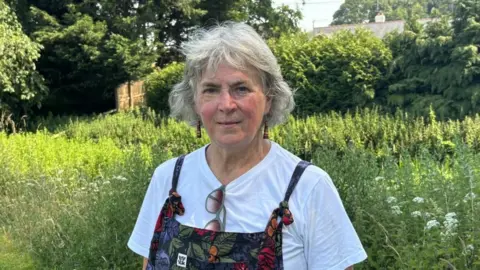
A group of volunteers in north Shropshire have said they are determined to get rid of an invasive plant which has taken root along their river.
River Perry Water Watch, based in Baschurch, is pulling up Himalayan balsam from their riverbanks, with members saying it degrades them and damages biodiversity.
The group's leader Wendy Lowdon said it was a preventative measure to stop biodiversity decay in the river, in which other species are crowded out or killed off.
Volunteers have started work at Queen Elizabeth Field, in Ruyton-XI-Towns, but added there is "a lot more work to do" along the river.
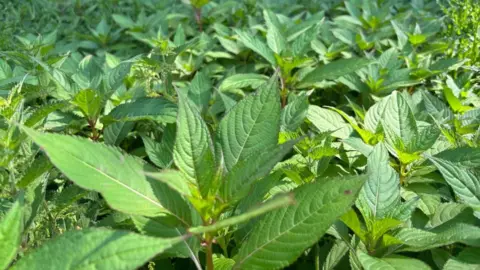
Himalayan balsam is one of the most widespread and common invasive plants that are not native to the United Kingdom.
The flower on the plant has 3cm-long pods that are highly-pressurised. When they are ripe and touched, up to 800 seeds can be propelled up to seven metres away.
Wendy Lowdon, from the River Perry group, said the plant could "kill" diversity along the riverbank.
"It grows very tall fairly rapidly in the summer, up over two metres, it shades all other British plants including nettle and thistle," she said.
"It has a pretty flower, which bees and insects like, but it's very short-lived."
Lowdon added that once the balsam is "pollinated and seeded", it dies back and "has no root system", meaning the bank is destabilised.
 Charlie Stubbs/BBC
Lowdon has an army of volunteers that help her get rid of the balsam, including Alyson Lister from Ruyton-XI-Towns.
Speaking near Platt Mill Bridge in the village, she said more work still needs to be done.
"It's fairly quick to pull - it comes up very easily," she said.
"There's an area we did a couple of weeks ago that was 50 yards (46 metres) by 10 yards (9 metres) and then there's another one that we haven't tackled yet this is 75 yards by three yards.
"We've got various people who have gardens that are on the river and land who are aware of it and helping us tackle it so we're not alone."
Follow BBC Shropshire on BBC Sounds, Facebook, X and Instagram.