Market revamp budget set to rise by £1.9m

 ULAS
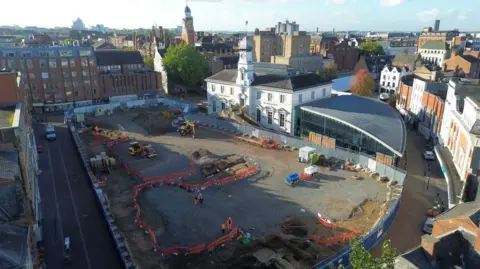
ULASThe budget for redeveloping the market place in Leicester is set to increase by £1.9m.
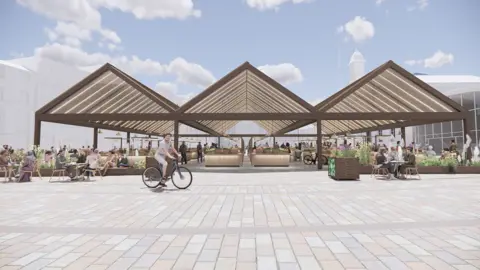
Work on a £7.5m project to revamp the site started in March 2024 before it was paused, with the council announcing a rethink which would see the area transformed into a space capable of hosting large-scale public events.
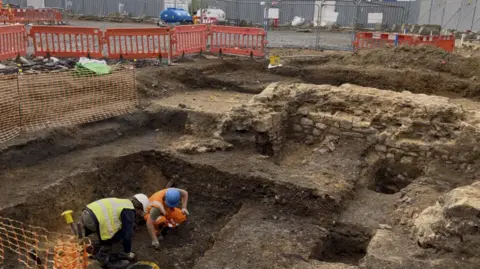
As part of the project, University of Leicester Archaeological Services (ULAS) carried out a dig on the site, which discovered artefacts from the Bronze Age, the Roman era and Middle Ages.
City mayor Sir Peter Soulsby said the increase in the budget for the scheme was a "small price to pay for the new knowledge and understanding" of the city.
A decision notice confirming an increase of £1.9m to the budget for the market scheme is expected to be signed by the mayor next month, the Labour-run council said.
Soulsby said: "Ensuring that a construction site such as this is properly explored by archaeologists is a statutory duty – and there are costs, of course, when you have a team of archaeologists on site for eight months.
"With the archaeology bill coming in at more than £1m, and with other costs rising, the overall budget for the market scheme will need to be increased."
While the main excavations are now complete, the council said archaeologists would remain on site to record any further finds as new service trenches are dug.
 Leicester City Council
Finds from archaeologists included the remains of a building called Gainsborough Chamber, a 16th Century civic building with its own "vile" dungeon.
Also discovered during the excavations was evidence of the city's medieval Shambles and Drapery, a 15th Century market hall that once housed butchers, drapers, shoemakers and other trades.
Among the oldest finds was a small collection of prehistoric worked flints, including cutting tools characteristic of the Neolithic period, about 12,000 years ago.
They also included a hoard of about 30 Roman coins, thought to be from the 4th Century, and several Roman buildings across the site, including evidence of early timber structures and rare pottery kilns.
ULAS said it had also found the grave of a Roman infant beneath the floor of a timber building thought to be nearly 1,800 years old.
"These discoveries are of considerable importance to the history and identity of Leicester – and provide valuable new insight into the city's development through time," Soulsby said.
The city council added contractors working on the new market square were completing the groundworks.
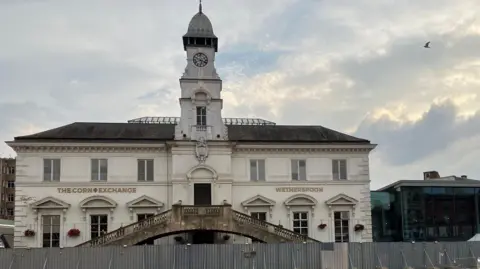
Other works taking place as part of the regeneration of the market area include the restoration of the stone staircase in front of the Corn Exchange, it added.
The council said conservation work would "soon get under way" to repair the staircase – known locally as 'the Rialto Bridge'.
In 2024, Historic England said the Grade-II* listed site was at risk as rainwater run-off was causing the staircase's thin stone cladding to deteriorate.
Listen to BBC Radio Leicester on Sounds and follow BBC Leicester on Facebook, on X, or on Instagram. Send your story ideas to eastmidsnews@bbc.co.uk or via WhatsApp on 0808 100 2210.