I hand-make clogs, as my great-grandfather did

 BBC
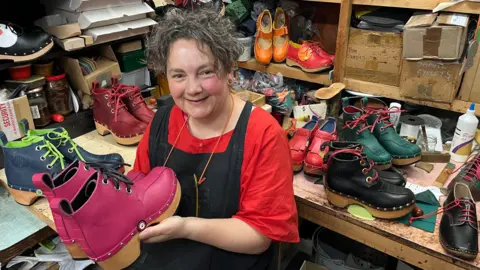
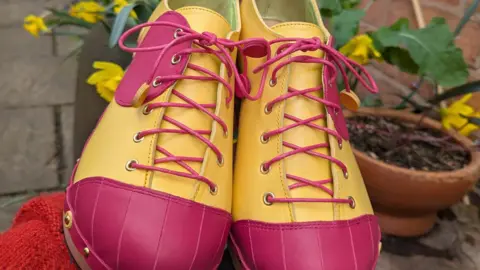
BBCThey may look clunky and a little bit odd but Jackie Leggett, one of only a handful of clog makers left in the UK, says her wooden-soled shoes are "very comfortable".
The 55-year-old, from Leicester, says the wooden base actually helps "relax your feet" and will slowly mould to the shape of your sole.
Leggett is one of only five clog makers in the UK according to Heritage Crafts - a charity set up to celebrate, support and safeguard traditional craft skills.
The clog maker is continuing the legacy of her great-grandfather who owned a clog shop, and her father who owned a shoe factory.
"Clogs aren't just another normal type of footwear, they're part of our cultural heritage," Leggett says.
"They're a symbol of the people who worked in industries past like mining and mills."
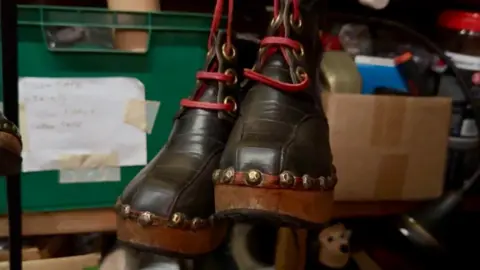
The clog maker says she has been practising the craft for more than 30 years.
Differing from the traditional Dutch clogs, the British version is made from leather, with a thick wooden sole.
A form of the footwear was worn by the upper classes as over shoes to keep their soft leather shoes clean.
Despite taking about three days to make a pair, the shoes can "last a lifetime," Leggett says.
"They're a very repairable piece of footwear as long as you look after them," she says.
"They bring out your inner child. They're really fun to wear and they relax your feet.
"They're just very comfortable and tactile.
"After a time the wood will take on the shape of your feet slightly, so they become more comfortable as you wear them, they become you."
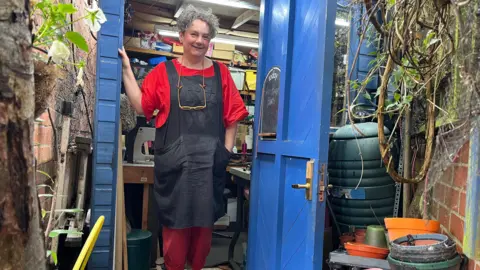
Her great-grandfather's workshop was in Maryport, Cumbria, in the early 1900s.
"In Cumbria they would have been used down the mines and on the farms as well," she says.
"They were definitely an industrial piece of footwear.
"I'm trying to bring a very traditional industrial footwear into something that's a bit sassy."
In the 1970s and 80s Jackie's father, Anthony Leggett, owned a shoe factory in Maryport called Leggett Footwear.
"I used to spend all my holidays working down there through choice and I learnt quite a lot from them," she says.
"There's kind of similarities in the process.
"They made a wedge sandal and they made the heels, it was a wooden heel, very trendy with a gold bar across the back."
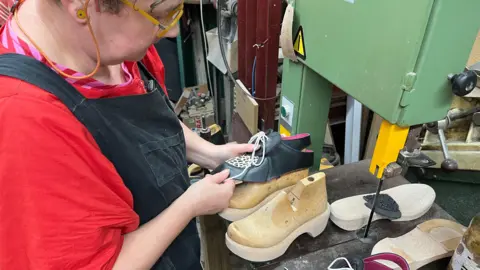
It was when Leggett moved to study at Leicester Polytechnic - now De Montfort University - that she learnt the skills needed to make her first pair of clog boots which she says were in homage to her great-grandfather.
Jackie sells her clogs online, most are commissioned pieces for individual customers, often repeat clients for about £300 a pair.
She hopes more people will learn the traditional craft.
"It is a dying art," she says.
"It's just so nice and it'd be even nicer if there were more people making them still."
 Jackie Leggett
Mary Lewis, head of craft sustainability at Heritage Crafts, says there are only five handmade clog makers listed in the UK, including Jackie.
She says: "The numbers have declined in the past two decades and most of the makers are on the older side now, so it is declining.
"But it's still relevant... it's linked to our cultural heritage through things like our folk dances, Morris dancing and clog dancing."
Clog making is on the organisation's red list of endangered crafts and is classed as critical, which means it is in danger of dying out.
The charity is offering a grant of up to £4,000 for training and materials for people who want to learn any of the crafts on the red list including clog making.
"It's quite hard to set yourself up as a clog maker if you can't get access to the right training.
"A lot of degree courses are primarily focused on design and less so on the making, but at De Montfort University in Leicester [where Jackie studied] they definitely do focus on making," Mary says.
Jackie adds: "I think it's perhaps a footwear that's always going to be made by the individual.
"If you want something that's really handmade, you just look for a British maker."
Listen to BBC Radio Leicester on Sounds and follow BBC Leicester on Facebook, on X, or on Instagram. Send your story ideas to eastmidsnews@bbc.co.uk or via WhatsApp on 0808 100 2210.