The captain who glided jumbo jet to safety through an erupting volcano
When British Airways flight 9 took off from Kuala Lumpur in June 1982, the pilot and passengers were unaware they were about to become part of history.
The journey to Australia seemed to be going well - until the Boeing 747 hit a cloud of ash from the erupting volcano Mount Galunggung in Indonesia.
During the flight, Captain Eric Moody, from Totton in Hampshire, made this announcement: "Ladies and gentlemen, this is your captain speaking.
"We have a small problem. All four engines have stopped. We are doing our damnedest to get them going again. I trust you are not in too much distress."
Keeping his cool, Moody managed to restart the failing engines and landed safely after navigating around the volcano - following 13 minutes of gliding without power, with a sandblasted windscreen, in the middle of the night.
But his story did not stop there. He made a significant impact on aviation history all the way up until his death in 2024, with his expert handling of the incident studied by training pilots across the world.
Forty-four years on, Pat Moody, Eric's wife of 58 years, recalled the moment she found out about his miraculous landing.
"We were at home and the telephone rang. It was British Airways (BA) to say there'd been an emergency landing into Jakarta in Indonesia - but I wasn't too worried, because there were no injuries.
"And then a little while later, Eric rang me to say that they had had a bit of a whoopsie, but they were all safe.
"The hard bit on that was, although I spoke to him a lot, this happened on a Thursday, and he didn't actually come home until the following Tuesday.
"I had an 11-year-old daughter who I told 'yes I know, daddy's fine. I've spoken to him but I won't believe it till I actually see him'. So she was literally counting the minutes."
Her son Ian, who is now a BA pilot, came out of school that day shouting: "I might not be the hero but I'm the next best, I'm the hero's son!"
Pat met Eric when they were teenagers in Totton. They both grew up in Hampshire and later moved to Surrey for his work.
He learned to fly in 1958 in Eastleigh and then he went to the College of Air Training at Hamble in 1963.
She recalls the first time flying with Eric.
"I'd never been in a little aeroplane before," she said. "And we sort of trundled down the runway at Eastleigh, which was then grass, and went down a hole.
"So Eric said 'would you just get out and lift the airplane out of this hole?' I thought, no, that's really not what I came for, but that was the way it started.
"According to his mother, he first started saying when he was about four that he wanted to learn to fly."
Moody was known for his calm demeanour on BA Flight 9 and in interviews about the event - but less so in his personal life.
"Big things Eric can cope with, little things Eric couldn't cope with. If anything went a little bit wrong, it was a little bit fraught for a time," Pat said.
"But he gave me an absolutely wonderful life as the wife of an airline pilot. I've travelled, I've met all these lovely people through things he's done and there are lots of facets to Eric's life. He absolutely adored his children, he was so proud of them."

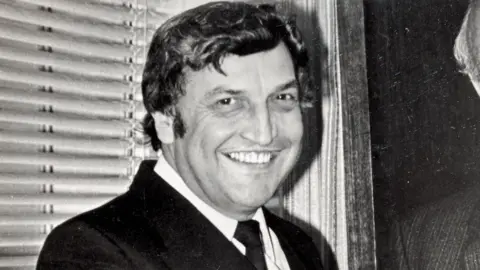 Family handout
Sarah Myers, Eric's daughter, who was 11 at the time, recalls not quite understanding how significant it was at the time.
"For me it was very much 'oh Dad's on the television again, Dad's in the newspaper'."
Not long before he died, Sarah attended a talk Eric gave about the incident.
"It was amazing," she said. "He loved telling the tale but it was also incredible to hear what they went through at the time, what happened in the cockpit and how it all panned out
"And to me he was just Dad, but to them he was a hero, he saved 263 lives - but he also did more than that.
"He changed the aviation industry, which I had no idea he had done.
"For me, it was just like he was just doing his job - but now he's changed the training, he's changed the training manuals. It's just incredible.
"Reading the manuscripts of the interviews that he's done, it's tear-jerking, it makes me quite emotional."
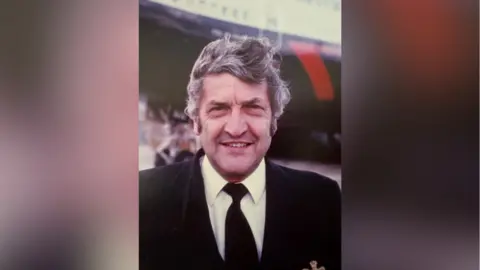 Family handout
Moody's flight has also been the focus of an academic study.
An article about the 40th anniversary of the event caught the attention of Claire Horwell, a professor of geohealth at Durham University.
"I've known about the BA9 flight crisis for many years, and I'd often wondered whether there'd been any health impacts for passengers and crew," she said.
"I'd never actually thought that I could find this out for myself.
"No academic research had previously been done on the health impacts, whether psychological or physical, so that's why we were so interested in it."
Interviews with four crew members and 14 passengers, including Moody, were used to study their response to the crisis in 1982 and its long-term effects on their lives.
The professor said: "I'd say Captain Moody himself was very stoic, and maybe had fewer impacts than some - although his hair did turn white!
"During the event itself, he was very, very focused on sorting out the situation.
"Several passengers mentioned in their interviews that they didn't think they would be alive today if it hadn't been for Captain Moody's actions.
"He was clearly highly competent, and the bravery of the rest of the crew as well, really maintained the calmness on the plane, and that was very important to the passengers."
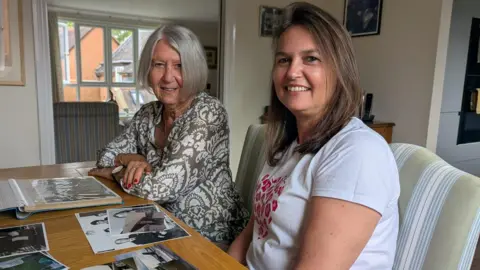
Those on board have had reunions, which they called the Galangung Gliding Club.
Claire said the club gave them all a sense of belonging and was a "safe space to talk about things".
She added: "[The club] helped people to build friendships and even relationships as a result of being in that shared experience together. There was one couple who actually got married."
Pat said Eric had also spent time training airline pilots and giving talks - and had met many incredible people along the way.
"Let's be honest, nobody else had been through a volcanic eruption like this before," she said.
"Well, obviously other people had, but they hadn't come out the other end like Eric did.
"So a whole new industry was based on what happened so that they could then train other airline pilots not to get caught in that situation."
Pat recalled meeting a man from the US who was interested in dust ingestion into aeroplane engines.
"It wasn't until we got to know him better that we found that he was working for the CIA and that this was the experience they needed to know if you put an airplane through with an atomic bomb," she said.
"Apparently Eric did so much of their research for them because of what happened.
"I'm still friends with them until this day."