Time out for for Manx castle's 400-year-old clock

 BBC
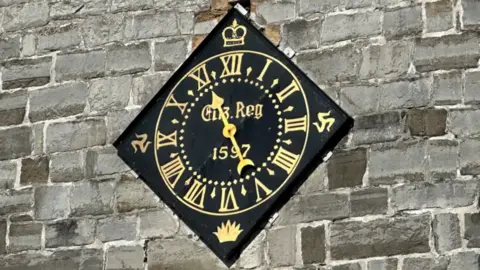
BBCIt has been keeping time at Castle Rushen since Elizabeth I was on the throne, but the 800-year-old Viking stronghold's medieval turret clock is now leaving the Isle of Man for the first time.
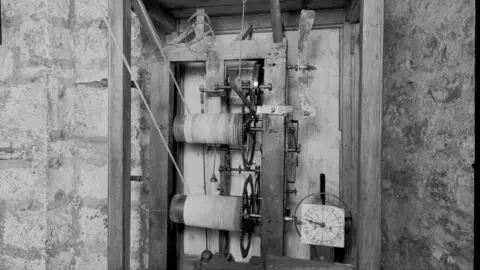
Believed to date from the late 16th century, the wooden-framed clock is one of only a handful of its kind to survive anywhere, and has kept time at the landmark castle for more than 400 years.
It now needs specialist conservation before returning to Castletown in the hope of ticking for centuries more to come.
'Largely unaltered condition'
It is thought to have been a gift from Elizabeth I, the last of the Tudor monarchs.
While no documentary evidence has been found to confirm this, the clock's style, design and carbon dating are all consistent with the story, while historical records can prove it was definitely a part of the castle by the 17th century.
The clock has changed with the times. Its original escapement was swapped for a pendulum mechanism in the early 18th century, and it did not even get a clock face until around 1720, by which point it was already more than 100 years old.
Its original dial has since been lost, and the single-handed face it wears today dates only from the 1980s.
However, a 2012 study found the mechanics of the clock have survived in an exceptionally original, largely unaltered condition, and it was formally accessioned into the Manx National Heritage museum collections in recognition of its significance.
 Manx National Heritage
Restoration work between 2012 and 2014 got the clock working again, though not every improvement could be finished - the ropes running across the clock room ceiling made it impossible to fit protective glazing that would let visitors see the mechanism up close.
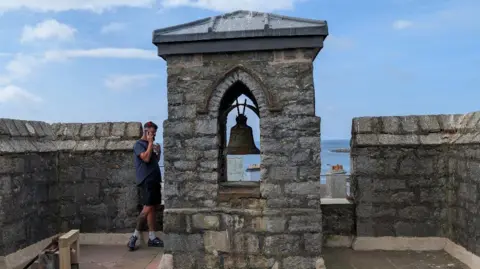
Since then, water getting into the clock room has affected its reliability, and safety concerns led to the bell hammer being disconnected, silencing its chime altogether.
The final straw came when part of the clock room's ceiling collapsed on to the mechanism, prompting its removal for safekeeping while the tower was repaired.
Manx National Heritage's conservation team finished drying out and repairing the tower and wall walks in 2025, clearing the way for the clock's next chapter.
'Highly specialised conservation'
The clock will now undergo specialist conservation, including repairs to worn pivots and bushes, testing on a full-scale rig, restoration of the chime, redesigning of the rope system before its preparation for reinstallation in a glazed case.
Given its rarity, the job has gone to the internationally recognised Cumbria Clock Company in Penrith, the team behind the restoration of Big Ben between 2017 and 2019.
Chris Weeks, conservator for Manx National Heritage, said the clock was "an extraordinarily rare survival and one of the Isle of Man's most significant historic objects".
"Although it has faithfully kept time for centuries, its age and complexity mean it now requires highly specialised conservation to ensure it can continue to do so for generations to come," he said.
He added that the finished work would let visitors get a much closer look at the clock's craftsmanship when it returns to Castle Rushen.
 Manx National Heritage
Read more stories from the Isle of Man on the BBC, watch BBC North West Tonight on BBC iPlayer and follow BBC Isle of Man on Facebook and X.