Girl gets tumour diagnosis 12 hours after eye test

 Family handout
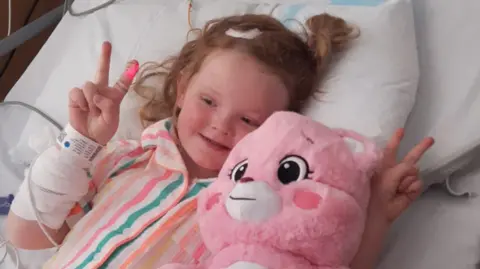
A mum said she "fell apart" after finding out her four-year-old daughter had a brain tumour, just 12 hours after an eye test.
Katie, 41, said her daughter Phoebe, now five, started to be sick and was getting severe headaches in February, but was told "it was just migraines" by a GP.
Following an eye test in May, Katie was called by the optician who told her to take her daughter straight to A&E at Addenbrooke's Hospital in Cambridge. Just hours later, she was diagnosed with a brain tumour.
"I fell apart and just sobbed and sobbed," said the mum from St Neots, Cambridgeshire. Thankfully, Phoebe's tumour was not cancerous and she is now under the care of specialists.
Katie said: "I felt like we were probably wasting the hospital's time because Phoebe was running around playing like normal but, looking back, she was probably the sickest kid there.
"I kept thinking, how am I going to tell her dad and the other children?
"I kept asking if Phoebe would survive but the doctors said they were unable to answer that at that time, which is the worst thing in the world as a parent."
 Family handout
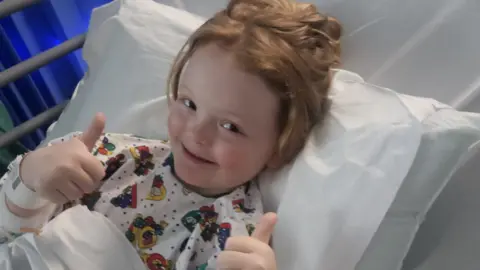
The day after her diagnosis, Phoebe had her first surgery where a drain was inserted to relieve the pressure on her brain, caused by a build-up of cerebrospinal fluid.
She underwent a second surgery the day after that, with surgeons removing most of the tumour during a 10-hour procedure, where it was confirmed to be a pilocytic astrocytoma.
Astrocytomas are the most common type of brain and spinal cord tumour in children and are also known as gliomas, according to Cancer Research UK.
It said about 175 children were diagnosed with an astrocytoma each year in the UK.
 Family handout
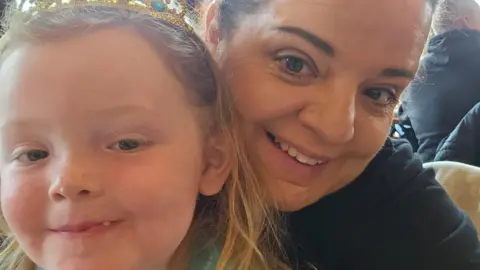
Katie told BBC Radio Cambridgeshire: "Within three weeks of coming out of hospital she was back at school part-time, and by the end of the term we managed to get into school full-time again."
Phoebe's progress is now being monitored.
She will have her first follow-up MRI scan in November, and is likely to need one every six months until post-puberty or into her early adulthood, as the condition is hormone-related.
If MRI results are positive, Phoebe is unlikely to need further care, but if the tumour returns she would most likely be suitable for targeted treatment.
More stories from Cambridgeshire
 Family handout
Speaking of Phoebe's resilience, Katie said: "She is incredible.
"If the opticians hadn't spotted us or told us straight away, who knows what would happen."
Katie added that she wanted to "bring more awareness" to getting children's eyes tested.
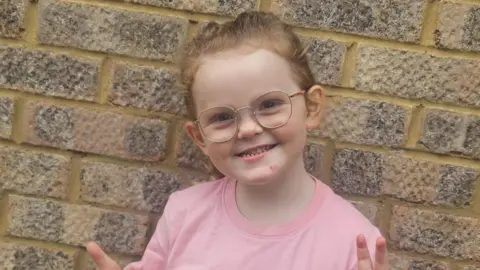
"She now wears glasses which are mega strong, but she's very comfortable wearing them.
"If it's just that she now has bad eyesight and wears glasses, then so be it."
After the diagnosis, Katie started to work for the charity Brain Tumour Research, and has been calling on the government to increase spending on science.
"Funding for research into brain tumours is so important because this really could happen to anyone," she said.
"You never think something like this will happen to you, but it does."
The Department of Health and Social Care said it was establishing a "national Brain Tumour Research Consortium" and announced a £13.7m investment to support research to develop new treatments.
Do you have a story suggestion for Cambridgeshire? Contact us below.
Follow Cambridgeshire news on BBC Sounds, Facebook, Instagram and X.