Hospital solar farm makes 'positive' difference to NHS

 Royal Wolverhampton NHS Trust
A solar farm, created to help power a city hospital, has won a national sustainability award.
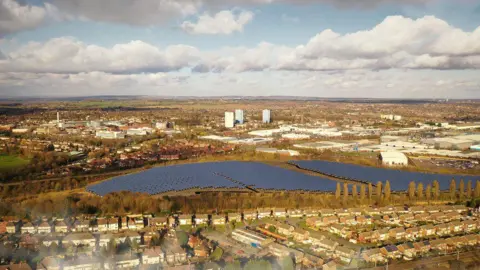
The Royal Wolverhampton NHS Trust's solar farm, which was built on a former landfill site covering the equivalent of 22 football pitches, was praised for making significant benefits to the hospital and local community.
It provides New Cross Hospital with its own self-generated renewable energy for around 288 days a year, or roughly three-quarters of its annual electricity demand.
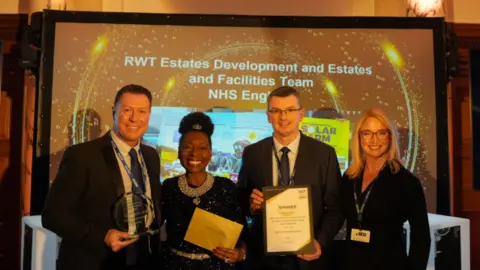
The project has been named Best Sustainability Project at the Government Commercial Function (GCF) Awards.
 The Royal Wolverhampton NHS Trust
The ceremony was hosted by UK Government chief commercial officer Andrew Forzani alongside Baroness Floella Benjamin.
Stew Watson and Tom Butler from the NHS trust attended the event at the Churchill State Rooms on Parliament Street, London, to receive the award.
Mr Watson said: "Tom and I were both surprised and delighted when they announced our victory and were honoured to accept this national award on behalf of the Trust.
"The Trust could not have achieved this without the excellent support of such a fine group of technical specialists and industry professionals – to which we thank you all for aiding the Trust throughout our collective journey over the last five years."
The trust said the solar farm had enable it to reduce its reliance on the national grid and protect itself from rising electricity prices, while significantly lowering carbon emissions.
The project is expected to save an estimated 1,583 tonnes of CO₂e each year.
Jon Gwynn, project manager at Carbon and Energy Fund, one of the partners on the project, said: "The solar project with The Royal Wolverhampton NHS Trust is a fantastic demonstration of what the NHS can achieve when it commits to real, practical decarbonisation.
"It's an inspiring scheme with significant positive benefits for the Trust, patients, and the wider community.
"We're incredibly proud to have worked closely with the Trust to deliver such an important and impactful project."
Follow BBC Wolverhampton & Black Country on BBC Sounds, Facebook, X and Instagram.