Royal Navy docks in Harwich after 60-year absence

 Andy Meeson/BBC
A Royal Navy ship has docked in Harwich for the first time since the 1960s.
HMS Severn anchored in the Essex port on Sunday for a crew change and was due to depart on Wednesday.
The 80m-long (262ft) vessel is used for patrols around the UK coastline, where responding to Russian ships has become an increasingly common task.
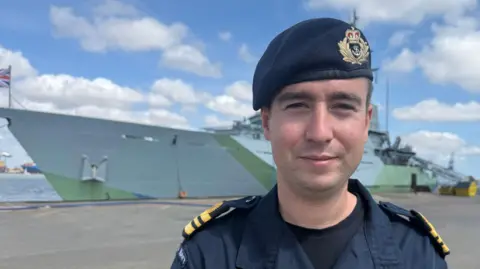
Lt Cdr Dominic Jacob, its executive officer, said crews wanted to make sure the vessels were not involved in "nefarious activity".
"We quite often get tasked on to Russian ships which are at sea – frigates, destroyers and such like," he said.
"We shadow them within the UK area of responsibility to make sure they don't get up to any nefarious activity and just to act as a deterrent."
On Saturday, the Royal Navy said its warships and helicopters spent 21 days monitoring Russian activity in UK waters and the North Atlantic throughout July - a 25% rise on the previous year.
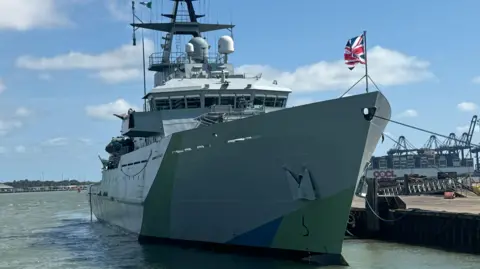
Crowds were excited to see the HMS Severn after a 60-year absence of the Royal Navy in Harwich, which has a proud maritime history and was the home port of Mayflower captain Christopher Jones.
It can hit speeds of 20 knots (23mph or 37km/h) and has 30 people onboard.
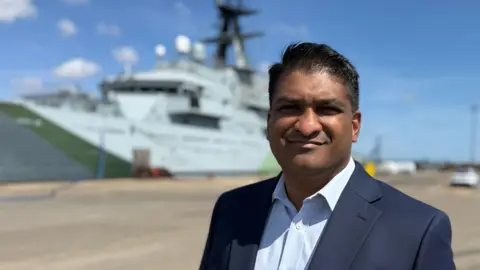
Indy Wijenayaka, chairman of the East of England Defence and Security Cluster, said returning to the Essex town had taken "far too long".
He said the coastline had "vital, critical infrastructure" that needed to be protected amid a background of "destabilisation across the world".
 Andy Meeson/BBC
"We have to recognise that we are behind the drag curve," Wijenayaka said of the UK's defence capabilities.
"It's not just the UK, it's other countries around Europe and other areas as well. We need to increase our innovation."
Do you have a story suggestion for Essex? Contact us below.
Follow Essex news on BBC Sounds, Facebook, Instagram and X.