Baby puffins make uninhabited island their new home

 BBC
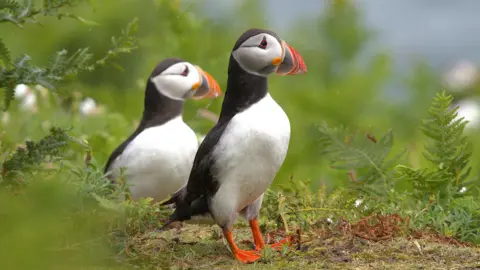
BBCFootage of a puffling - a baby puffin - bred on the Copeland Islands off the County Down coast has been captured for the first time.
The seabirds, synonymous with Rathlin Island off County Antrim, are not indigenous to the uninhabited Lighthouse Island, so no population existed there until an introduction scheme was launched around 2013.
There are now around 30 breeding pairs of puffins, which is being seen as a real success story.
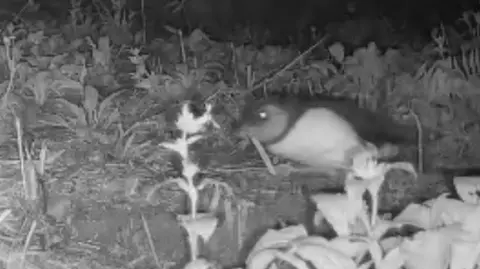
They arrive to the island each April, and this year - in fact, just last month - trail cameras near their burrows in the ground filmed a young puffling out of its burrow, and an adult puffin bringing fish back to feed its young.
Attempts to attract puffins to Lighthouse Island included setting up fake "decoy" puffins, and a solar powered speaker system broadcasting its call.
'The puffins are thriving'
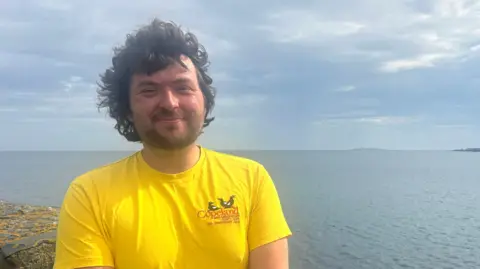
Adam Ringland of Copeland Island Bird Observatory which is based on Lighthouse Island said the puffins are thriving due to the environment.
"They like the nice grassy slopes and the burrows have already been dug out for them by rabbits and Manx shearwaters, which is our star bird on the island."
There are no people on Lighthouse Island, apart from volunteers and the occasional visitor to the bird observatory at weekends.
That, said Adam, has given the puffins the space to grow and breed.
Lighthouse Island is protected by the bird observatory and can only be accessed on an approved charter boat.
But he says its important people know this conservation work is happening, with declines in some sea bird populations.
"They (puffins) are such important regulators of the eco-system, from keeping fish stocks under control to fertilising the land and of course people just love puffins.
"They get such a buzz out of seeing these birds - it's such an important thing for our mental health, it connects us to nature, and helps us understand we need to protect nature as a whole."
And why do people love puffins?
 Copeland Island Bird Observatory
"They're so funny looking. There's something about the very oversized bill, their behaviour on some of the trail camera footage, the nuzzling behaviour. And they're also so clumsy."
While people mainly associate Rathlin Island with puffins, they have returned to the Isle of Muck nature reserve in County Antrim in recent years, after a rat eradication programme.
"Hopefully this will continue up and down the east coast," said Adam.