'The department has lost touch with farmers' - call for minister's resignation over cattle cull

 BBC
BBCA farmers' union has called for the Agriculture Minister Andrew Muir to resign over how a cull of 51 cattle was carried out in County Tyrone.
The cows were shot in June, leading to complaints about the manner of the cull which was carried out within earshot of members of the public.
The Ulster Farmers' Union (UFU) President John McLenaghan said there were concerns about the independence of a Department of Agriculture, Environment and Rural Affairs (Daera) review into the incident.
A Daera spokesperson said their door would "remain open to engage with all including the UFU".
The union also called for Daera's Permanent Secretary Katrina Godfrey and the Chief Veterinary Officer Brian Dooher to resign.
In response, the senior civil servants' union the FDA said it was "entirely inappropriate" to call for the resignation of officials who were "duty-bound to serve ministers" and "could not defend themselves publicly".
The minister has previously said there was no reasonable alternative to the cattle being euthanised on site and has insisted it was a last resort as officials had to act on a court order.
An external review of the cattle cull was announced by Daera earlier this month, but the UFU's Executive Committee met on Thursday night.
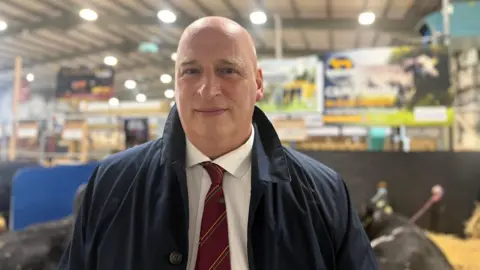
In a statement on Friday the UFU said it "does not have the confidence in the independence of the review as presently constituted, including the scope of the Terms of Reference and appointment of a single person to conduct it.
"The UFU has consistently maintained that an investigation into an incident of this seriousness must be demonstrably independent, robust and capable of commanding the confidence of farm families and the wider public."
John McLenaghan said calling for resignations was not a decision his union had taken "lightly".
However he added that confidence had been "severely damaged".
He said the most recent event is "just one of many instances where farmers feel that the Department has lost touch with farmers".
"We no longer have confidence that the department can deliver."
A Daera spokesperson said they and the minister were aware of the decision.
"An external independent review is already underway to review the action taken by Department officials in response to the Deprivation Order in Fivemiletown," they continued.
"There are many strategic issues and challenges for agriculture.
"It is vital we face up to those challenges together to restore our environment and ensure a sustainable future for agriculture".
Responding to the vote against the two named senior officials, the FDA union's Robert Murtagh said: "This kind of performative stunt, naming and targeting officials, does not aid understanding and undermines the need for constructive dialogue.
"The UFU's action appears also to be seeking to pre-empt and to influence the independent review already now in train.
"It should be awaiting its findings and recommendations before jumping to respond to voices who do not care about public service or indeed public servants."
What happened in Fivemiletown?
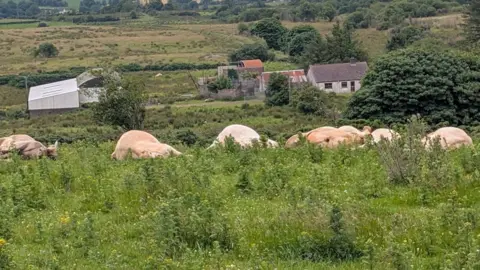
Warning: This article contains an image of dead animals that some may find distressing
Animal welfare inspections on the farm dating back to 2022 identified serious concerns, including 33 animal carcasses, feed contaminated with urine and faeces, and emaciated animals.
The farmer was found guilty of a number of animal welfare offences in May and disqualified from keeping animals for life.
The offences included:
• Thirteen charges of failure to dispose of an animal carcass.
• One charge of failure to comply with an Animal By-Products notice.
• Six charges of causing unnecessary suffering to an animal.
• One charge of failure to produce medicine records.
The court issued a deprivation order on 8 June - that the farmer must have the animals removed from his ownership.
As is practice, he was given two weeks to appeal the sentence, or to transfer, sell or give away his stock.
He was then given an extra week.
On 29 June, when the extended grace period had lapsed, the departmental humane slaughter team arrived at the farm to begin destruction of the remaining 51 animals by shooting them.
The operation was completed on 30 June.
Some members of the public witnessed the operation in one of the three areas across the farm that the animals were in.
Questions about how the operation was conducted were first raised by a local councillor, then concerns were expressed by politicians and farming leaders.
The AERA committee was recalled to discuss the incident, and quiz the minister and veterinary officials.
What was the Stormont committee told?
 Other
OtherThe committee heard that officials had been working with the farmer after "numerous" inspections, beginning in 2022.
The agriculture minister Andrew Muir said those had revealed a "grotesque" situation and "a large number of animals were caused unnecessary suffering", leading to the deprivation order.
"That order legally required the department to deprive the individual of any livestock.
"The department had no choice.
"And so my officials took the necessary steps to fulfil this legal obligation."
It emerged that a total of 21 animals had been removed during the grace period, but 51 remained on the farm.
Officials said animals in two of the areas on the farm were disposed of by 13:30 on 29 June.
The slaughter operation in the final area was stopped when a local farmer offered to buy some of the remaining cattle.
But the animals could not be rounded up, and escaped onto the road.
They were eventually herded back and a vet recommended they be shot.
One remaining animal was disposed of on 30 June.
The carcasses were removed later that day.
Questions have been asked about the weapons used, the amount of ammunition, and why slaughter in situ was chosen as the method of disposal.
Deputy Chief Veterinary Officer Gemma Daly described the cattle as "semi-feral" and said staff had expressed concerns over the years about how to handle the animals without causing them stress, or risking injury to themselves.
Senior Principal Veterinary Officer Elsie McGarvey said the department was "technically" potentially in breach of the court order by extending the grace period.
She added that approximately half of the animals were not suitable for the food chain and others were too young.
And she said officials were "always prepared" that the farmer would be disqualified and they "knew" removing the animals would present "significant issues".
How will the review be carried out?
Before the committee met, the minister announced that an independent external review would be conducted.
It will be led by Dr Martin Blake, a former Chief Veterinary Officer for Ireland.
His work will include looking at the decision-making, risk assessments and communication around the operation.
He will make recommendations, based on his examination of the records and any interviews he carries out.
Muir said Dr Blake's review would be "thorough but not prolonged", and told the committee it would be complete "by early autumn".
The UFU has called for the review to be conducted by a panel of experts, rather than an individual.
An uneasy relationship - analysis
Agriculture and environment are uncomfortable but inseparable bedfellows under the department.
And the relationship between Daera and the UFU has been fractious in the past.
The UFU's Executive passed a vote of no confidence in the department - not the minister - in October last year.
That came after an outcry over the initial consultation document for the Nutrients Action Programme.
It has since been revised by a stakeholder group of farmers, agri-food representatives, conservationists and environmental groups.
But the size of the protest on Monday about this incident shows farmers are not happy.
The findings of Dr Blake's review will be closely scrutinised.
The Democratic Unionist Party (DUP) has tabled a motion of no confidence in Andrew Muir which requires 30 signatures to make it to the floor of the Assembly.
But any change at the top of the department would have to come from the minister's party - or the minister himself.
And there are just seven months left for this minister to get a substantial number of significant policies past the Executive.
What is a deprivation order?
A deprivation order may be issued by a court when a person is convicted of animal welfare charges.
It requires that person to be deprived of ownership of the animal - to have it taken away - and for the animal to be disposed of.
The court may specify how that disposal will happen, or it may delegate that decision to a person appointed to carry out the order.
The legislation states that "disposal" includes destroying an animal.