Big changes proposed to reduce Scotland's prison population

 PA Media
Sweeping changes to the justice system that could see fewer criminals jailed and hundreds of prisoners get out of jail earlier have been unveiled by the Scottish government.
The number of people in prisons has reached record highs with ministers forced to bring in emergency measures in recent years to ease the pressure.
Now the Scottish government has launched a consultation on permanent measures to address the crisis, including encouraging judges to not issue prison sentences of less than two years - up from the current 12 months.
Justice Secretary Neil Gray said it was important to act now in order to ensure prisons function safely and effectively.
Scotland's parole system allows for those on short-term sentences to be released after serving 40% of their time - this followed a change in the law last year. Those serving long-term sentences can be eligible for parole after 50% of time served.
The latest proposals being put forward by ministers follow on from the recommendations of the Scottish Sentencing and Penal Policy Commission on ways to stem the problem of prison overcrowding.
If all the plans were implemented - and they need the backing of MSPs - then some criminals serving more than five years would be freed automatically after two thirds of their sentence, serving the rest under supervision in the community.
Another change would designate all inmates serving up to five years as short-term prisoners, meaning many of them would be freed after completing 30% of their sentence.
People convicted of sex offences or domestic abuse would be excluded from the short-term sentence changes.
Adding temporary modular accommodation at existing prison sites to create more spaces is also being considered.
 Gavin Hopkins
Scotland - along with other parts of the UK - has long had one of the highest incarceration rates in Europe.
The country's prison population on 19 June was 8,515 - above the 7,805 which the prison authorities have said its system is designed to accommodate.
Latest Scottish government "worst‑case long‑term projections" suggest that demand for prison places will rise to around 9,500 within the next decade if no new measures are put in place.
But why is the population so stubbornly high?
Nearly a quarter is awaiting trial
Just over 1,700 of the 8,515 people in Scotland's prisons are there while they wait for their criminal trial to begin.
To put this number in context, the country's biggest jail, Barlinnie in Glasgow, holds around 1,400 prisoners.
The proportion of prisoners awaiting trial increased as a result of the Covid pandemic but latest figures show these levels have failed to return to what was more typical before the pandemic.
BBC Scotland has previously reported how some prisoners are waiting years for their trial to start.
Court delays, some of which relate to the impact of the Covid pandemic, are the main factor behind this.
Last month it was revealed a backlog of trials in Scotland's highest criminal courts has nearly tripled, due in part to an increase in complex cases involving serious organised crime and historic sex abuse.
Longer sentences and fewer short-term prisoners
A big focus of successive Scottish governments has been to reduce the short-term prison population.
This has been achieved through the long-standing policy of a presumption against sending people to jail for short sentences, with the cut off currently at 12 months.
But emergency measures to reduce the short-term prison population have also been deployed in recent years.
Since June 2024, more than 1,400 prisoners have been freed early in three waves of emergency releases.
In addition, the automatic release point for some short-term prisoners was gradually reduced from 50% to 30%.
However, these measures have done little to stop the overall prison population creeping back up.
This is because the number of longer-term prisoners has increased significantly, and they now account for 65.8% of the prison population serving a sentence.
One factor in this is that the average sentences issued by the courts are soaring, up 40% in the last decade.
The increase in longer-term prisoners also reflects an increase in convictions related to historic sexual offences but also serious organised crime, with around 660 inmates thought to have strong links to serious organised crime gangs and many others associated with lower level, local gangs.
What is the prison service and government saying?
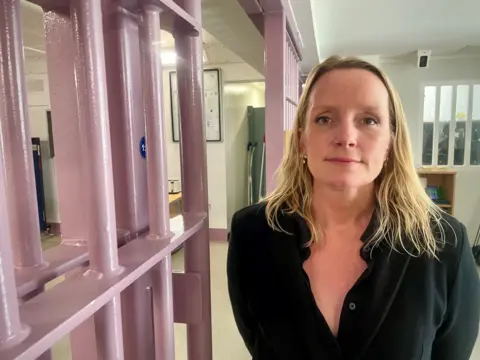
The Scottish Prison Service (SPS) has been warning for years that the prison population is unsustainable.
The organisation's new chief executive, Linda Pollock, described the overstretched conditions as "very serious".
She added: "We've seen this in England and Wales and across Europe as well so we're not alone, but this is significantly impacting our ability to work with people, to be able to help them on the rehabilitation journey.
"The emergency releases have had an impact but we need further action if we want to be safe and we want to be sustainable."
Justice Secretary Neil Gray told a Holyrood debate about prison overcrowding that 400 additional spaces are being created within the existing estate.
This is at the delayed and over budget replacement for Barlinnie in Glasgow and a new prison in Inverness, which Gray revealed will now open in the spring of 2027 and not by the end of this year as previously expected .
He added: "Protecting victims and the public is my top priority, and I am clear that prison will always be necessary.
"It is absolutely crucial, however, that our prisons function safely and effectively. If not, rehabilitation breaks down, reoffending rises and more people become victims.
"With the sustained population pressures we have seen over recent years, that is the reality we are facing, and that is why we must act."
Concern over sex offenders
Rape Crisis Scotland said the proposals could "profoundly change the way the prison system treats perpetrators of sexual violence".
It said it would be looking at the plans closely "with the rights and interests of survivors firmly in mind".
Chief executive Alev Taylor said: "Organisations like ours have fought hard to maintain the exemption of rape and sexual offenders from early release schemes, both to ensure the safety of survivors and to maintain overall confidence in the justice system.
"Reports of sexual offending reached a record high this week, and still sexual offences continue to have the lowest conviction rate of any crime type in Scotland while survivors wait for up to three years for a court case to conclude.
"We cannot get to a point where a survivor spends longer pursuing justice than a perpetrator of rape spends in prison."
She said the prompt implementation of key parts of the Victims, Witnesses and Justice Reform (Scotland) Act – such as parole reform and reform of the Victim Notification Scheme – must be prioritised and brought into effect along with other proposed changes.
Debbie Adams, interim chief executive of Victim Support Scotland, said early release schemes had not been the answer to reducing the prison population, and welcomed the government's "more holistic, evidence-based approach".
She said: "Victims of crime must be brought along on this journey. In the face of data that shows serious crimes are on the rise, the Scottish government must prove that victims' safety and rights will be prioritised and ensure that any measures are properly resourced."