The 5,000-year-old grave on a Manx front lawn

 BBC
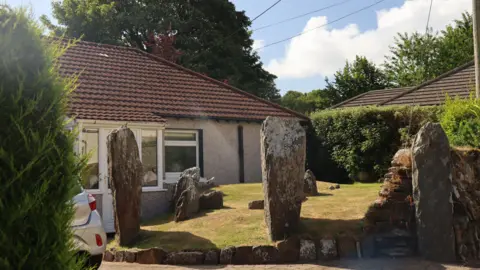
BBCTucked behind a hedge, alongside a quiet bungalow's driveway, sits one of the Isle of Man's oldest structures, The Cloven Stones, a Neolithic tomb believed to be around 5,000 years old.
It is one of around a dozen chambered tombs found on the Island, part of a much wider ancient tradition seen across Britain and Ireland.
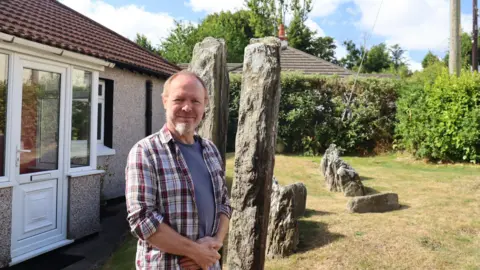
"It's a Neolithic tomb, about 5,000 years old," says Andy Johnson, Inspector of Ancient Monuments for Manx National Heritage.
"'The condition that we see today'"
The tomb first caught the attention of antiquarians in the 1790s.
"In 1798, a gentleman tourist called John Feltham came to the Isle of Man. . . he brought some very competent artists with him."
"One of them makes a very detailed sketch of this site, and it's pretty much in the condition that we see today. All of the stones are visible."
This is the first known documentation of the stone's history.
"A giant's grave"
About 10 years later, in 1808, local miners helped another antiquary dig into the chamber at the centre of the site.
"What they did was discover the remains of a skull and some leg bones, some of the long bones that form our thighs," Johnson said.
"They immediately decided it must have been a giant's grave, because these appeared larger than they would think were associated with ordinary human beings."
"That's actually the sum total of excavation that's gone on at this site."
In the 1860s, two surveyors produced a highly accurate plan of the site, now held in the Manx National Heritage archives.
Comparing that plan with what remains on the ground today tells its own story. "We can tell that the construction of this house in the 1910's, has slightly damaged the back half of the site," Johnson said.
The Cloven Stones is one of around a dozen chambered tombs on the Island.
Sites like this are "typically not the grave for a single person," Johnson said.
"They're probably built for the elite, important members of a large extended family or a local community."
'The entrance, or the exit, from this world to the afterlife'
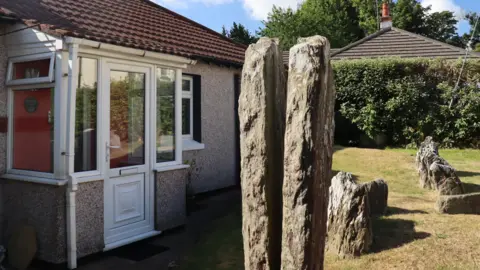
The two huge standing stones are what archaeologists call the forecourt, an alcove that would once have opened into a mound of earth and stones.
"At the back of it you've got these two stones which are at right angles to the stones , and between them there's a narrow passageway," Johnson said.
"That kind of constriction marks the entrance, or the exit, from this world to the afterlife."
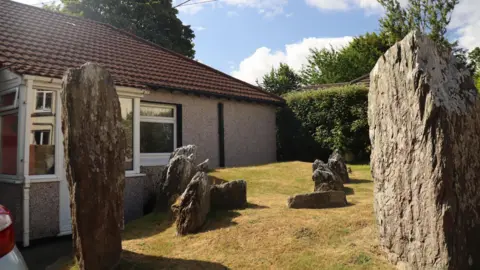
Beyond it, further stones form the burial chamber itself, an area now around four to five metres long and at least two metres wide.
The initial drawing from the 1790s hints that the chamber may once have been divided into two separate cells, though with only that single, nearly 230 year old sketch to go on, Johnson said it is not certain.
The chamber's scale and layout make it unlike any of the Island's other tombs.
Its closest parallels in terms of design can be found on the Isle of Skye in the Scottish Hebrides.
"Custodians of this monument"
Without a modern excavation, dating the Cloven Stones relies on comparing it with similar, better understood monuments elsewhere.
Any future dig, Johnson said, would need clearly defined research questions, and a recognition that excavation is destructive and can't be undone.
Excavation is also expensive, he added, and "wouldn't be a decision that was taken lightly."
"We are only custodians of this monument for the time that we're here to look after it," Johnson said.
"If we leave it in the state in which we found it, that means the archaeologists of the future can bring perhaps better techniques and technology, it's often the best policy to leave well alone."
Life in the Neolithic age
Johnson said the Island would have been far less crowded when the tomb was built, with people increasingly utilising agriculture and the domestication of animals, yet not fully settled in one place.
With this efficiency in gathering food, shelter, and warmth, "it gives you more spare time,"
"You couldn't even contemplate building a monument like this if almost every thought you had was, 'Where's my next meal coming from?'"
Raising the stones would have taken real organisation, and hard work.
"Dragging them [the stones] into place, digging holes, and fitting everything together structurally, would've been a collective effort.'
"Many sites like these, though not all, appear to be positioned deliberately within the landscape, sometimes aligned with the sunrise at the summer or winter solstice," Johnson said.
"That's all bound up with ideas of understanding how the seasons work, and when it's time to stop thinking about just saving those resources to get you through winter, and start thinking about when you're going to plough new crops."
Five thousand years on, the Clovenstones still stand. Much of the world around it has changed dramatically, but their mystery quietly holds on to secrets no one alive will ever fully understand.
Read more stories from the Isle of Man on the BBC, watch BBC North West Tonight on BBC iPlayer and follow BBC Isle of Man on Facebook and X.