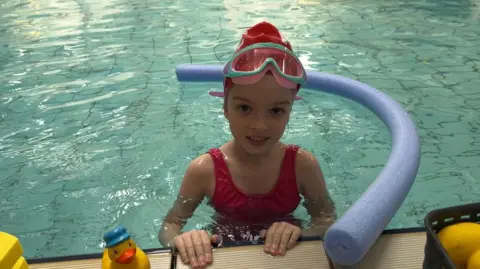
Schools swimming gap revealed across region

 BBC
BBCChildren at primary schools in Slough have some of the lowest swimming ability across the south of England, according to new BBC research.
The results of a Freedom of Information request to the Department for Education (DfE) suggest children at primary schools where there are more pupils on free meals are less likely to leave Year 6 being able to swim 25m.
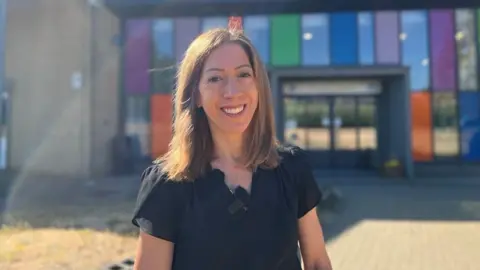
Claycots School head teacher Sarah Mijatovich, based in Slough, said the figures in her area were a "shocking statistic but unfortunately not surprising".
The DfE said it was planning "targeted support for the areas and pupils who need it most".
The national curriculum in England states that when they leave Year 6, all pupils should be able to:
- Swim competently, confidently and proficiently over a distance of at least 25m
- Use a range of strokes effectively (for example, front crawl, backstroke and breaststroke)
- Perform safe self-rescue in different water-based situations
Across the south of England region, the highest proportion of children who can confidently meet the target is in Dorset, at 81%.
But in Slough, an area with pockets of deprivation, it is 47%.
Mijatovich said limited budgets, logistical challenges in getting children into swimming pools, and fitting more swimming into the curriculum were among the issues schools faced.
Portsmouth is only one percentage point above Slough.
Hampshire-based swimming teacher Bethany Harris said it was "really tough" to teach the life skill to children who had not had much access to swimming.
"I think it needs to come in basically, as we're teaching them to read and write in the infant school," she said.
Harris lives "on the doorstep" of Hawley Lake, where a 14-year-old died after being reported missing while swimming.
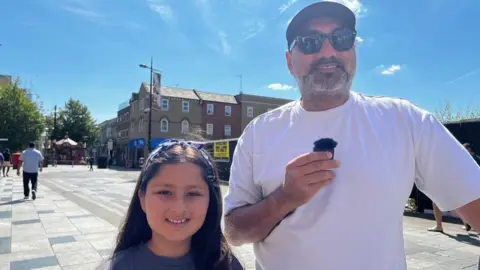
Slough-based parent Parmjjt, who cannot swim himself, wants to ensure his daughter Avanni picks it up in school.
"I think it's important that kids do learn how to swim - it's a skill that you can retain for life," he said.
"We send our daughter in to ensure she learns how to swim."
BBC presenter Summaya Mughal made the Brown Gal Can't Swim podcast in 2022 about her personal experiences of not knowing how to swim.
She found that she was not alone, and that "on average, only 32% of South Asian communities in England were able to swim 25m unaided compared to the national average of 80%," according to Swim England research.
She said the figures showed that "across gender, nationality and religion, the community likely to face the highest number of barriers were British Pakistani Muslim women".
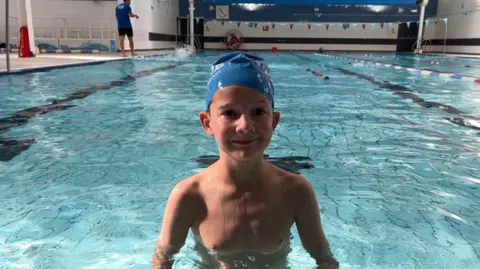
The data also showed that one in four children in Oxfordshire were leaving primary school unable to swim to the national standards.
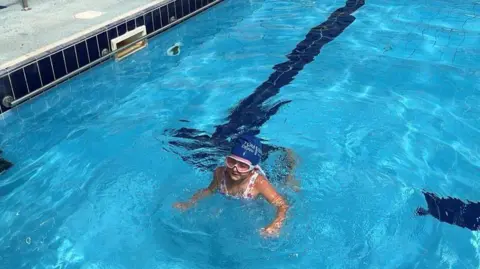
Children having lessons at the Ferry Leisure Centre in Summertown, Oxford, described swimming as "important," "joyful" and "fun".
"Nowadays, there's a lot more rubbish and dangerous things in rivers and if you fall in one, if you don't how to swim, it's a lot more dangerous for you," nine-year-old Bill said.
Six-year-old Maddie, who was having her fourth lesson, said she liked swimming because it was "nice and cool".
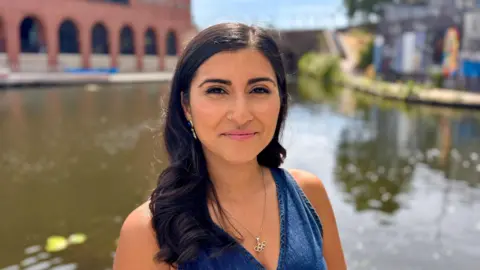 Summaya Mughal
Berkshire gold medal-winning Olympian Tom Dean said swimming was the "only sport that can save your life".
"I grew up not far from the River Thames and there are always horror stories, and there have been up and down the country," he said.
He said while schools did an "absolutely fantastic job", with the "squeeze, time, and financial budget" that they had, more needed to be done for children to learn to swim the required minimum.
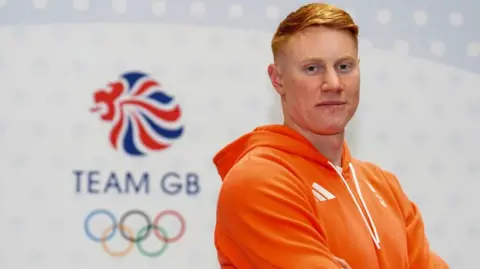 PA Media
The DfE said its new "partnership network" would help close the gap, and include "targeted support for the areas and pupils who need it most, so that every child, wherever they live, gets the same chance to learn to swim".
"The latest data shows around three quarters of children can swim 25m by the time they leave primary school – but we know that figure is significantly lower for disadvantaged children, and that needs to change," it said.