As Starmer's star dims, what part has our region played?

 EPA/Shutterstock
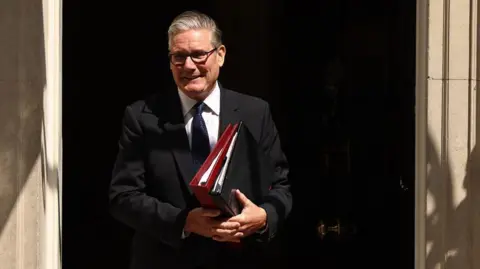
The 2024 general election in the north-east of England and Cumbria looked like an unqualified triumph for Sir Keir Starmer.
In what seemed like a rebuilding of Labour's formidable red wall of support, the party won all but two of the region's constituencies.
Not only was the party winning back its heartland, it also struck out into unfamiliar territory. Hexham got its first ever Labour MP. All but one Cumbrian constituency was won.
Two years later, how has Starmer's star fallen so low? And what part has our region played?
Go back to election night on 4 July and not everything was as rosy as it seemed.
The majorities for many of the region's new Labour MPs were shallow and built on a relatively low vote share for a governing party.
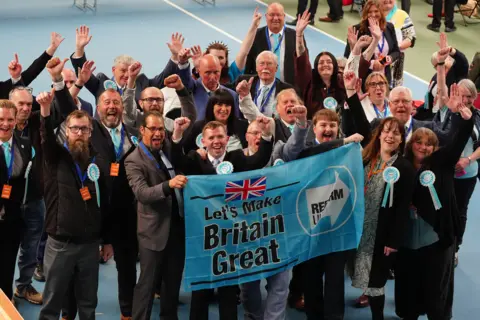
And lurking in a strong second place in many of those seats was Reform UK. A set of results the party achieved despite a limited ground campaign, and some low profile, or even invisible, candidates.
The warning signs were there. Enthusiasm for Starmer's Labour was muted at best. The prime minister needed to deliver the change he promised, or opponents would pounce.
U-turns and plummeting polls
The challenges started immediately. Riots and disorder in places like Sunderland and Hartlepool dominated the first few weeks of Starmer's premiership.
He got a grip and the violence melted away, but this was not a region entirely at ease with itself. Then came a series of choices that played badly.
There was the decision to remove the winter fuel payment from many pensioners - not a move designed to win over the coldest region in England.
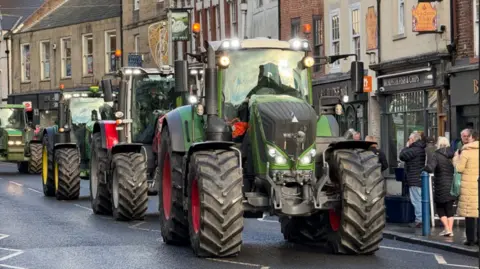
Changes to the inheritance tax regime for farmers also led to unhappiness and protests in many of the rural seats Labour had just taken. And a drive to cut welfare payments for disabled people appeared cruel to some of the region's MPs, as well as voters.
Government does involve taking tough and unpopular decisions. But when u-turns on all followed, Starmer had little to show but plummeting poll ratings.
With the economy also not delivering the growth surge Labour had promised, the party went into its first test in May 2025's local elections fearing a backlash.
It duly came in County Durham where Labour was almost wiped out in a Reform landslide. In a county council it had largely dominated for a century, the party won just four of the 98 seats. Labour MPs began looking nervously at their shallow majorities.
More mis-steps followed. The decision to appoint Hartlepool's former MP Lord Mandelson as US ambassador appeared bold but proved catastrophic.
Although wages were rising, so were prices, and, particularly among young people, unemployment headed up.
Feedback on the doorstep
And so came the 2026 local elections. Unluckily for Starmer they were bigger than usual.
Boundary changes meant four North East councils had their biggest polls for two decades. Instead of electing a third of their chambers, every seat was at stake in Sunderland, South Tyneside, Gateshead and Newcastle.
The result was another hammering. Sunderland and Gateshead lost for the first time. All but one of Labour's councillors was ejected in South Tyneside. Losses to Reform were matched by defeats to the Greens in Newcastle. Every Labour councillor up for election in Hartlepool lost. The feedback on the doorstep was this was all about the man at the top.
The prime minister insisted he was staying, but as more of the region's MPs called for him to go, it became clear time was up.
 PA Media
But is there a Starmer legacy in the region?
The prime minister certainly gave every impression of wanting the region to play a part in generating economic growth.
Some of his first guests in Number 10 were elected mayors, including the North East's Kim McGuinness and Tees Valley's Ben Houchen.
More powers and money have been sent north, allowing planning to begin for the first extension of the Tyne and Wear Metro for more than 20 years. Tees Valley has around £1bn to spend on transport improvements. Cumbria will get a mayor with powers next year.
But much power remains in Whitehall and Westminster.
Starmer's government became the latest regime to scrap a scheme to dual parts of the A1 in Northumberland. It vacillated about the A66 before backing its upgrade. Cumbria's rail services remain starved of investment.
Many of our high streets also continue to struggle under a business rates regime that has merely been tinkered with. Council tax rates here remain some of the highest in the country.
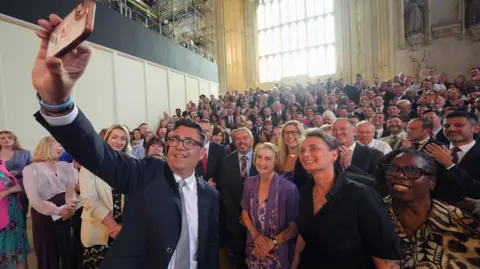
The man now destined to succeed him, Andy Burnham, has promised a deeper devolution revolution but Sir Keir has left something to build on.
 PA Media
The outgoing prime minister did also make good on a pre-election promise to workers at Hitachi in Newton Aycliffe by helping to back a deal to secure orders for new trains.
There is the prospect of the region being at the centre of new energy generation with the jobs it could bring, although promised investments in new nuclear power and carbon capture here still lie in the future.
Starmer also came to the region to announce a drive to improve school exam results that lag behind other parts of the country. We have though yet to find out exactly how much money will be invested in what has been called the North East Education Challenge.
After months of deliberation, the two-child cap on many benefits was lifted. Perhaps not an obvious vote winner, but a measure campaigners here believed was keeping many children locked in poverty.
Some of the region's most deprived communities are being promised more control over their destiny through a Pride in Place scheme that will see them choose how £20m is invested over the next decade.
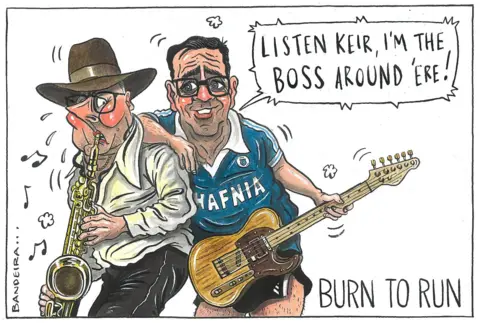 Graeme Bandeira/Northern Agenda
Did the region just to need to be more patient for results to flow? Or actually does this smack of the timid gradualism that Starmer himself criticised in the speech he made after this year's local election defeats?
It was a speech that could not save him. Ultimately not enough Labour MPs here were convinced that he could prevent wholesale losses to Reform in the region at the next election.
They are now looking to a northern PM to save their bacon, albeit a 'Mancunian'. To do that, he might have to deliver something all governments have struggled to do for the last 15 years - make people feel better off.
As we are the part of England with the lowest incomes and highest levels of deprivation, it is a mission that feels particularly urgent here.
It is Andy Burnham though now who is about to bear the weight of expectation and the pressure to deliver.