Thousands gather for anti-racism rally in Belfast after disorder

 Reuters
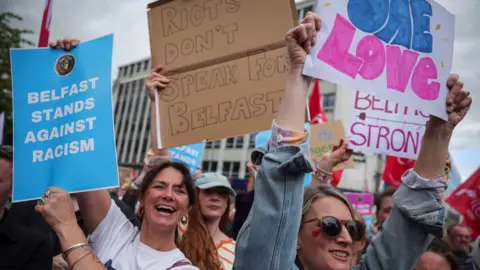
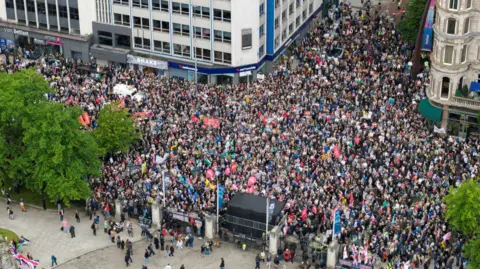
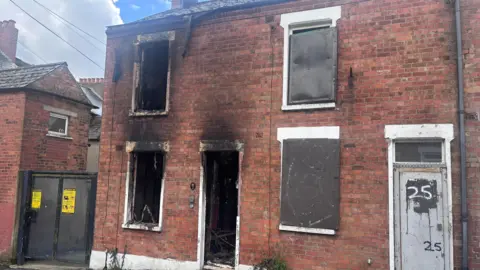
Thousands of people gathered on Saturday at an anti-racism protest in Belfast, after violence erupted across the city this week which saw people's homes, businesses and vehicles targeted.
The disorder was sparked after footage of a knife attack in north Belfast on Monday night was shared widely on social media, which left the victim with serious injuries, and a man has been charged with attempted murder.
The "Together Against Hate" rally started at about 13:00 at Belfast City Hall.
Police closed a number of roads to facilitate the crowd.
 Reuters
A number of political parties and trade unions were represented in the crowd.
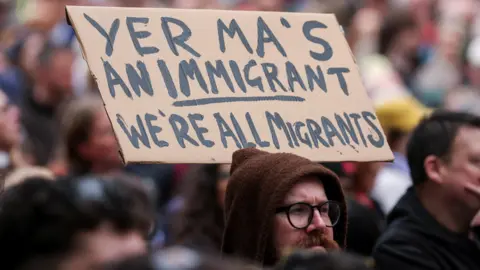
Some in the crowd held up banners saying: "Strike back against racism", "Refugees welcome" and "Riots don't speak for Belfast".
The protest was organised by the group United Against Racism. The group has said up to 20,000 people attended.
 Aodhán Roberts
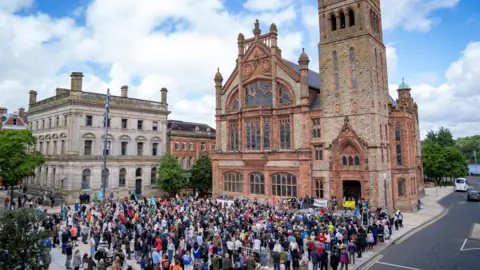
An anti-racism protest also took place at Londonderry's Guildhall.
It was organised by United Against Racism - Derry and North West.
'The whole world watched Belfast in horror'
 Reuters
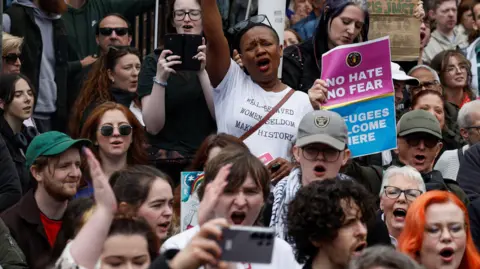
The event in Belfast started with the crowd chanting: "Say it loud, say it clear, refugees are welcome here. Who is Belfast? We are Belfast."
Speaker Ivanka Antova said: "This week we witnessed something we will never forget. The scenes of families and young children fleeing their homes in terror.
"We'll never forget how rich and powerful people used their online platforms."
 Reuters
Sympathy was also extended to the victim of last week's knife attack in north Belfast before Antova turned to the trouble over the past few days.
"The whole world watched Belfast in horror," she said.
"There is nothing legitimate about racist pogroms, and racism has no place in our city."
Solidarity was extended to the hundreds of volunteers "who evacuated people, provided meals, and reassured frightened communities".
Carmel Gates from the Irish Congress of Trade Unions praised healthcare workers, fire fighters, bus drivers and teachers, who "picked up the pieces" and dealt with the aftermath of the violence.
"I got a call from a government minister who asked what he could do. The only practical thing that Westminster can do is provide money to tackle the poverty that fuels racism," she said.
She said her "message to the far right was to 'get out of our communities'."
"We will not stand for you in our communities," she said.
"We have had enough division in this community, we have had enough sectarianism and we will not tolerate racism."
She also led a chant of: "Worker's rights are migrant's rights, same struggle, same fight."
A number of speakers criticised the police and the political institutions in Northern Ireland, claiming that it had been left to refugee women and local groups to coordinate the response to the violence and intimidation.
To date, police have made 23 arrests, 17 people have been charged to court, five have been bailed, and one person was reported to the Public Prosecution Service (PPS).
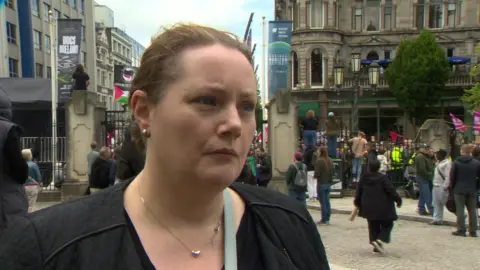
Elaine Crory, a lobbyist at the Women's Resource and Development Agency, also addressed the crowds in Belfast.
She told people that "nothing about this violence supports the safety of women and girls in our community".
Crory said hundreds attended the event out of "disgust and rage".
What motivated people to attend the rally?
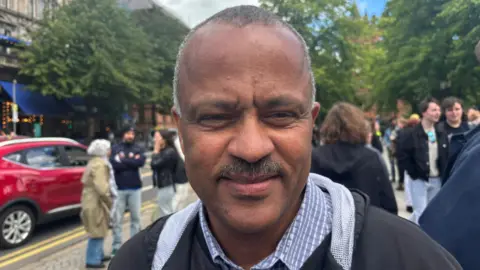
Mohamed Eltayeb has been living in Belfast for almost 20 years.
He said the "correct way" to react to anger was by taking part in "civilised protest" that did not involve violence.
He said he had been contacted by concerned family members checking he was safe.
He added that Saturday's event made him "feel more relaxed" to see "overwhelming support" from politicians, trade unions and local people.
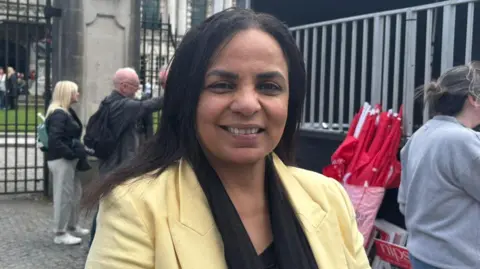
Manal Mahdi said that after attending the rally in Belfast she received the "reassurance" she was hoping for, and no longer felt "rejected in this community".
She said she was originally "scared" to attend the event, but now felt "safe in an immense crowd who appreciate us".
Her son has been sitting GCSE exams this week, and she said a lot of children had been "traumatised" and "stressed" about completing school work on time.
Mahdi, who is originally from Sudan, but has been living in Northern Ireland for 10 years, said this week was "beyond description" and "startling".
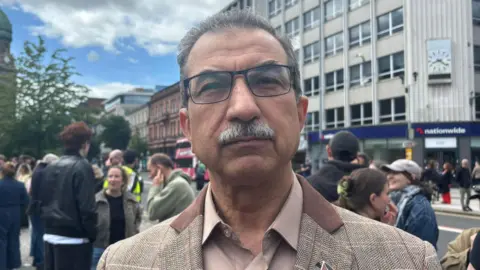
Raied Al-Wazzan, from the Belfast Islamic Centre, said he attended the rally to "tell all ethnic minorities that they are welcome in Belfast".
He said he has experienced "a lot of hatred in the streets recently" but on Saturday he saw "a lot of love".
Al-Wazzan said the Belfast he calls home was reflected in "people delivering food to their neighbours and driving nurses to their work" in the aftermath of violence.
Having lived in Belfast for almost four decades, Al-Wazzan said he had noticed an increase in race hate incidents but "at the same time there are a lot of good people out there".
What caused the violence?
 PA Media
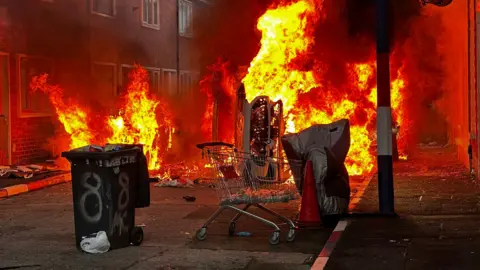
The disorder earlier in the week was sparked after footage of a knife attack in north Belfast on Monday night was shared widely on social media.
Hadi Alodid, a 30-year-old originally from Sudan, appeared in court on Wednesday charged with attempted murder over the attack which left the victim, Stephen Ogilvie, with serious injuries.
 PA Media
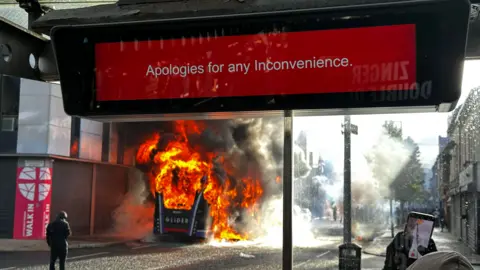
Many of the protests passed peacefully but, elsewhere, hundreds of masked people took to the streets and violence followed.
The disorder was restricted to pockets of Belfast and other towns, but across Northern Ireland schools and shops closed early, and public transport shut down.
Police have released a number of images of people they would like to identify following the disorder.