Gracie Abrams captures pain of early adulthood in new album - but you're left wanting more

 Getty Images
Knives. So many knives. Gracie Abrams' third album is like a cutlery drawer full of daggers.
They're stuck in her back, waiting to be twisted by a two-faced friend. She's "cut to the bone" by the careless words of a lover. Abrams even has a song called The Knife, where she proclaims she'll live with a blade "in my side", as an act of defiance.
"They're daring me to pull it out / I'll probably keep it for a lifetime."
Her lyrics are equally sharp and penetrating. The album has a broad theme of responsibility, as Abrams accepts blame for her mistakes, without letting others off the hook.
On the stunning ballad Good Reason, she struggles with the idea of a relationship fizzling out, with no major disagreements, just the gut feeling it's not working.
"I'm only half sure that I mean it," she sighs as she calls it off. "If only I had a good reason."
Broke My Heart finds her on the other side of a break-up. "How could I know you and not have a clue?" she pleads. "No difference to you / but you just broke my heart."
The knife, she's realised, cuts both ways.
Abrams' record is called Daughter From Hell, a reference to her rebellious teenage years, and it arrives to a flurry of anticipation.
The 26-year-old has been making introspective, confessional pop since the end of the 2010s, but her career really took off with the release of her debut album, Good Riddance in 2023. That year, she supported Taylor Swift on the Eras tour, and won a Grammy nomination for best new artist.
She earned her first UK number one in 2024 with That's So True, a single from the deluxe edition of her second album, The Secret Of Us. Anticipation for her new work has been building since last year, when she performed two new songs – Death Wish and Cold Goodbyes – on tour.
They hinted at a darker, more gothic aesthetic, with lyrics haunted by ghostly figures and existential crises.
Cold Goodbyes, in particular, is set to the sound of an unsettling synth drone – a world away from the gently-plucked ballads of her earlier work.
Sadly, it's an outlier. The music on Daughter From Hell is largely the same as before: low key, whisper-soft, self-interrogating, floaty and inconsequential.
The pianos are always muted, the drums all sound like they're being played next door, and the orchestra is buried deep in the mix to foreground Abrams' voice.
 Julie Greve
That's not a consistently bad choice. When Abrams sings about feeling like a burden on the lead single Hit The Wall, for example, her vocals are isolated in a way that emphasises her loneliness and disconnection.
But over the album's 16 tracks, the gossamer production – by indie-folk guru Aaron Dessner (Taylor Swift, Ed Sheeran) – is too insubstantial to sustain interest.
Worse still, it's at odds with the serrated edges of Abrams' lyrics.
Take the song Humming, which observes the US through the eyes of someone who's grown up knowing nothing but economic turmoil and the politics of hostility.
"Every kid I grew up with has lost their childhood house," sings Abrams. "And there's no one at the top to believe / What a way to feel in your 20s."
The power of that writing is let down by another plodding arrangement, stripping Abrams' words of their urgency.
When she sings "Let me wake up from this horrible dream", it sounds like she's sleepwalking.
Thankfully, there are a few moments when the album sputters into life.
 Getty Images
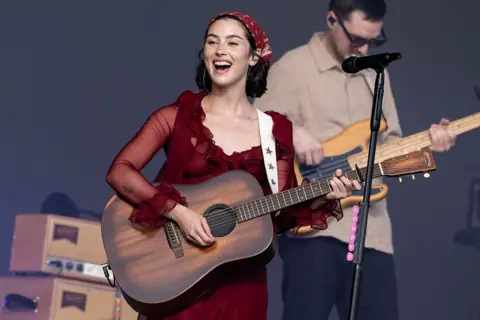
The title track is anchored by a raw, distorted guitar (think Jesus & Mary Chain or Mazzy Star) as Abrams apologises to her mother for being "hungry and loud", and causing misery during her teens.
It's an unavoidable element of Abrams' biography that she's the daughter of producer/activist Katie McGrath, who co-founded the Time's Up movement in 2018, and the Star Wars filmmaker JJ Abrams.
During publicity for the album, the musician has admitted the atmosphere at home could be stifling.
"Just how it is in any household, I think there's so much going down all the time, you're sometimes fighting to find your own lane," she recently told the New York Times.
"And for me that included a total rejection of being around my family.
"It wasn't the craziest [expletive] you've ever heard, but there was lots of sneaking out. I think I would sometimes put myself in positions that were actually unsafe."
Still, she never really gives away the details of what caused her parents such heartache. The worst thing she admits to on Daughter From Hell is doing "light drugs", which leaves me unconvinced she had the troubled adolescence she keeps hinting at.
 Getty Images
She's more candid on Look At My Life – spilling secrets about the music industry and her relationship with fame over a strobing synth line.
"I got what I wanted and it doesn't sit right," she observes, describing parties full of "big shots and barbies" whose empty talk makes her "ears bleed".
Co-produced with Olivia Rodrigo's chief collaborator Dan Nigro, it's one of the few songs with an elevated pulse rate.
The other is Mini Bar, a breathless account of nights out, laced with bad decisions and social anxiety.
That one's a co-write with her best friend, the pop singer Audrey Hobert – which makes you wonder what Abrams could do if she broke away from Dessner's muted production style.
It's frustrating because there are a handful of excellent songs here (Hit The Wall, Look At My Life, Death Wish, Good Reason), and Abrams generally does a superb job of capturing the restless uncertainty and of early adulthood.
If only she could deliver the songs with the conviction of her lyrics, she'd have a classic on her hands.
What she needs is a good knife sharpener.