Auction house criticised over sale of 3,000-year-old mummy head

 BBC
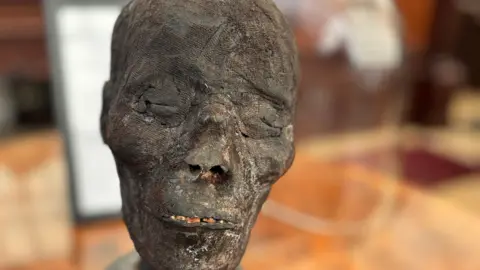
BBCA Northern Ireland auction house has come under fire from a number of academics over it selling human remains, including a 3,000-year-old Egyptian mummy head.
Anthropologists have questioned whether it's right for On The Square Emporium to sell the remains, with one saying "just because something is legal doesn't mean it's ethical".
The auction house's owner Justin Lowry has defended the sale.
"I appreciate there are people that see human remains as something that's religious, but to a lot of people once you die and your soul, or whatever is you, has left the body," he said.
"What is left is an inanimate object. Like all other objects, some people have no interest in this, some people think it's repulsive, but other people like them and they collect them."
However, a Labour MP who is sponsoring a bill to ban the sale of human remains in the UK, Bell Ribeiro-Addy, referenced the On The Square sale in a post on X and said: "The government must legislate to end this macabre trade."
On The Square Emporium also has a site at Sydenham Business Park on Belfast's Heron Road.
In a statement, Belfast Harbour Police said that in April 2026, "what was believed to be a human skull was seized from a business in the Harbour Estate".
It is understood this is not the Egyptian mummy head.
Belfast Harbour Police said the item seized "is now part of an investigation and currently undergoing carbon dating to assess the legality of sale of such items".
Allow X content?
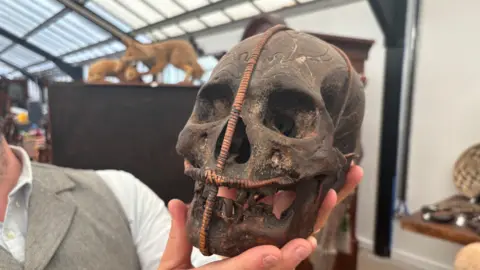
The auction house, in Bangor, County Down, has two human heads listed for sale in an ongoing auction: the 3,000-year-old Egyptian head and a Dayak tribal trophy skull from Borneo, Indonesia.
Lowry said a local buyer has been secured for the Egyptian head.
He added that it will remain in the emporium until the end of September so the public can see it.
It will then be going into a private collection.
Lowry said he understands the argument that the human remains should be "disposed of or buried" but said any call for the items should be studied was "hypocritical", adding: "So only people who have doctorate degrees or work in museums should be allowed to look at and appreciate these things?"
"The Egyptian mummy head is something from 3,000 years ago. It has an intrinsic value and an ownership, " he added.
"Why should someone hand over £20,000 of stuff that they have bought, that they have appreciated?"
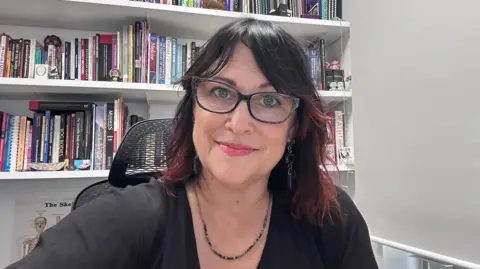
The joint letter, sent in April by anthropologists from the British Association of Biological Anthropology and Osteoarcheology (BABAO), raised issues with the origin of the items for sale from On The Square, as it said very few imported human remains were obtained ethically or legally.
Dr Trish Biers, a human remains expert on the board of trustees for BABAO, told Good Morning Ulster that she understood the "fascination around the dead, but they are human beings".
"They haven't stopped being human beings, they've simply stopped breathing," she said.
"I think selling human beings is what's really ethically problematic."
How old is the Egyptian mummy head?
The auction house listing describes the Egyptian head as being radio-carbon dated to between 750 and 800 BC, adding that it came from a private collection.
It says the head was brought to the UK by a British soldier during World War One and it remained in the possession of the family for a century.
The Indonesian head has been carbon-dated to between 800 BC and 750 BC.
Lowry added that he believed there are thousands of these types of remains "in attics" around the UK, with "all sorts of people" also choosing to display them in their homes.
He added that people take "great pleasure" in their aesthetics and "wondering who was that person".
Biers, who co-ordinates a task force which tracks how human remains are sold online, said there has been a spike in sales "since social media began", but particularly in the last five years.
She said the ethical issues stem from how the remains were historically obtained.
"Murder, kidnap, people selling because they're poor and they have no other way to feed their family so somebody wealthy comes along and says: 'Well, I'll buy that head or that body from you and take it back to London and then sell it at auction,'" she said.
Biers added that collectors have many uses for the remains, ranging from the ritualistic to some being turned into things like lamps and earrings.
"We've got all of this evidence of these horrific situations, like a child's spine as the handle of a handbag being sold for over €6,000 (£5,174)."
Science journalist Patrick Pester, tracks the trade in human remains and said listings like this are not unusual
"I come across auctions like this every single day, and the vast majority are taking place online," he said.
Pester said that tens of thousands of these skeletons remain in private collections or within the medical field, but the reality is that nobody knows how many are still out there.